
We read your photo as:
Split the compound inequality into two separate inequalities.
ScanSolve AI Answer
Answer
Step-by-step solution
4 stepsStep 1: Split the compound inequality into two separate inequalities.
The given inequality is .
This can be written as:
Part a
Part b3, 4, 5
Solve the first inequality.
Convert the mixed number to an improper fraction: .
Multiply the entire inequality by 2 to eliminate fractions:
Subtract from both sides:
Add 4 to both sides:
Divide by 3:
Solve the second inequality.
Convert mixed numbers to improper fractions: and .
Multiply the entire inequality by 2 to eliminate fractions:
Subtract from both sides:
Subtract 3 from both sides:
Divide by 4:
Combine the solutions.
From Step 2, we have .
From Step 3, we have .
Combining these two conditions gives .Find the integral values of .
The integral values of that are greater than 2 and less than or equal to 5 are 3, 4, and 5.
The integral values are .
Try one yourself
A new problem that tests the same skill.
Still stuck on this one?
Ask a follow-up, and the answer starts from this question.
More Chemistry Questions
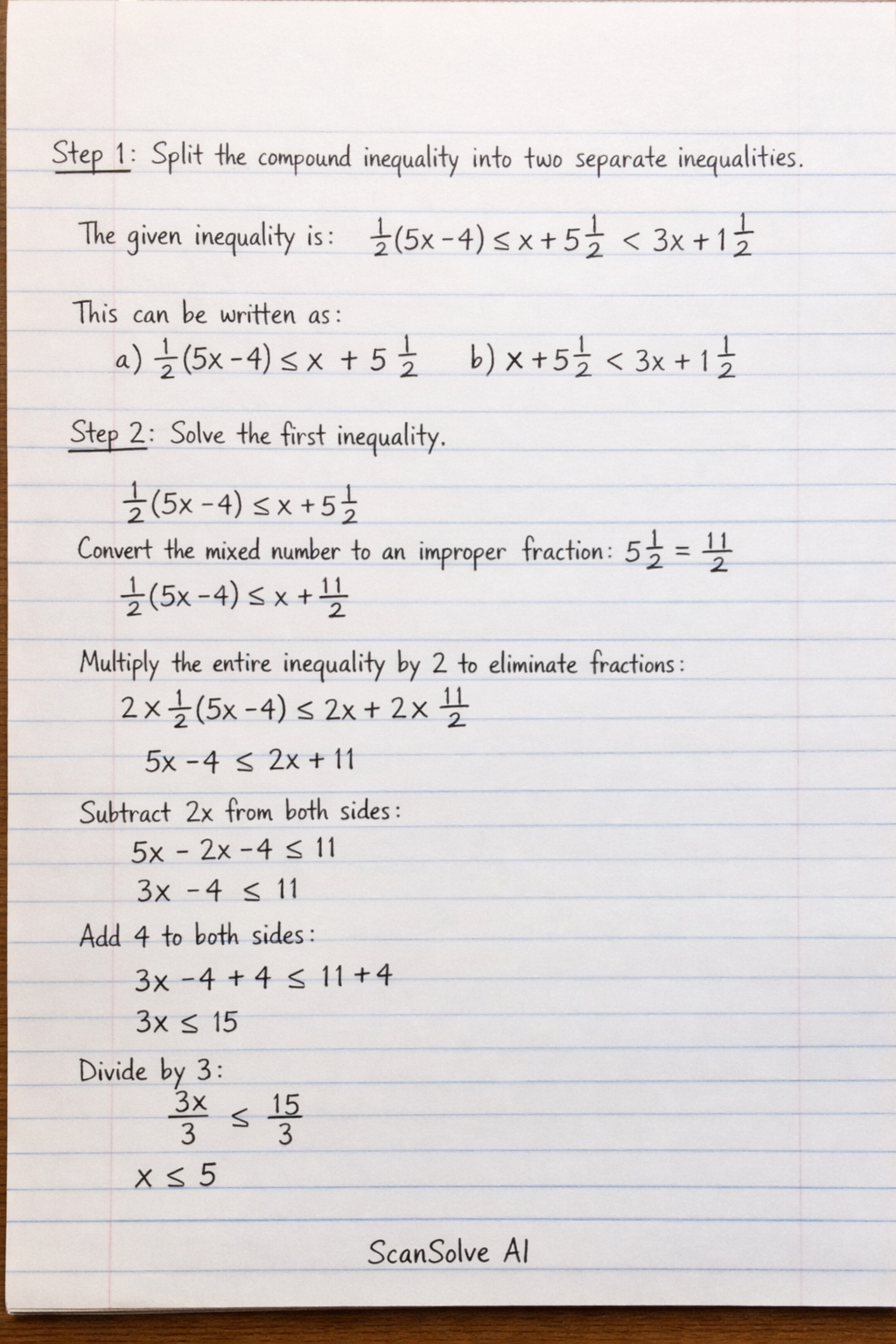
Handwritten Step-by-Step Solution
Get this as a handwritten image on WhatsApp — like a tutor wrote it for you.
Try on WhatsApp