
SPT STANDARD UTME QUESTIONS 🔥 🔥 1. What is the general formula for alkenes? A) CnH2n B) CnH2n+2 C) CnH2n-2 D) CnHn 2. Which of the following is an example of an alkene? A) Methane B) Ethene C) Propane D) Butane 3. Alkenes are characterized by the presence of: A) Single bond B) Double bond C) Triple bond D) Ionic bond 4. What is the IUPAC suffix for alkenes? A) -ane B) -ene C) -yne D) -ol 5. Alkenes are: A) Saturated B) Unsaturated C) Aromatic D) Aliphatic 6. What is the hybridization of carbon in alkenes? A) sp B) sp2 C) sp3 D) sp3d 7. What is the shape of ethene? A) Linear B) Trigonal planar C) Tetrahedral D) Bent 8. Alkenes typically undergo: A) Substitution reaction B) Addition reaction C) Elimination reaction D) Condensation reaction 9. What is the product of alkene hydrogenation? A) Alkane B) Alkyne C) Alcohol D) Ketone 10. What is the catalyst for alkene hydrogenation? A) Pt B) Pd C) Ni D) All of the above 11. What is the reaction of alkenes with bromine water? A) Addition B) Substitution C) Elimination D) Oxidation 12. What is the product of alkene hydration? A) Alkane B) Alcohol C) Aldehyde D) Ketone 13. Markovnikov's rule applies to: A) Alkene hydration B) Alkene hydrogenation C) Alkene halogenation D) All of the above 14. What is the product of alkene ozonolysis? A) Aldehyde B) Ketone C) Carboxylic acid D) All of the above 15. Alkenes are: A) Polar B) Non-polar C) Ionic D) Aromatic 16. What is the boiling point trend of alkenes? A) Increases with molecular weight B) Decreases with molecular weight C) Remains constant D) Unpredictable 17. Alkenes are soluble in: A) Water B) Organic solvents C) Both A and B D) None of the above 18. What is the reaction of alkenes with KMnO4? A) Oxidation B) Reduction C) Addition D) Substitution 19. Alkenes react with hydrogen halides to form: A) Alkyl halides B) Alkanes C) Alcohols D) Aldehydes 20. What is the most common method of preparing alkenes? A) Dehydration of alcohols B) Dehydrohalogenation of alkyl halides C) Both A and B D) None of the above
ScanSolve AI Answer
Answer
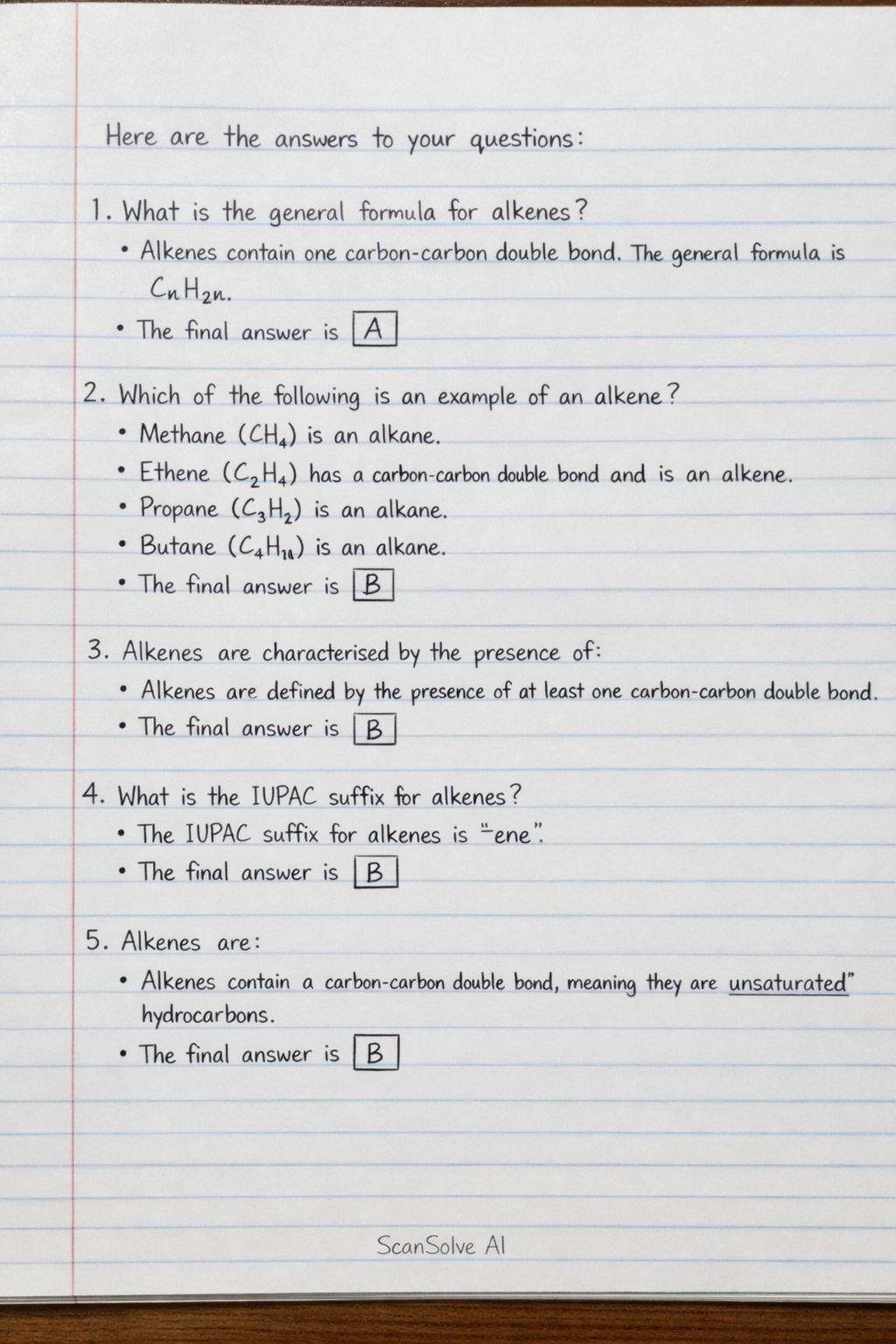
Here are the answers to your questions:
-
What is the general formula for alkenes?
- Alkenes contain one carbon-carbon double bond. The general formula is .
- The final answer is
-
Which of the following is an example of an alkene?
- Methane () is an alkane.
- Ethene () has a carbon-carbon double bond and is an alkene.
- Propane () is an alkane.
- Butane () is an alkane.
- The final answer is
-
Alkenes are characterized by the presence of:
- Alkenes are defined by the presence of at least one carbon-carbon double bond.
- The final answer is
-
What is the IUPAC suffix for alkenes?
- The IUPAC suffix for alkenes is "-ene".
- The final answer is
-
Alkenes are:
- Alkenes contain a carbon-carbon double bond, meaning they are unsaturated hydrocarbons.
- The final answer is
-
What is the hybridization of carbon in alkenes?
- The carbon atoms involved in the double bond of an alkene are hybridized.
- The final answer is
-
What is the shape of ethene?
- Ethene () has two hybridized carbon atoms, resulting in a trigonal planar geometry around each carbon, making the entire molecule planar.
- The final answer is
-
Alkenes typically undergo:
- Due to the presence of the reactive pi bond in the double bond, alkenes readily undergo addition reactions.
- The final answer is
-
What is the product of alkene hydrogenation?
- Hydrogenation is the addition of hydrogen () across the double bond of an alkene, converting it into an alkane.
- The final answer is
-
What is the catalyst for alkene hydrogenation?
- Common catalysts for the hydrogenation of alkenes include Platinum (Pt), Palladium (Pd), and Nickel (Ni).
- The final answer is
-
What is the reaction of alkenes with bromine water?
- Alkenes react with bromine water via an addition reaction, where bromine adds across the double bond, causing the characteristic decolorization of the bromine water.
- The final answer is
-
What is the product of alkene hydration?
- Hydration is the addition of water across the double bond of an alkene, typically in the presence of an acid catalyst, to form an alcohol.
- The final answer is
-
Markovnikov's rule applies to:
- Markovnikov's rule describes the regioselectivity of the addition of unsymmetrical reagents (like H-X or H-OH) to unsymmetrical alkenes. It applies to alkene hydration and hydrohalogenation.
- The final answer is
-
What is the product of alkene ozonolysis?
- Ozonolysis cleaves the carbon-carbon double bond of an alkene, producing aldehydes and/or ketones, depending on the substituents on the double bond.
- The final answer is
-
Alkenes are:
- Alkenes are hydrocarbons, which are generally non-polar due to the similar electronegativity of carbon and hydrogen and their relatively symmetrical structures.
- The final answer is
-
What is the boiling point trend of alkenes?
- Similar to other homologous series, the boiling point of alkenes increases with molecular weight due to increased London dispersion forces.
- The final answer is
-
Alkenes are soluble in:
- Alkenes are non-polar compounds, so they are generally insoluble in polar solvents like water but are soluble in organic solvents (like dissolves like).
- The final answer is
-
What is the reaction of alkenes with KMnO4?
- Alkenes react with potassium permanganate (), especially cold, dilute, alkaline (Baeyer's test), to undergo oxidation, forming diols.
- The final answer is
-
Alkenes react with hydrogen halides to form:
- Alkenes undergo addition reactions with hydrogen halides (HX, e.g., HCl, HBr) to form alkyl halides.
- The final answer is
-
What is the most common method of preparing alkenes?
- Common laboratory and industrial methods for preparing alkenes include the dehydration of alcohols and the dehydrohalogenation of alkyl halides.
- The final answer is
Try one yourself
A new problem that tests the same skill.
Still stuck on this one?
Ask a follow-up, and the answer starts from this question.
More Chemistry Questions
Handwritten Step-by-Step Solution
Get this as a handwritten image on WhatsApp — like a tutor wrote it for you.
Try on WhatsApp