
We read your photo as:
Explain the steps involved in determining the reaction rate of the iodine clock reaction, including the roles of each component.
ScanSolve AI Answer
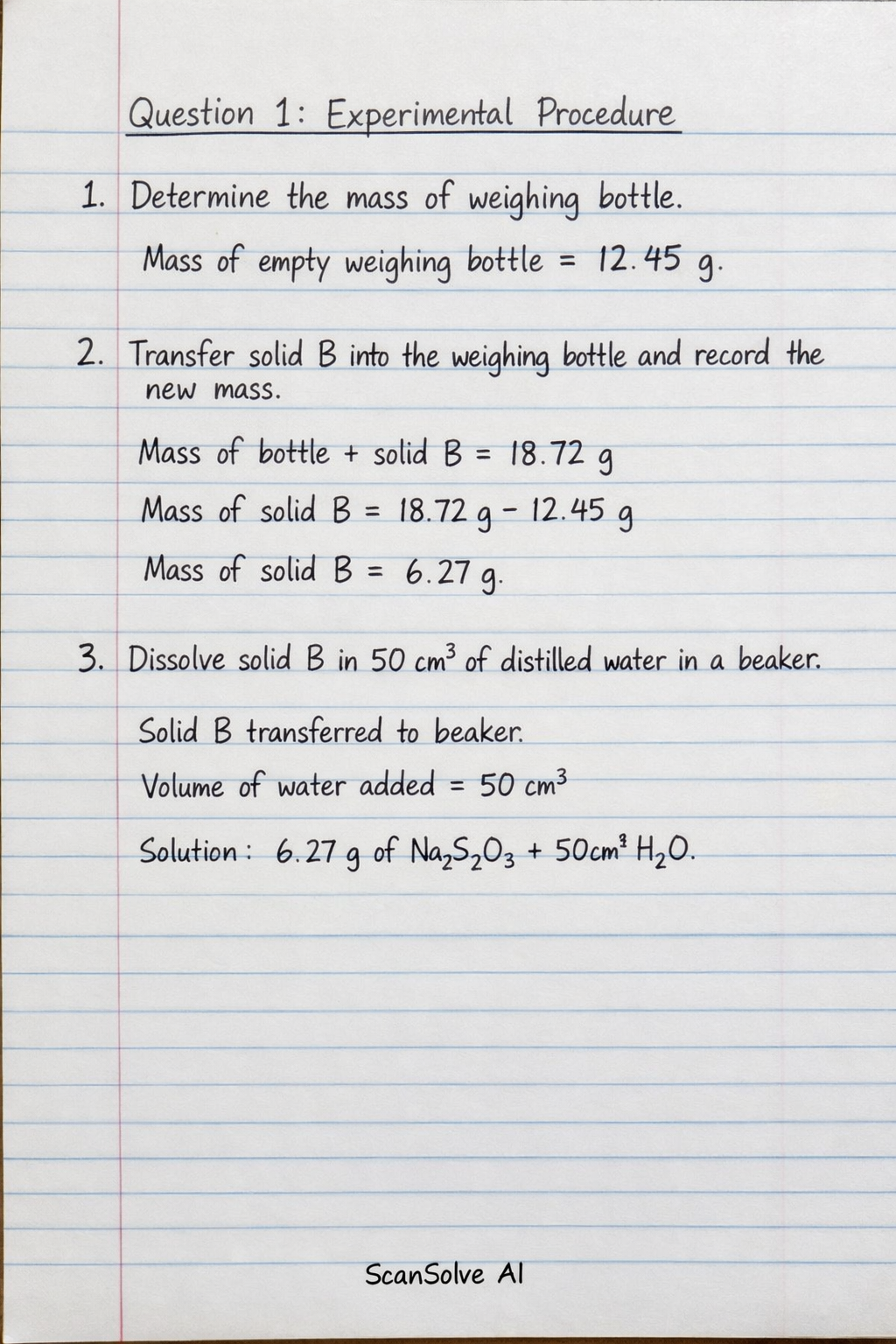
Hey la — thanks for sending the image again. I previously explained the "Table of results." Now, let's go through the numbered instructions for "QUESTION 1" which describe the experimental procedure.
Here's an explanation of each step:
-
1. Determine the mass of weighing bottle. This step involves placing an empty weighing bottle on a balance and recording its mass. This is crucial for accurately determining the mass of the solid added later.
-
2. Transfer solid B into the weighing bottle and record the new mass. After determining the mass of the empty bottle, a quantity of solid B (sodium thiosulphate) is added to it. The combined mass of the bottle and solid B is then measured. The mass of solid B alone can be found by subtracting the mass of the empty bottle from this combined mass.
-
3. Dissolve solid B in 50 cm³ of distilled water in a beaker. The weighed solid B is transferred from the weighing bottle into a beaker, and 50 cm³ of distilled water is added to dissolve it, forming a solution.
-
4. Add 10 cm³ of solution C and 5 cm³ of starch solution to the mixture. Solution C (potassium iodide) and starch solution are added to the beaker containing the dissolved solid B. These are the other reactants and the indicator for the iodine clock reaction.
-
5. Measure the time taken for the blue-black colour to appear. Once all reactants and the indicator are mixed, a stopwatch is started. The reaction proceeds, and the time taken for the solution to turn blue-black (indicating the formation of the iodine-starch complex) is recorded. This time is inversely proportional to the reaction rate.
-
6. Repeat the experiment using different masses of solid B. To study the effect of reactant concentration on the reaction rate, the entire experiment (steps 1-5) is repeated multiple times, each time using a different initial mass of solid B. This allows for the collection of data to determine the relationship between the concentration of solid B and the reaction rate.
The text in the green circle on the right side of the image remains unreadable, so its content cannot be interpreted.
Still stuck on this one?
Ask a follow-up, and the answer starts from this question.
More Chemistry Questions
Handwritten Step-by-Step Solution
Get this as a handwritten image on WhatsApp — like a tutor wrote it for you.
Try on WhatsApp