
We read your photo as:
Explain the components of a results table for an experiment on reaction rates, specifically detailing how to calculate the mass of reactant B and the reaction rate from the time.
ScanSolve AI Answer
The image provided outlines an experiment to study reaction rates, likely an iodine clock reaction, and includes a "Table of results" to record observations. Since no numerical data is provided in the image, the table cannot be filled with specific values. However, I can explain what each clear row represents and how to calculate the derived values.
Here's an explanation of the table's components:
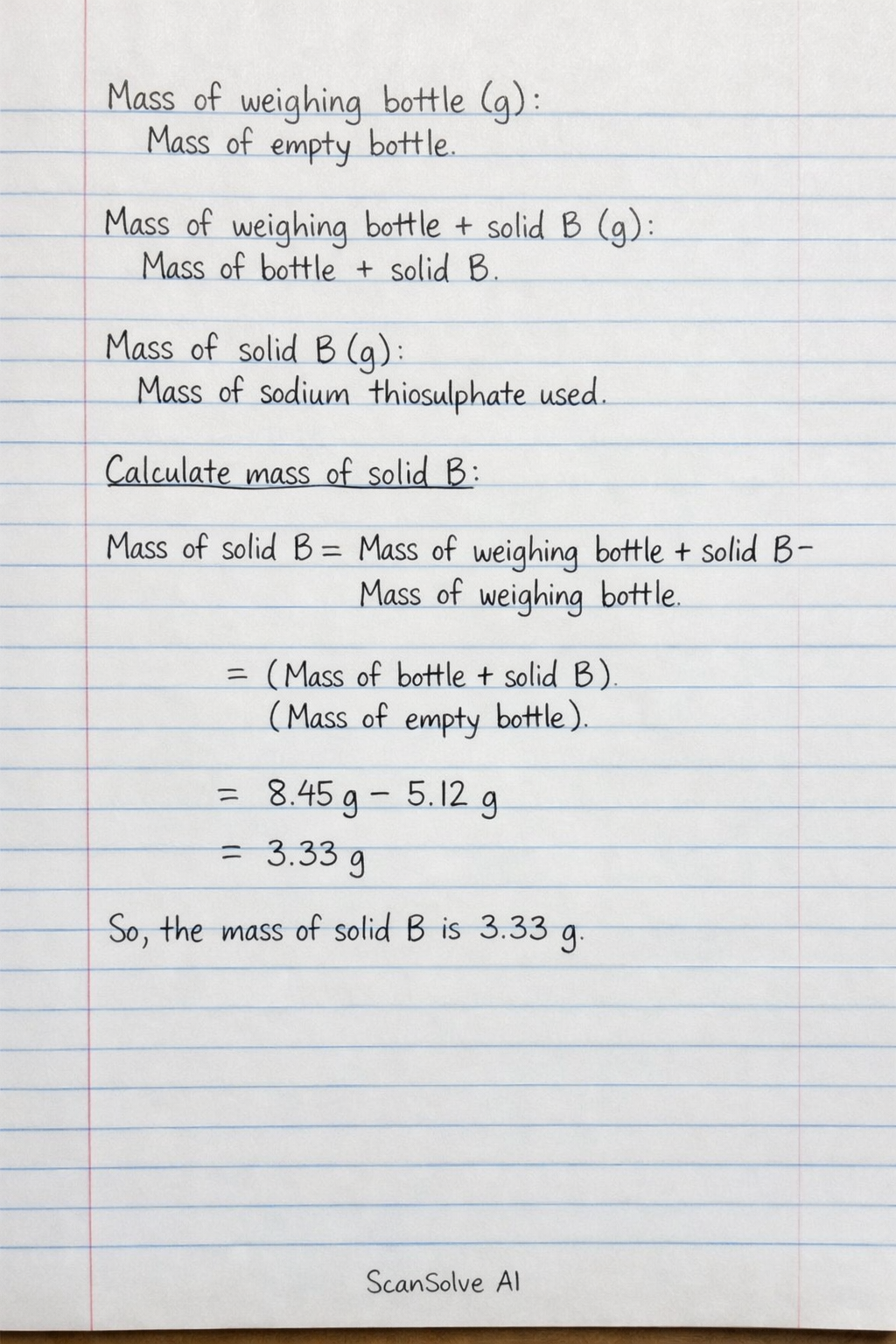
- Mass of weighing bottle (g): This is the mass of the empty container used to weigh solid B (sodium thiosulphate).
- Mass of weighing bottle + solid B (g): This is the combined mass of the weighing bottle and the solid B transferred into it.
- Mass of solid B (g): This is the actual mass of sodium thiosulphate used in a particular trial. It is calculated by subtracting the mass of the empty weighing bottle from the mass of the weighing bottle plus solid B.
- Time (s): This is the measured duration from the moment the reactants are mixed until the blue-black color appears. This time is inversely proportional to the reaction rate.
- 1/time (s⁻¹): This value represents the rate of reaction. A shorter time (smaller 'Time (s)' value) indicates a faster reaction, resulting in a larger '1/time (s⁻¹)' value.
The table also contains some repeated rows ("Mass of weighing bottle (g)" and "Mass of solid B (g)") which might be for multiple trials or a template error. Additionally, some text in the right column and the last two rows ("Mass of weighing", "Mass of weighing.") are unreadable, so their specific purpose cannot be determined.
To complete this table, you would need to perform the experiment as described in steps 1-6 and record the measured masses and times for each trial.
Still stuck on this one?
Ask a follow-up, and the answer starts from this question.
More Chemistry Questions
Handwritten Step-by-Step Solution
Get this as a handwritten image on WhatsApp — like a tutor wrote it for you.
Try on WhatsApp