
We read your photo as:
The provided table is for an experiment that investigates the relationship between reaction rate and temperature. Complete the table by calculating the values for 1/t. The temperature column is intent
ScanSolve AI Answer
Step-by-step solution
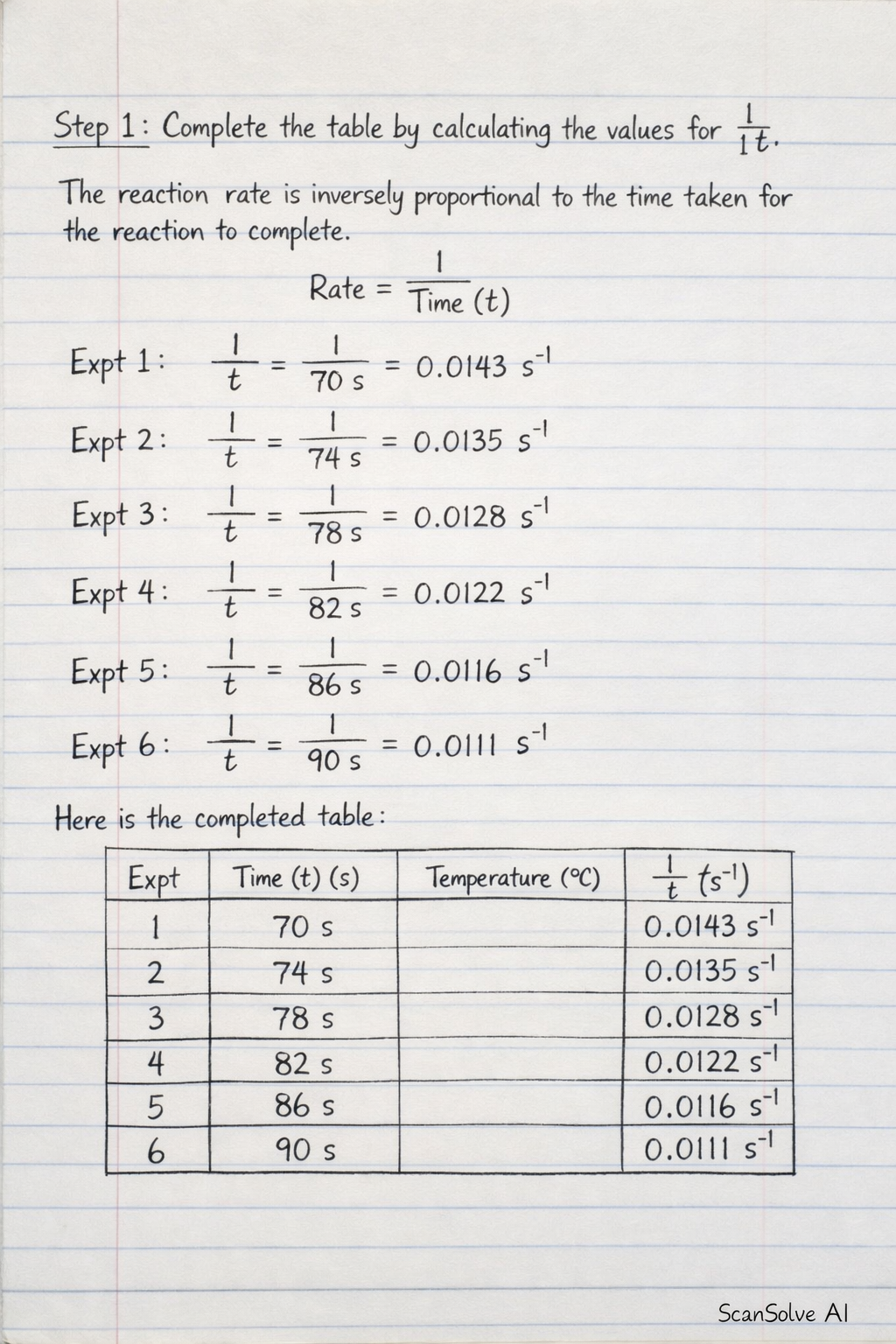
2 stepsComplete the table by calculating the values for .
The reaction rate is often taken as inversely proportional to the time taken for the reaction to complete.
- Expt 1:
- Expt 2:
- Expt 3:
- Expt 4:
- Expt 5:
- Expt 6:
The temperature column is left blank as the values are not provided and cannot be determined from the image.
Here is the completed table:
Experiment Volume of solution I / cm³ Volume of water / cm³ Volume of dilute H₂SO₄ / cm³ Volume of starch / cm³ Volume of solution J / cm³ Time, t / sec Temperature / °C 1/t / s⁻¹ 1 30.0 10.0 20 5.0 10.0 70 0.0143 2 26.0 10.0 20 5.0 10.0 74 0.0135 3 22.0 10.0 20 5.0 10.0 78 0.0128 4 18.0 10.0 20 5.0 10.0 82 0.0122 5 14.0 10.0 20 5.0 10.0 86 0.0116 6 10.0 10.0 20 5.0 10.0 90 0.0111 Plot a graph of (vertical axis) against the volume of solution I (horizontal axis).
To plot the graph:
- Draw and label the horizontal axis (x-axis) as "Volume of solution I / cm³". Choose a suitable scale that covers the range from 10.0 to 30.0 cm³.
- Draw and label the vertical axis (y-axis) as "Reaction Rate, 1/t / s⁻¹". Choose a suitable scale that covers the range from approximately 0.011 to 0.015 s⁻¹.
- Plot the following points from the completed table:
- (30.0, 0.0143)
- (26.0, 0.0135)
- (22.0, 0.0128)
- (18.0, 0.0122)
- (14.0, 0.0116)
- (10.0, 0.0111)
- Draw a smooth curve or line of best fit through the plotted points.
The graph should show that as the volume of solution I (and thus the concentration of iodate ions) decreases, the reaction rate (1/t) also decreases.
Still stuck on this one?
Ask a follow-up, and the answer starts from this question.
More Chemistry Questions
Handwritten Step-by-Step Solution
Get this as a handwritten image on WhatsApp — like a tutor wrote it for you.
Try on WhatsApp