
We read your photo as:
What are the answers to the following chemistry questions? 3c) Main ore of Aluminum? 3d) Products of brine electrolysis? 3e) Element atomic number 17? 3f) % alumina in a mixture? 3g) electrolysis of N
ScanSolve AI Answer
Step-by-step solution
2 stepshere are the answers to the questions:
3c) The main ore of Aluminum is .
3d) Electrolysis of brine solution is used to produce , , and .
3e) An element with atomic number 17 is a non-metal. It is , a reactive non-metal belonging to the halogen group.
3f)
Calculate the total mass of the mixture.
Calculate the percentage of alumina.
3g) Nitrogen (III) chloride () is a covalent compound and does not typically undergo electrolysis in the same way ionic compounds do, as it does not readily dissociate into ions. If an electrical current were forced through it, decomposition would occur. At the anode, oxidation takes place. In , the chlorine atoms are in the oxidation state. If oxidation were to occur, chloride would lose electrons to form chlorine gas.
3h) The Contact Process is an industrial method for the manufacture of . The "percentage of Nitrogen" likely refers to the Haber process for ammonia synthesis, where nitrogen gas typically constitutes of the reactant mixture (1 part to 3 parts by moles).
3i) In the reaction :
The oxidation state of sulfur in is .
The oxidation state of sulfur in is .
The oxidation state of sulfur in elemental is 0.
is oxidized (sulfur goes from to 0), so is the .3j) The oxidation number of Sulfur in is:
Let the oxidation number of Sulfur be .3k) Which halogen is a gas at room temperature?
The correct option is . (Iodine is a solid, Bromine is a liquid at room temperature).3l) The colour in transition metal complexes is due to .
Still stuck on this one?
Ask a follow-up, and the answer starts from this question.
More Chemistry Questions
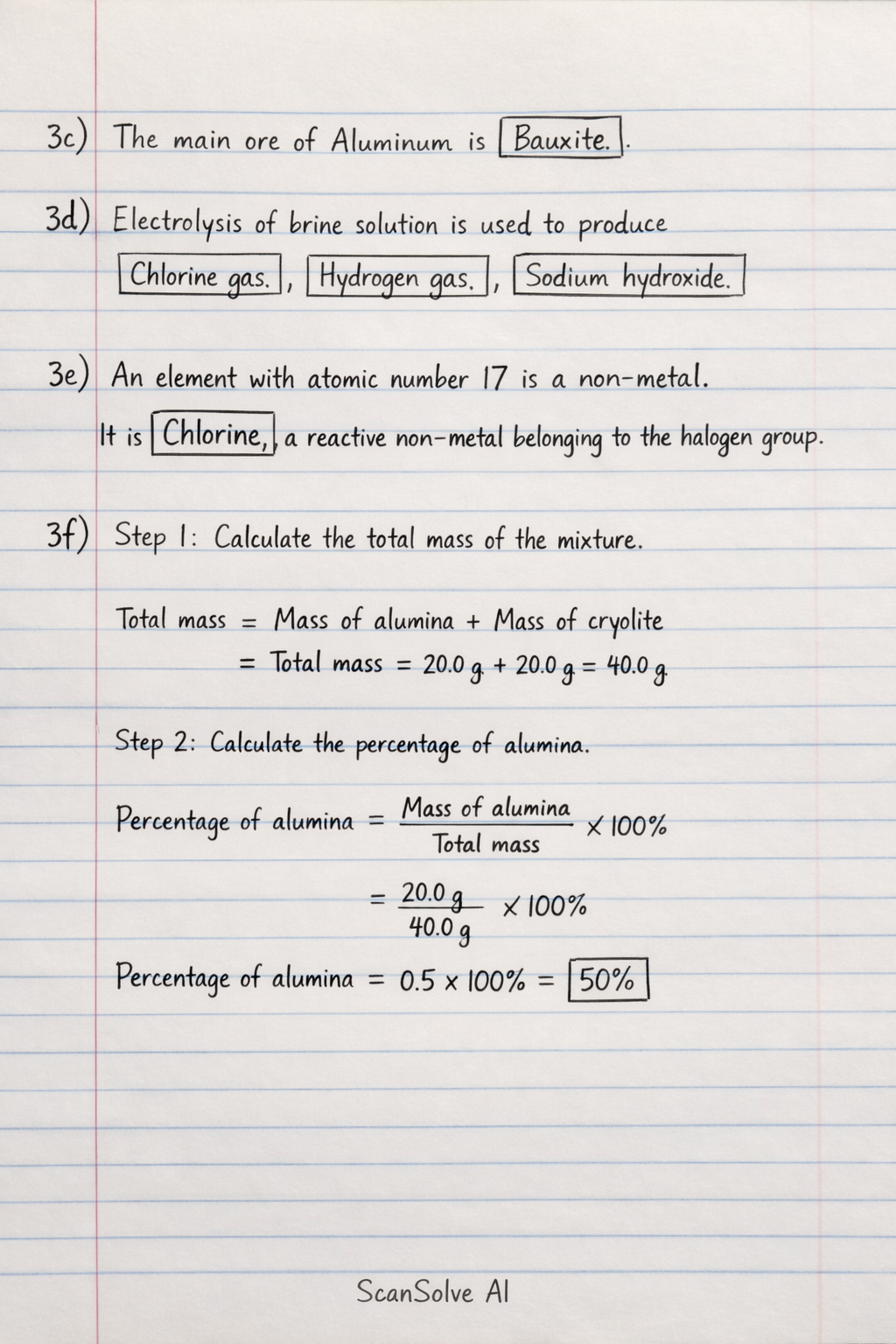
Handwritten Step-by-Step Solution
Get this as a handwritten image on WhatsApp — like a tutor wrote it for you.
Try on WhatsApp