We read your photo as:

What is the average volume of solution C used? Calculate the concentration of the diluted hydrochloric acid solution C in Moles per litre. Determine the concentration of the original hydrochloric acid solution B in moles per litre.

Chemistry

ScanSolve AI Answer

Step-by-step solution

10 steps

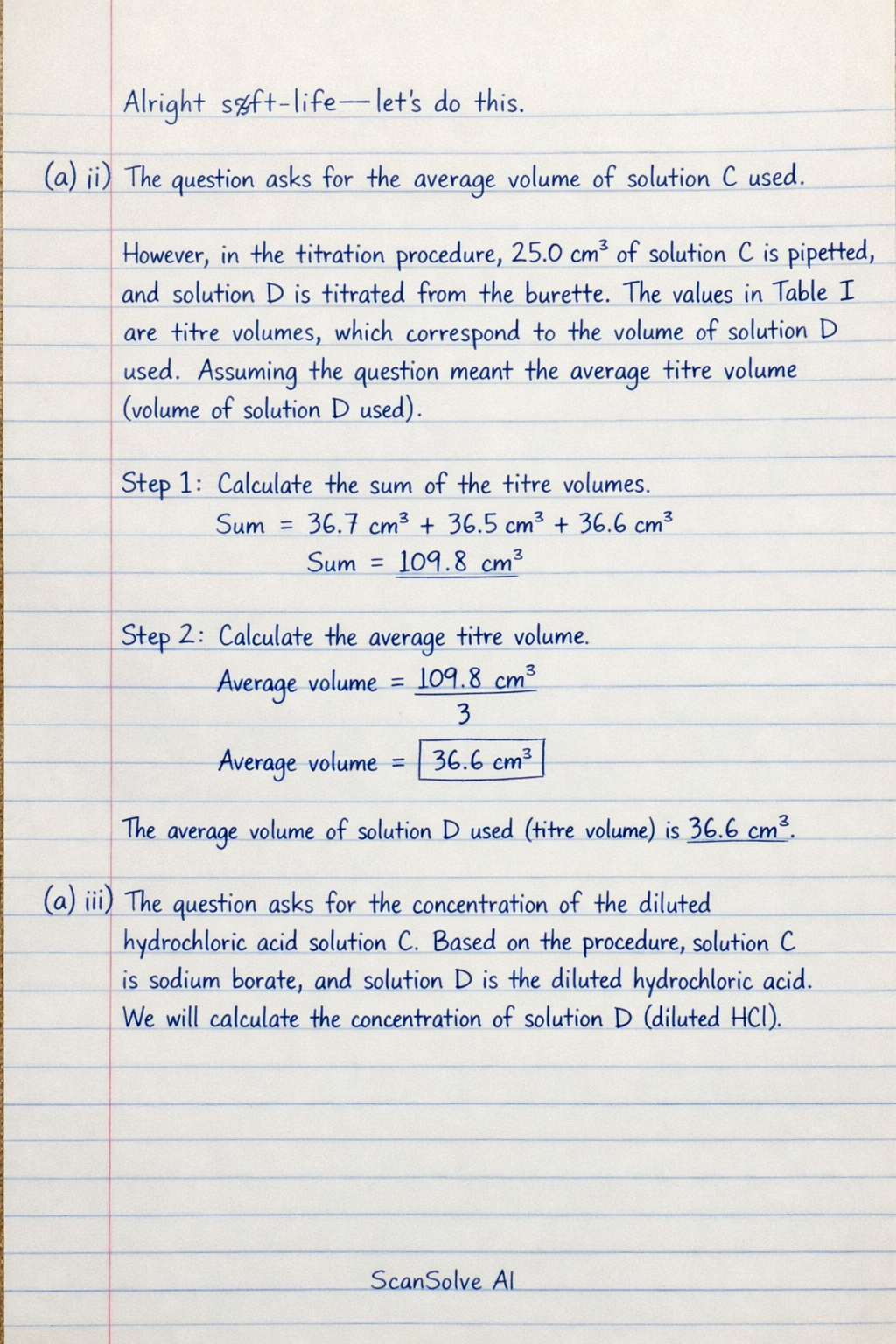
a) (i) The question asks for the average volume of solution C used. However, in the titration procedure, 25.0 cm³ of solution C is pipetted, and solution D is titrated from the burette. The values in Table I are titre volumes, which correspond to the volume of solution D used. Assuming the question meant the average titre volume (volume of solution D used):

  1. Calculate the sum of the titre volumes.

    Sum=36.7 cm3+36.5 cm3+36.6 cm3=109.8 cm3\text{Sum} = 36.7 \text{ cm}^3 + 36.5 \text{ cm}^3 + 36.6 \text{ cm}^3 = 109.8 \text{ cm}^3
  2. Calculate the average titre volume.

    Average volume=109.8 cm33=36.6 cm3\text{Average volume} = \frac{109.8 \text{ cm}^3}{3} = 36.6 \text{ cm}^3

    The average volume of solution D used (titre volume) is 36.6 cm3\boxed{\text{36.6 cm}^3}.

    a) (ii) The question asks for the concentration of the diluted hydrochloric acid solution C. Based on the procedure, solution C is sodium borate, and solution D is the diluted hydrochloric acid. We will calculate the concentration of solution D (diluted HCl).

  3. Calculate the molar mass of sodium borate decahydrate (Na2B4O7⋅10H2O\text{Na}_2\text{B}_4\text{O}_7 \cdot 10\text{H}_2\text{O}).

    (Atomic masses: Na = 22.99, B = 10.81, O = 16.00, H = 1.008)

    M(Na2B4O7⋅10H2O)=(2×22.99)+(4×10.81)+(7×16.00)+10×((2×1.008)+16.00)M(\text{Na}_2\text{B}_4\text{O}_7 \cdot 10\text{H}_2\text{O}) = (2 \times 22.99) + (4 \times 10.81) + (7 \times 16.00) + 10 \times ((2 \times 1.008) + 16.00) M(Na2B4O7⋅10H2O)=45.98+43.24+112.00+10×(2.016+16.00)M(\text{Na}_2\text{B}_4\text{O}_7 \cdot 10\text{H}_2\text{O}) = 45.98 + 43.24 + 112.00 + 10 \times (2.016 + 16.00) M(Na2B4O7⋅10H2O)=45.98+43.24+112.00+180.16=381.38 g/molM(\text{Na}_2\text{B}_4\text{O}_7 \cdot 10\text{H}_2\text{O}) = 45.98 + 43.24 + 112.00 + 180.16 = 381.38 \text{ g/mol}
  4. Calculate the moles of Na2B4O7⋅10H2O\text{Na}_2\text{B}_4\text{O}_7 \cdot 10\text{H}_2\text{O} in 250 cm³ of solution C.

    Moles of Na2B4O7⋅10H2O=MassMolar mass=3.125 g381.38 g/mol≈0.008194 mol\text{Moles of } \text{Na}_2\text{B}_4\text{O}_7 \cdot 10\text{H}_2\text{O} = \frac{\text{Mass}}{\text{Molar mass}} = \frac{3.125 \text{ g}}{381.38 \text{ g/mol}} \approx 0.008194 \text{ mol}
  5. Calculate the concentration of solution C.

    Volume of solution C = 250 cm³ = 0.250 L.

    Concentration of C=0.008194 mol0.250 L≈0.032776 mol/L\text{Concentration of C} = \frac{0.008194 \text{ mol}}{0.250 \text{ L}} \approx 0.032776 \text{ mol/L}
  6. Calculate the moles of Na2B4O7⋅10H2O\text{Na}_2\text{B}_4\text{O}_7 \cdot 10\text{H}_2\text{O} in 25.0 cm³ used for titration.

    Volume of C used = 25.0 cm³ = 0.025 L.

    Moles of C used=0.032776 mol/L×0.025 L≈0.0008194 mol\text{Moles of C used} = 0.032776 \text{ mol/L} \times 0.025 \text{ L} \approx 0.0008194 \text{ mol}
  7. Determine the moles of HCl (from solution D) reacted.

    The reaction between sodium borate and hydrochloric acid is:
    Na2B4O7+2HCl+5H2O→4H3BO3+2NaCl\text{Na}_2\text{B}_4\text{O}_7 + 2\text{HCl} + 5\text{H}_2\text{O} \rightarrow 4\text{H}_3\text{BO}_3 + 2\text{NaCl}
    From the stoichiometry, 1 mole of Na2B4O7\text{Na}_2\text{B}_4\text{O}_7 reacts with 2 moles of HCl.

    Moles of HCl=2×Moles of C used=2×0.0008194 mol≈0.0016388 mol\text{Moles of HCl} = 2 \times \text{Moles of C used} = 2 \times 0.0008194 \text{ mol} \approx 0.0016388 \text{ mol}
  8. Calculate the concentration of solution D (diluted HCl).

    Average volume of solution D used (from part i) = 36.6 cm³ = 0.0366 L.

    Concentration of D=Moles of HClVolume of D used=0.0016388 mol0.0366 L≈0.044776 mol/L\text{Concentration of D} = \frac{\text{Moles of HCl}}{\text{Volume of D used}} = \frac{0.0016388 \text{ mol}}{0.0366 \text{ L}} \approx 0.044776 \text{ mol/L}

    Rounding to three significant figures:
    The concentration of the diluted hydrochloric acid solution D is 0.0448 mol/L\boxed{\text{0.0448 mol/L}}.

    a) (iii) Determine the concentration of the original hydrochloric acid solution B.
    Solution D was prepared by diluting 25 cm³ of solution B to 250 cm³. We use the dilution formula M1V1=M2V2M_1V_1 = M_2V_2.

  9. Apply the dilution formula.

    Let MBM_B be the concentration of solution B and VB=25 cm3V_B = 25 \text{ cm}^3.
    Let MDM_D be the concentration of solution D (0.044776 mol/L0.044776 \text{ mol/L}) and VD=250 cm3V_D = 250 \text{ cm}^3.

    MB×VB=MD×VDM_B \times V_B = M_D \times V_D MB×25 cm3=0.044776 mol/L×250 cm3M_B \times 25 \text{ cm}^3 = 0.044776 \text{ mol/L} \times 250 \text{ cm}^3
  10. Solve for MBM_B.

    MB=0.044776 mol/L×250 cm325 cm3M_B = \frac{0.044776 \text{ mol/L} \times 250 \text{ cm}^3}{25 \text{ cm}^3} MB=0.044776 mol/L×10M_B = 0.044776 \text{ mol/L} \times 10 MB=0.44776 mol/LM_B = 0.44776 \text{ mol/L}

    Rounding to three significant figures:
    The concentration of the original hydrochloric acid solution B is 0.448 mol/L\boxed{\text{0.448 mol/L}}.

Was this helpful?

Still stuck on this one?

Ask a follow-up, and the answer starts from this question.

Got a different question?Ask your own question
Handwritten step-by-step solution preview

Handwritten Step-by-Step Solution

Get this as a handwritten image on WhatsApp — like a tutor wrote it for you.

Try on WhatsApp