
We read your photo as:
A student is given a solution A of hydrochloric acid (HCl) of unknown concentration and a solution B of an alkali XOH of unknown concentration. They are asked to determine the concentrations of these
ScanSolve AI Answer
Answers
2 partsStep-by-step solution
4 stepsTo solve this problem, we need to use the given information and make an assumption for the atomic mass of chlorine, as it is not provided.
Assumption: The atomic mass of Chlorine () is 35.5.
Part a(i)· 2 steps
Concentration of A (HCl) in
Calculate the molar mass of HCl.
The atomic mass of H is .
The atomic mass of Cl is assumed to be .Calculate the molar concentration of HCl (Solution A).
The mass concentration of HCl is given as .
Rounding to three significant figures:
Part a(ii)
Concentration of B in
Part a(iii)
Calculate the molar mass of XOH
These parts require experimental results from the titration, specifically the average volume of solution A used (the titre volume). Since no burette readings or average titre volume are provided, these calculations cannot be completed.
Part a(iv)
Mass of HCl in of the solution.
Convert the given volume from to .
Calculate the mass of HCl using its mass concentration.
The mass concentration of HCl is given as .
Try one yourself
A new problem that tests the same skill.
Still stuck on this one?
Ask a follow-up, and the answer starts from this question.
More Chemistry Questions
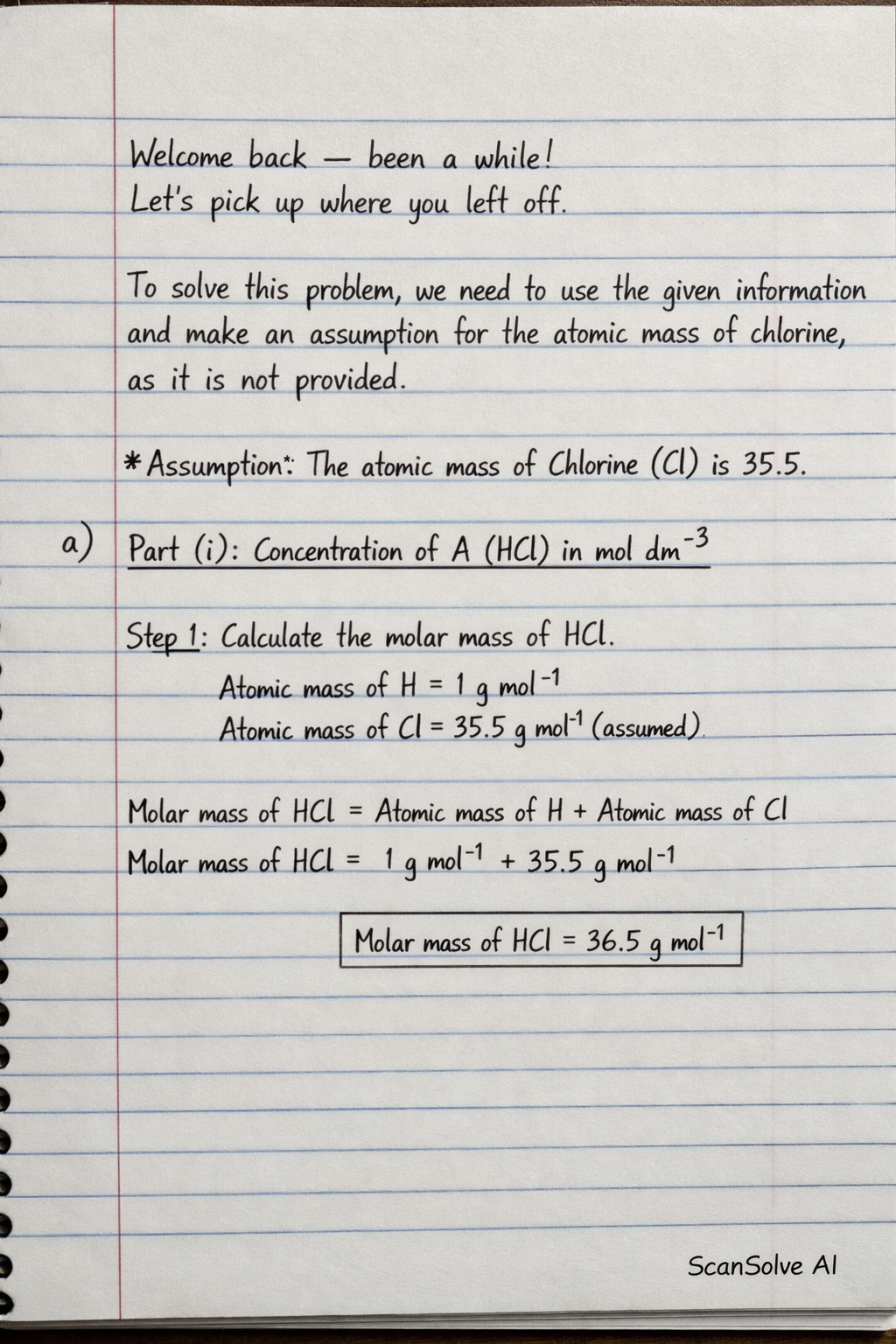
Handwritten Step-by-Step Solution
Get this as a handwritten image on WhatsApp — like a tutor wrote it for you.
Try on WhatsApp