
We read your photo as:
A is a solution of dibasic acid H2X. B is a solution of 1.00 g sodium hydroxide in 250 cm³ of solution. Put A into the burette and titrate against 20.00 cm³ or 25.00 cm³ portion of B using methyl orange as an indicator. Repeat the titration three more times and record your results in Table 1.1
ScanSolve AI Answer
Answer
Step-by-step solution
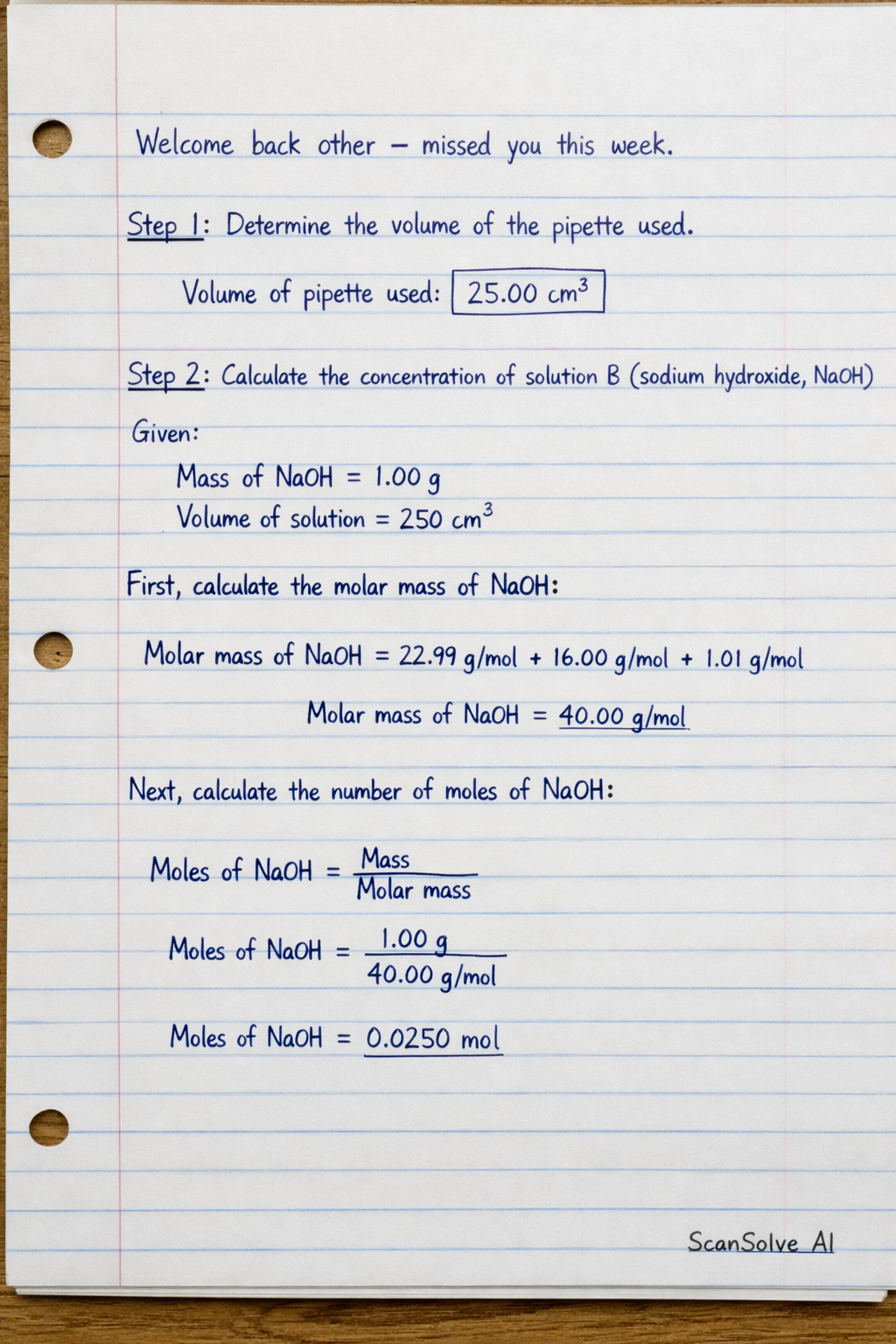
3 stepsDetermine the volume of the pipette used.
The instructions state that a "20.00 cm or 25.00 cm portion of B" should be used. You must choose one of these standard pipette volumes for your experiment and record it. For example, if you choose a 25.00 cm pipette, you would write:
Volume of pipette used: (or 20.00 cm if that was chosen)Calculate the concentration of solution B (sodium hydroxide, NaOH).
Given:
Mass of NaOH =
Volume of solution =First, calculate the molar mass of NaOH:
Molar mass of NaOH
Molar mass of NaOHNext, calculate the number of moles of NaOH:
Moles of NaOH
Moles of NaOH
Moles of NaOHConvert the volume of solution to dm:
Volume
VolumeFinally, calculate the concentration of NaOH:
Concentration of NaOH
Concentration of NaOH
Concentration of NaOHExplain how to complete Table 1.1.
For each titration (Rough, 1, 2, 3), you will record the initial and final burette readings. The "Volume of A used" is then calculated for each titration using the formula:
The rough titration is an estimate, while titrations 1, 2, and 3 are precise measurements. You would typically use the concordant (closest) values from titrations 1, 2, and 3 to calculate an average volume of A used for subsequent calculations.
Try one yourself
A new problem that tests the same skill.
Still stuck on this one?
Ask a follow-up, and the answer starts from this question.
More Chemistry Questions
Handwritten Step-by-Step Solution
Get this as a handwritten image on WhatsApp — like a tutor wrote it for you.
Try on WhatsApp