
We read your photo as:
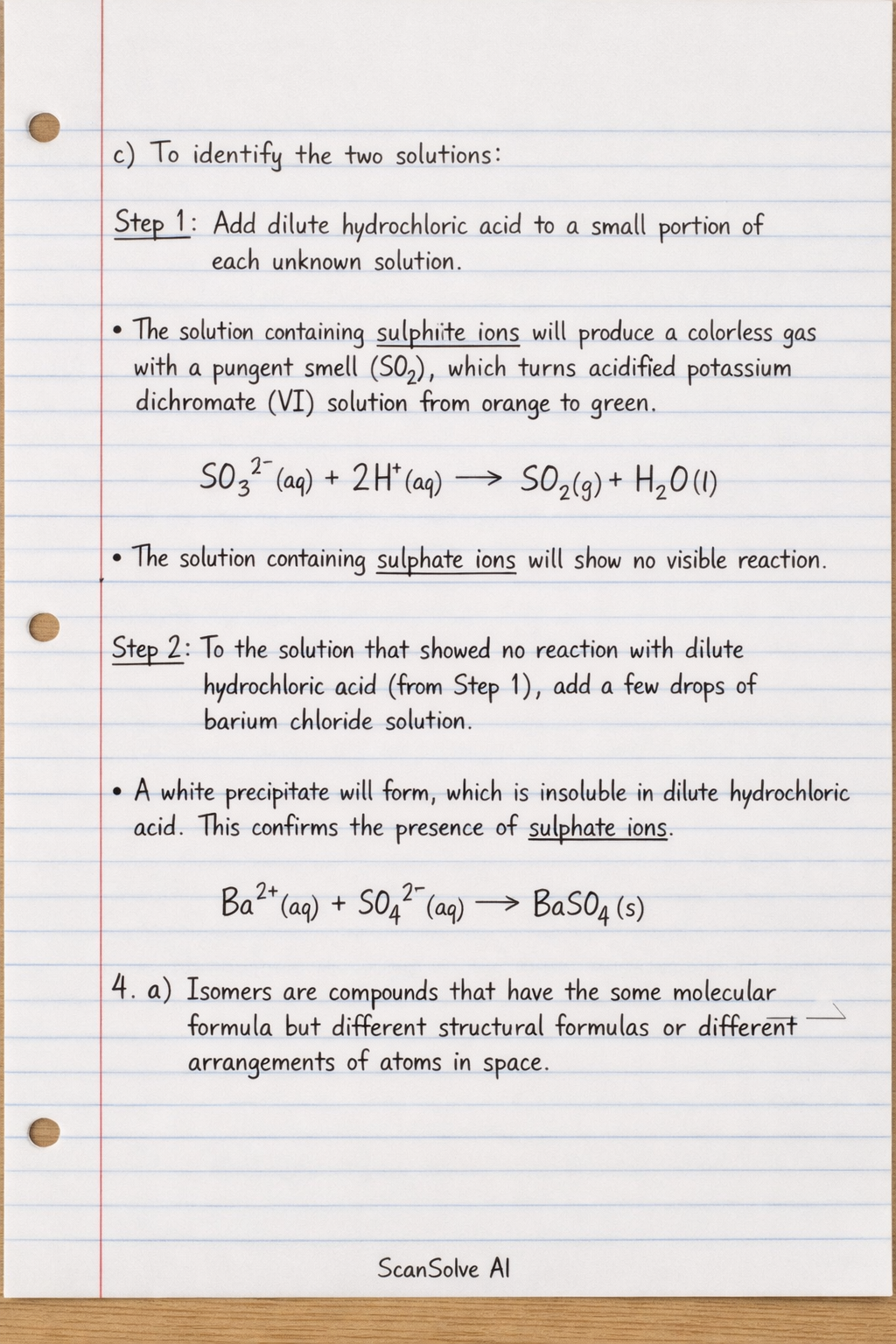
Add dilute hydrochloric acid to a small portion of each unknown solution.
Chemistry
ScanSolve AI Answer
Step-by-step solution
2 stepsPart c· 2 steps
To identify the two solutions
Add dilute hydrochloric acid to a small portion of each unknown solution.
- The solution containing sulphite ions will produce a colorless gas with a pungent smell (), which turns acidified potassium dichromate(VI) solution from orange to green.
- The solution containing sulphate ions will show no visible reaction.
To the solution that showed no reaction with dilute hydrochloric acid (from Step 1), add a few drops of barium chloride solution.
- A white precipitate will form, which is insoluble in dilute hydrochloric acid. This confirms the presence of sulphate ions.
-
a) Isomers are compounds that have the same molecular formula but different structural formulas or different arrangements of atoms in space.
-
b) The molecular formula has two isomers:
- Butane
- 2-Methylpropane
- c)
Part c(i)
- Chlorination of ethane: *Free radical substitution
- Chlorination of ethene: Electrophilic addition
Part c(ii)
A condition necessary for chlorination of ethane is ultraviolet (UV) light or *high temperature
- d) Two uses of ethene gas are:
- For the ripening of fruits.
- In the manufacture of polyethene (a plastic).
- e) Heat of combustion of a substance is the heat energy released when one mole of a substance undergoes complete combustion in excess oxygen under standard conditions.
Was this helpful?
Still stuck on this one?
Ask a follow-up, and the answer starts from this question.
Got a different question?Ask your own question
More Chemistry Questions
QA student is given a solution A of hydrochloric acid (HCl) of unknown concentration and a solution B…QA student is diluting concentrated sulfuric acid and preparing to test its properties. The…QAn unknown solution produced the following results with dilute hydrochloric acid bubbles of gas were…QCalculate the moles of hydrochloric acid (HCl) used.QI) Add dilute hydrochloric acid to sodium carbonate in a conical flask.
Handwritten Step-by-Step Solution
Get this as a handwritten image on WhatsApp — like a tutor wrote it for you.
Try on WhatsApp