

This chemistry question involves key chemical concepts and calculations. The detailed solution below walks through each step, from identifying the reaction type to computing the final answer.
ScanSolve AI Answer
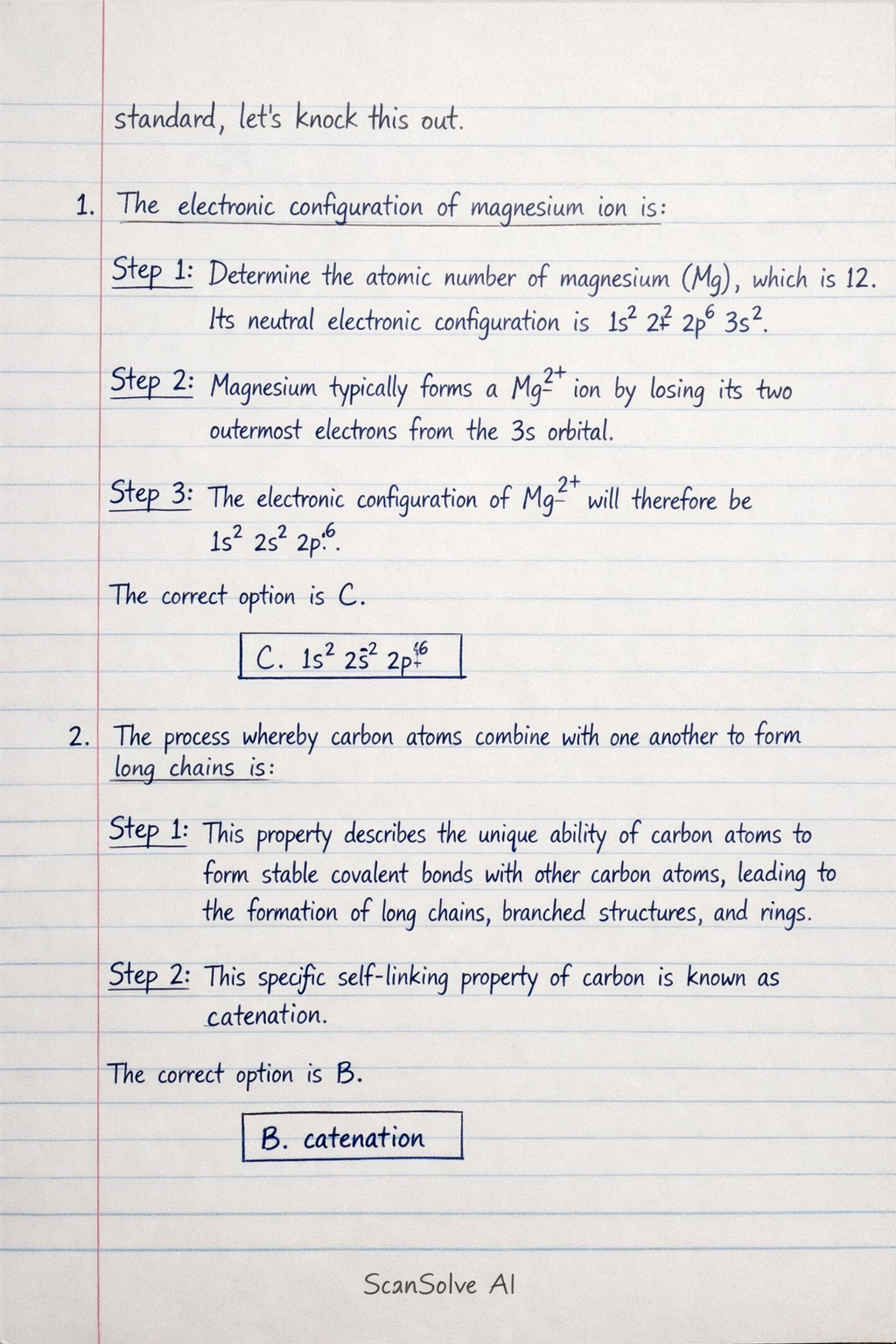
1. The electronic configuration of magnesium ion is: Step 1: Determine the atomic number of magnesium (Mg), which is 12. Its neutral electronic configuration is 1s^2 2s^2 2p^6 3s^2. Step 2: Magnesium typically forms a Mg^2+ ion by losing its two outermost electrons from the 3s orbital. Step 3: The electronic configuration of Mg^2+ will therefore be 1s^2 2s^2 2p^6. The correct option is C. C. 1s^2 2s^2 2p^6 2. The process whereby carbon atoms combine with one another to form long chains is: Step 1: This property describes the unique ability of carbon atoms to form stable covalent bonds with other carbon atoms, leading to the formation of long chains, branched structures, and rings. Step 2: This specific self-linking property of carbon is known as catenation. The correct option is B. B. catenation 3. The existence of an element in two or more forms in the same physical state is: Step 1: This phenomenon describes when an element can exist in different structural forms within the same physical state (e.g., solid). These different forms are called allotropes. Step 2: The term for this property is allotropy. For example, carbon exists as diamond and graphite, both solids. The correct option is A. A. allotropy 4. Graphite is a good lubricant because of its: Step 1: Graphite has a layered structure where carbon atoms are strongly bonded within each layer, but the forces between the layers are very weak (van der Waals forces). Step 2: These weak forces allow the layers to slide past each other easily, which gives graphite its soft nature and makes it an effective lubricant. The correct option is E. E. soft nature Send me the next one 📸