
We read your photo as:
Four options are provided as possible answers to the following questions. Each question has only ONE correct answer. Choose the answer and write only the letter (A D) next to the question number (1.1 5) in the ANSWER BOOK, for example 1.11 E.
ScanSolve AI Answer
Answer
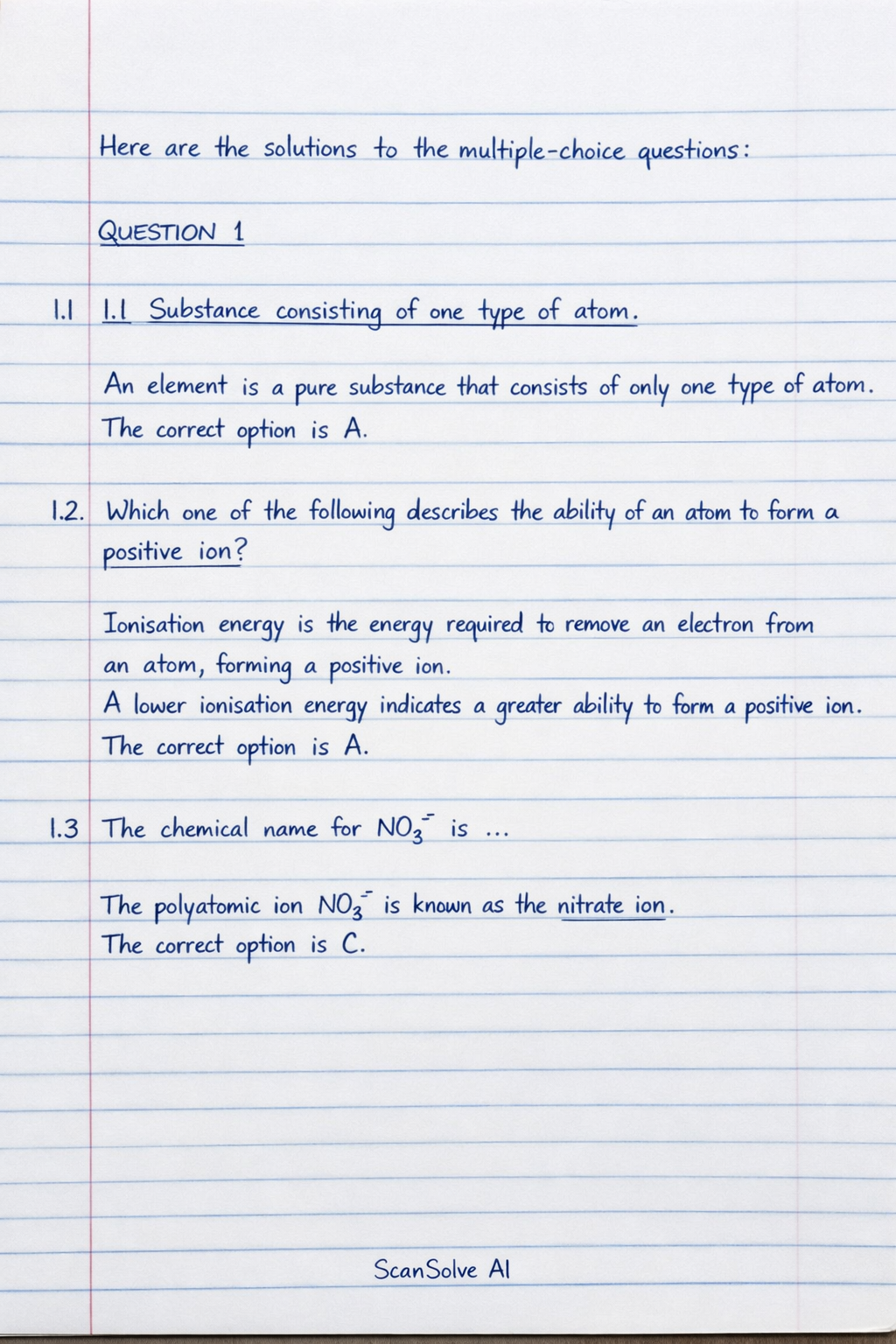
Here are the solutions to the multiple-choice questions:
QUESTION 1
1.1 Substance consisting of one type of atom.
An element is a pure substance that consists of only one type of atom.
The correct option is A.
1.2 Which one of the following describes the ability of an atom to form a positive ion?
Ionisation energy is the energy required to remove an electron from an atom, forming a positive ion. A lower ionisation energy indicates a greater ability to form a positive ion.
The correct option is A.
1.3 The chemical name for is ...
The polyatomic ion is known as the nitrate ion.
The correct option is C.
1.4 Which ONE of the following molecules will contain ionic bonds when chemical bonding occurs between the atoms?
Ionic bonds typically form between a metal and a non-metal due to a large difference in electronegativity, leading to the transfer of electrons.
- A. HCl: Hydrogen (non-metal) and Chlorine (non-metal) form a covalent bond.
- B. O: Oxygen (non-metal) and Oxygen (non-metal) form a covalent bond.
- C. AlO: Aluminium (metal) and Oxygen (non-metal) form an ionic bond.
- D. CO: Carbon (non-metal) and Oxygen (non-metal) form covalent bonds. The correct option is C.
1.5 In a chemical change:
(i) The number of atoms is conserved. (True, Law of Conservation of Atoms)
(ii) The total mass is conserved. (True, Law of Conservation of Mass)
(iii) No new substances are formed. (False, new substances are always formed in a chemical change)
(iv) The number of molecules is conserved. (False, the number of molecules can change)
Therefore, only statements (i) and (ii) are true for a chemical change.
The correct option is C.
Try one yourself
A new problem that tests the same skill.
Still stuck on this one?
Ask a follow-up, and the answer starts from this question.
More Physics Questions
Handwritten Step-by-Step Solution
Get this as a handwritten image on WhatsApp — like a tutor wrote it for you.
Try on WhatsApp