
We read your photo as:
The gas that can be dried using concentrated tetraoxosulphate(VI) acid (H2SO4) must not react with it. Concentrated H2SO4 is a strong acid, an oxidizing agent, and
ScanSolve AI Answer
The gas that can be dried using concentrated tetraoxosulphate(VI) acid () must not react with it. Concentrated is a strong acid, an oxidizing agent, and a dehydrating agent.
Let's examine each option:
-
A) Hydrogen bromide (): is a reducing agent. Concentrated will oxidize to bromine ().
Therefore, cannot be dried by concentrated .
-
B) Sulphur(IV) oxide (): is an acidic gas. It does not react with concentrated because both are acidic. Therefore, can be dried by concentrated .
-
C) Hydrogen sulphide (): is a strong reducing agent. Concentrated will oxidize to sulfur ().
Therefore, cannot be dried by concentrated .
-
D) Ammonia (): is a basic gas. It will react with the acidic concentrated to form ammonium sulfate.
Therefore, cannot be dried by concentrated .
Based on this analysis, only sulphur(IV) oxide can be dried using concentrated tetraoxosulphate(VI) acid.
The final answer is .
Still stuck on this one?
Ask a follow-up, and the answer starts from this question.
More Chemistry Questions
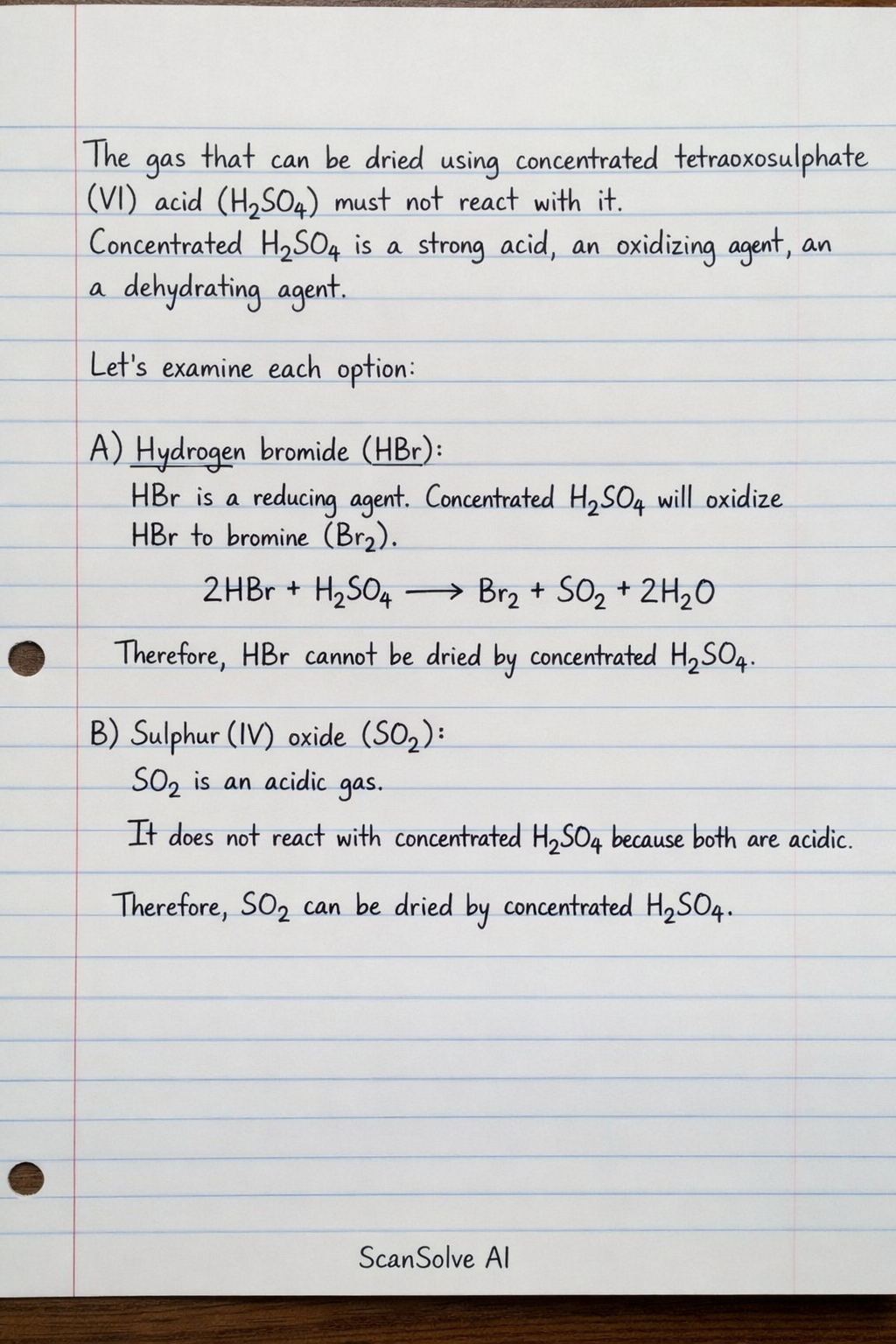
Handwritten Step-by-Step Solution
Get this as a handwritten image on WhatsApp — like a tutor wrote it for you.
Try on WhatsApp