
We read your photo as:
The graph shows how the rates of the forward and reverse reactions change with time.
ScanSolve AI Answer
3:
6.3.1
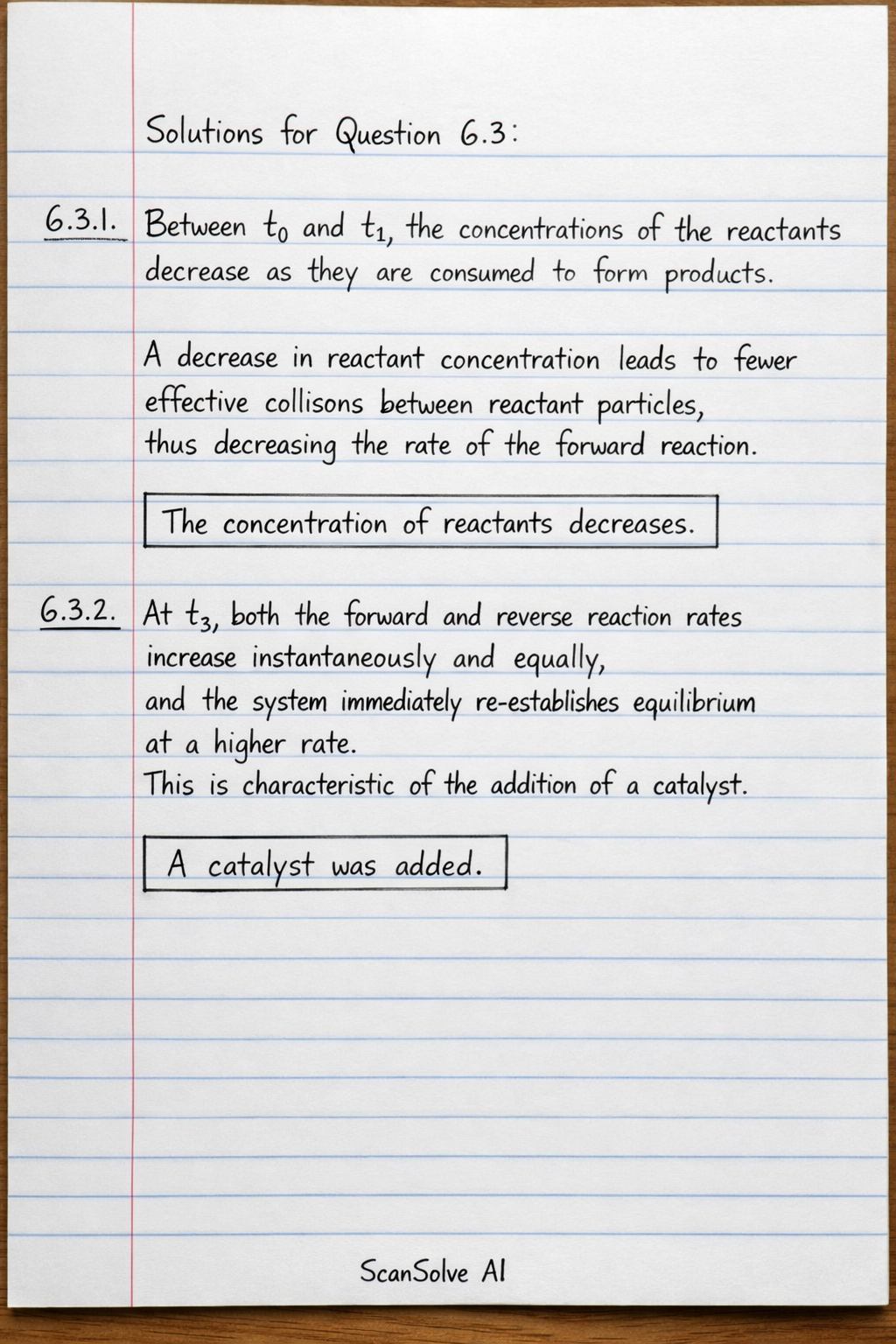
Between and , the concentrations of the reactants decrease as they are consumed to form products. A decrease in reactant concentration leads to fewer effective collisions between reactant particles, thus decreasing the rate of the forward reaction.
6.3.2
At , both the forward and reverse reaction rates increase instantaneously and equally, and the system immediately re-establishes equilibrium at a higher rate. This is characteristic of the addition of a catalyst.
6.3.3
At time , the temperature of the system is increased. The graph shows that both forward and reverse reaction rates increase, but the reverse reaction rate increases more significantly than the forward reaction rate, causing the equilibrium to shift towards the reactants (left). According to Le Chatelier's principle, an increase in temperature favors the endothermic reaction. Since the reverse reaction is favored, the reverse reaction is endothermic. Therefore, the forward reaction must be exothermic.
6.3.4
According to Le Chatelier's principle, when the temperature of a system at equilibrium is increased, the system will shift in the direction that absorbs heat (the endothermic direction) to counteract the change. At , increasing the temperature caused the reverse reaction rate to increase more than the forward reaction rate, indicating a shift in equilibrium towards the reactants (left). This means the reverse reaction is endothermic, and consequently, the forward reaction is exothermic.
Still stuck on this one?
Ask a follow-up, and the answer starts from this question.
More Chemistry Questions
Handwritten Step-by-Step Solution
Get this as a handwritten image on WhatsApp — like a tutor wrote it for you.
Try on WhatsApp