
We read your photo as:
What are the key aspects of the Haber process, including its purification, catalysis, recycling, conditions, and uses of ammonia?
ScanSolve AI Answer
Here are the answers to the questions about the Haber's process:
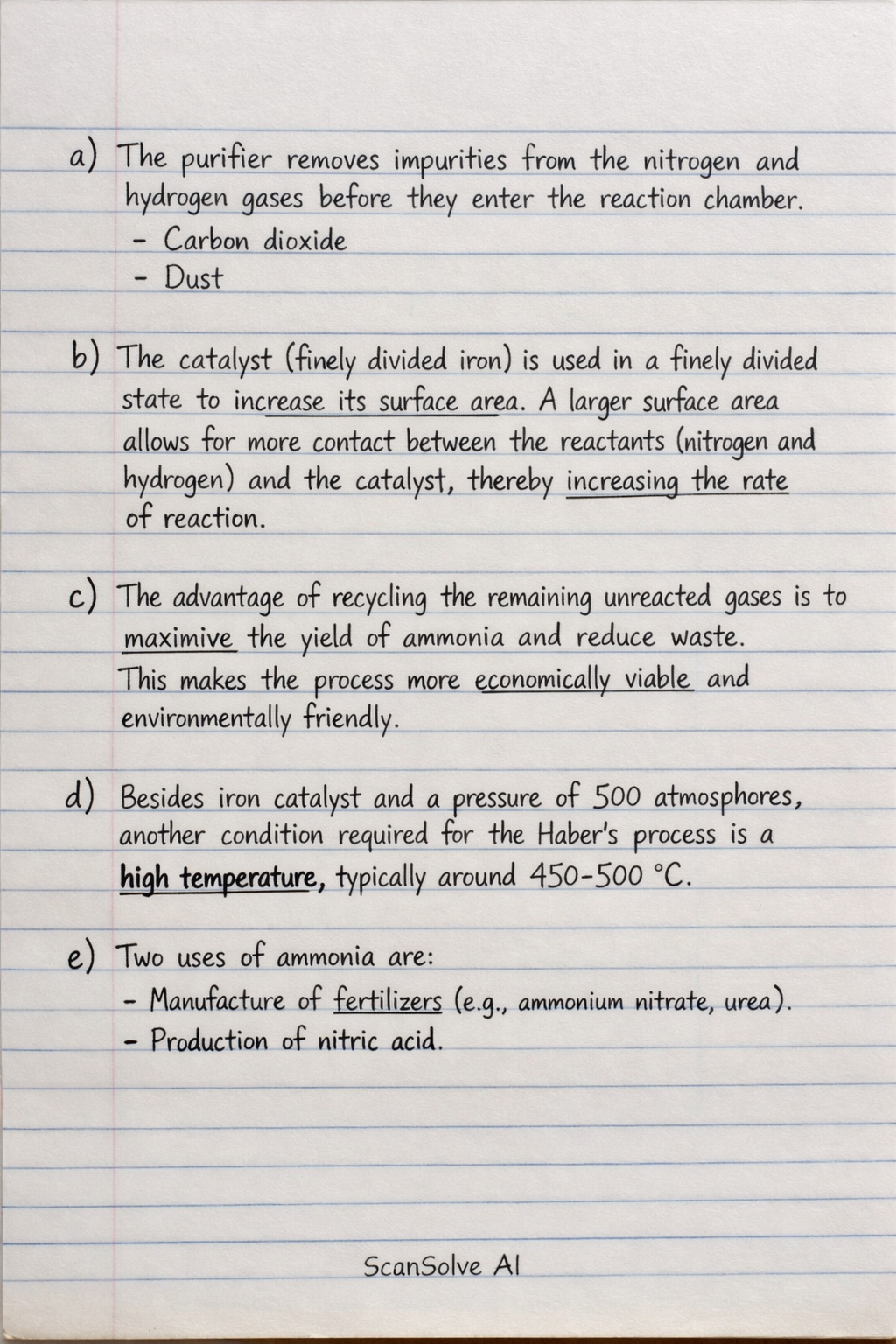
a) The purifier removes impurities from the nitrogen and hydrogen gases before they enter the reaction chamber.
- Carbon dioxide
- Dust
b) The catalyst (finely divided iron) is used in a finely divided state to increase its surface area. A larger surface area allows for more contact between the reactants (nitrogen and hydrogen) and the catalyst, thereby increasing the rate of reaction.
c) The advantage of recycling the remaining unreacted gases is to maximize the yield of ammonia and reduce waste. This makes the process more economically viable and environmentally friendly.
d) Besides iron catalyst and a pressure of 500 atmospheres, another condition required for the Haber's process is a high temperature, typically around 450-500 °C.
e) Two uses of ammonia are:
- Manufacture of fertilizers (e.g., ammonium nitrate, urea).
- Production of nitric acid.
Still stuck on this one?
Ask a follow-up, and the answer starts from this question.
More Chemistry Questions
Handwritten Step-by-Step Solution
Get this as a handwritten image on WhatsApp — like a tutor wrote it for you.
Try on WhatsApp