
How is ammonia and nitric acid extracted and prepared
ScanSolve AI Answer
Step-by-step solution
6 stepsHere's how ammonia and nitric acid are extracted and prepared:
Ammonia ()
Ammonia is primarily prepared industrially through the Haber process.
Raw materials.
Nitrogen gas () is obtained from the air (which is about 78% nitrogen). Hydrogen gas () is typically obtained from the steam reforming of natural gas (methane, ) or from the electrolysis of water.
Reaction conditions.
The reaction occurs at high temperatures (typically ) and high pressures (typically atmospheres). An iron catalyst (often with promoters like potassium oxide and aluminum oxide) is used to increase the reaction rate.
Chemical equation.
Nitrogen and hydrogen react reversibly to form ammonia.
The ammonia produced is then cooled and liquefied, separating it from unreacted nitrogen and hydrogen, which are recycled.
Nitric Acid ()
Nitric acid is primarily prepared industrially through the Ostwald process.
Catalytic oxidation of ammonia.
Ammonia gas is mixed with air (oxygen) and passed over a platinum-rhodium catalyst at high temperatures (). This oxidizes ammonia to nitrogen monoxide ().
Oxidation of nitrogen monoxide.
The hot nitrogen monoxide is then cooled and reacted with excess oxygen (from the air) to form nitrogen dioxide ().
Absorption of nitrogen dioxide in water.
Nitrogen dioxide is absorbed in water in an absorption tower, where it reacts to form nitric acid and nitrogen monoxide. The nitrogen monoxide is recycled back into the process.
This process typically yields concentrated nitric acid (around 68% by mass).
Still stuck on this one?
Ask a follow-up, and the answer starts from this question.
More Chemistry Questions
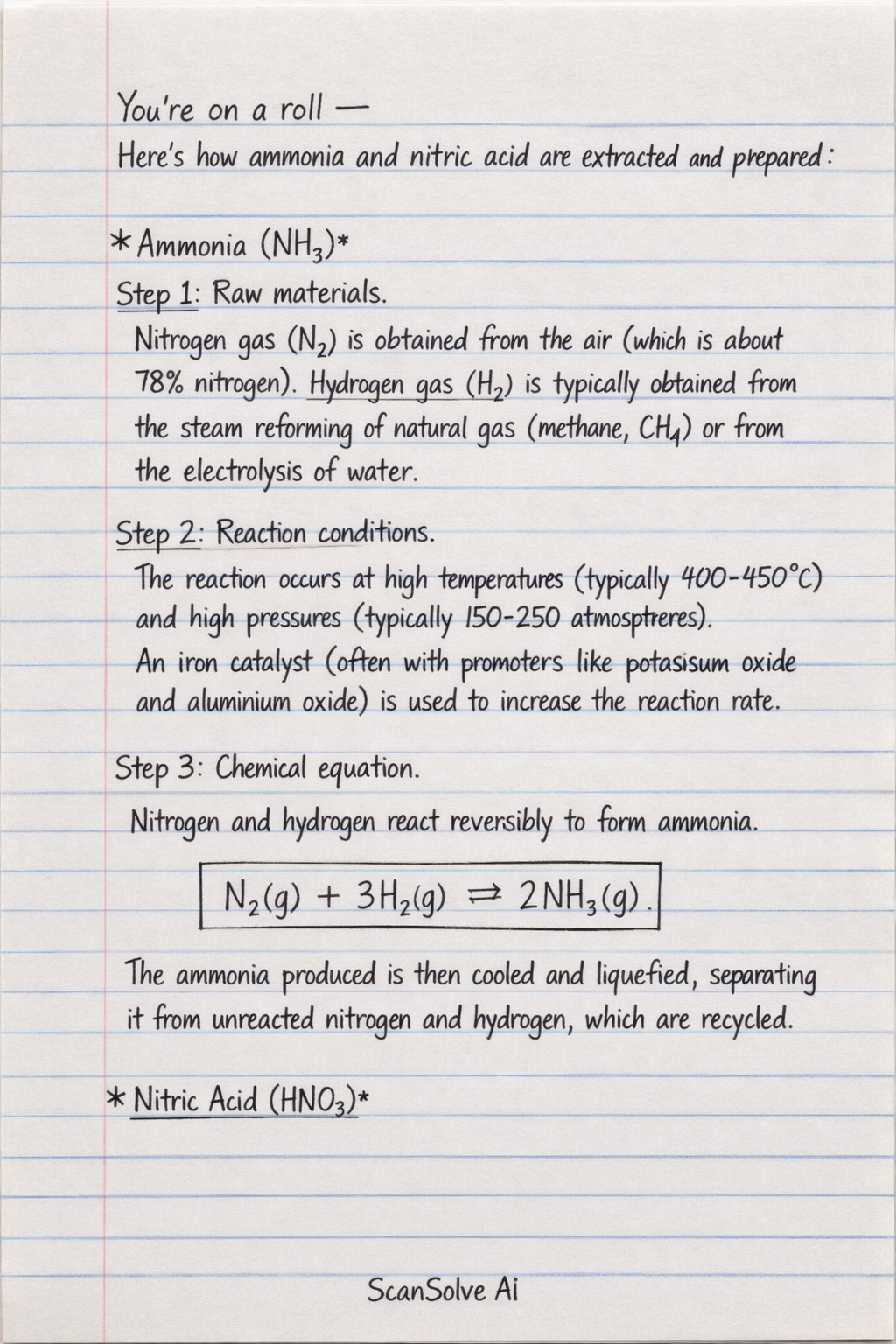
Handwritten Step-by-Step Solution
Get this as a handwritten image on WhatsApp — like a tutor wrote it for you.
Try on WhatsApp