
We read your photo as:
The solution provides answers to qualitative analysis tests for ions and the preparation of ammonia gas. What are the specific questions related to these tests and procedures?
Chemistry
ScanSolve AI Answer
Here are the completed table and answers:
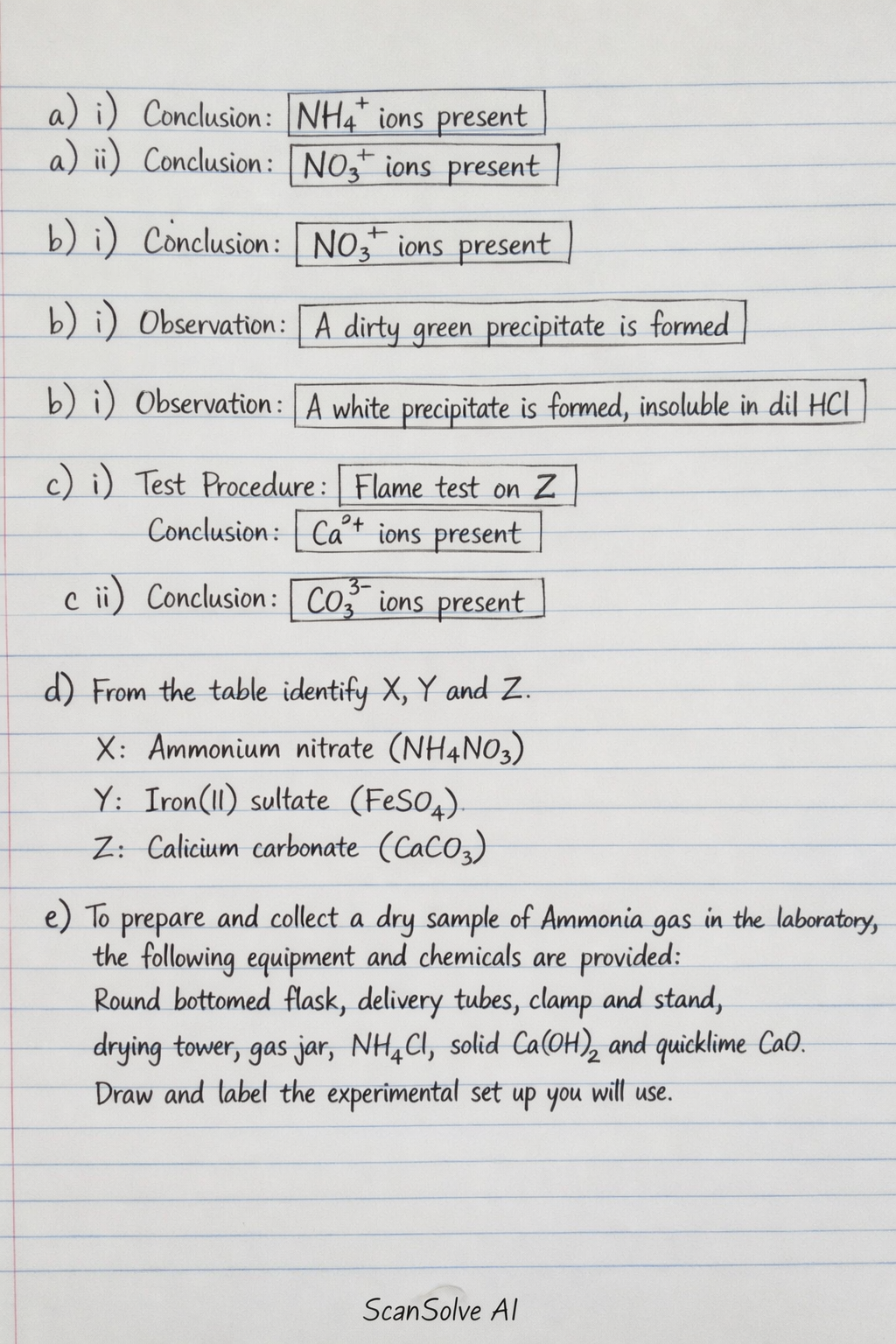
a) i)
Conclusion:
a) ii)
Conclusion:
b) i)
Observation:
b) ii)
Observation:
c) i)
Test Procedure:
Conclusion:
c) ii)
Conclusion:
d) From the table identify X, Y and Z.
- X: Ammonium nitrate ()
- Y: Iron(II) sulfate ()
- Z: Calcium carbonate ()
e) To prepare and collect a dry sample of Ammonia gas in the laboratory, the following equipments and chemicals are provided: Round bottomed flask, delivery tubes, clamp and stand, drying tower, gas jar, , solid and quicklime . Draw and label the experimental set up you will use.
Description of the experimental setup:
- A round-bottomed flask is clamped in a horizontal or slightly downward-sloping position using a clamp and stand.
- A mixture of solid ammonium chloride () and solid calcium hydroxide () is placed in the flask.
- The flask is heated gently.
- A delivery tube leads from the flask into a drying tower packed with quicklime (). Quicklime is used as a drying agent because ammonia is an alkaline gas and would react with acidic drying agents.
- Another delivery tube leads from the drying tower to an inverted gas jar.
- Ammonia gas, being less dense than air, is collected by the downward displacement of air in the inverted gas jar.
Reaction:
Was this helpful?
Still stuck on this one?
Ask a follow-up, and the answer starts from this question.
Got a different question?Ask your own question
More Chemistry Questions
QContinue the qualitative analysis of ions, focusing on specific tests and observations for cations.QAnswer the following questions about qualitative analysis, including observations and inferences for…QVolumetric Analysis Quantitative analysis Qualitative analysis Neutralization reaction Acid bases…QIdentify the cation and anion for the following compounds using qualitative analysis tests and…QIdentify the ions present based on the observations from the chemical tests.
Handwritten Step-by-Step Solution
Get this as a handwritten image on WhatsApp — like a tutor wrote it for you.
Try on WhatsApp