
We read your photo as:
The measure of the tendency of an atom in a molecule to attract shared electrons is known as
ScanSolve AI Answer
Answer
electronegativity
Step-by-step solution
2 stepsHere are the answers to the multiple-choice questions:
23. The measure of the tendency of an atom in a molecule to attract shared electrons is known as
Electronegativity is a chemical property that describes the tendency of an atom to attract a shared pair of electrons (or electron density) towards itself in a covalent bond.
The correct answer is A. electronegativity.
24. What is the molecular mass for ? [Cu = 63.5, S = 32.0, O = 16.0, H = 1.0]
Calculate the molar mass of each component.
- Copper ():
- Sulfur ():
- Oxygen ( in ):
- Water ():
Calculate the total molar mass for .
The compound contains one unit and five units.
The correct answer is A. 249.5 g.
25. All pure substances which are not elements are
Pure substances are classified into two categories: elements (which cannot be broken down further by chemical means) and compounds (which are formed when two or more elements are chemically combined in fixed proportions). Mixtures are not pure substances.
The correct answer is A. compounds.26. A neutron striking an unstable nucleus may split it, causing the process known as
This process, where a heavy atomic nucleus splits into two or more smaller nuclei when struck by a neutron, is called nuclear fission. It releases a large amount of energy.
The correct answer is A. nuclear fission.27. The valence electrons in magnesium are in the
Magnesium () has an atomic number of 12. Its electron configuration is . The valence electrons are the electrons in the outermost principal energy level, which is the 3rd shell in this case. These are the two electrons in the 3s orbital.
The correct answer is D. 3s orbital.
Try one yourself
A new problem that tests the same skill.
Still stuck on this one?
Ask a follow-up, and the answer starts from this question.
More Chemistry Questions
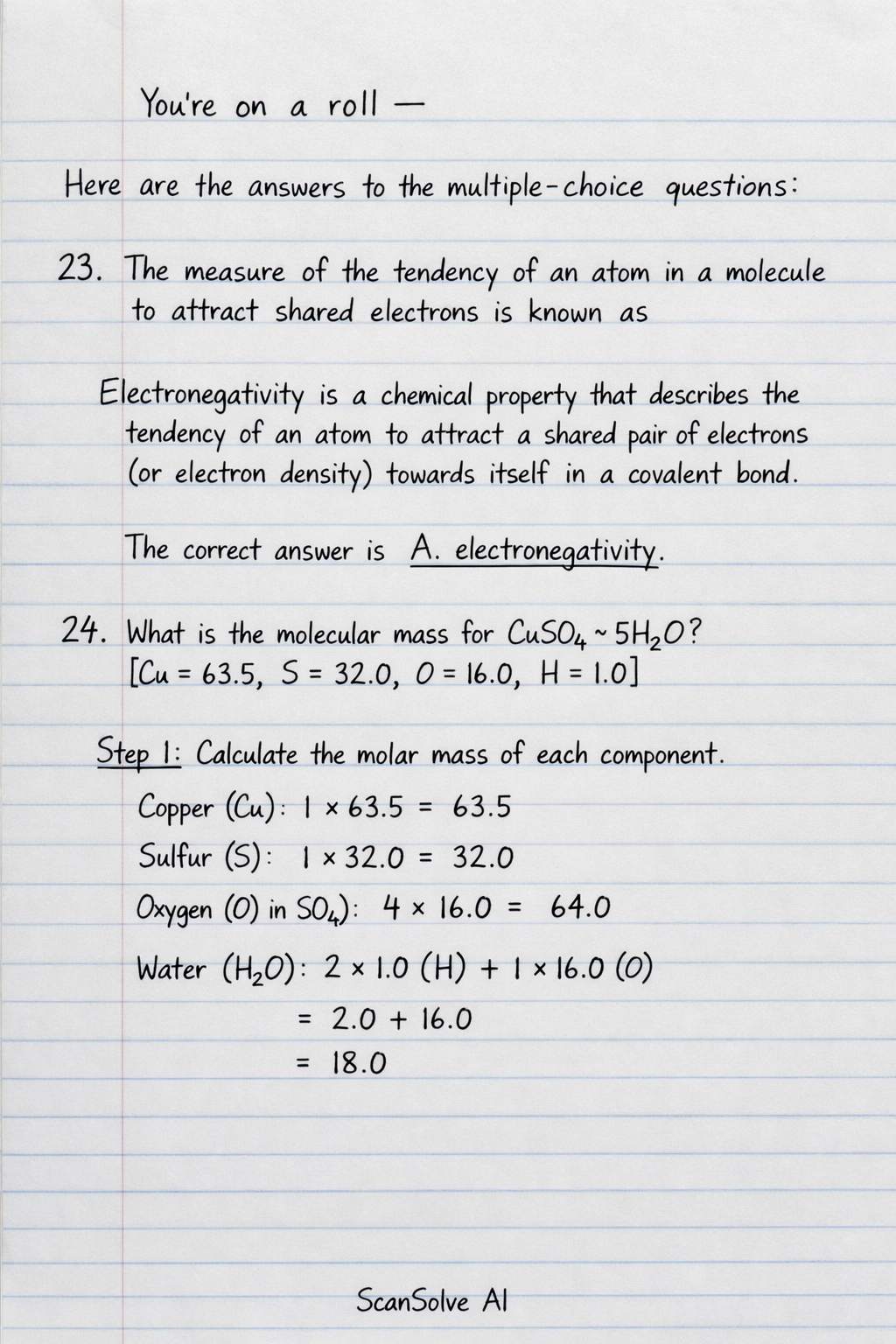
Handwritten Step-by-Step Solution
Get this as a handwritten image on WhatsApp — like a tutor wrote it for you.
Try on WhatsApp