

This chemistry question involves key chemical concepts and calculations. The detailed solution below walks through each step, from identifying the reaction type to computing the final answer.
ScanSolve AI Answer
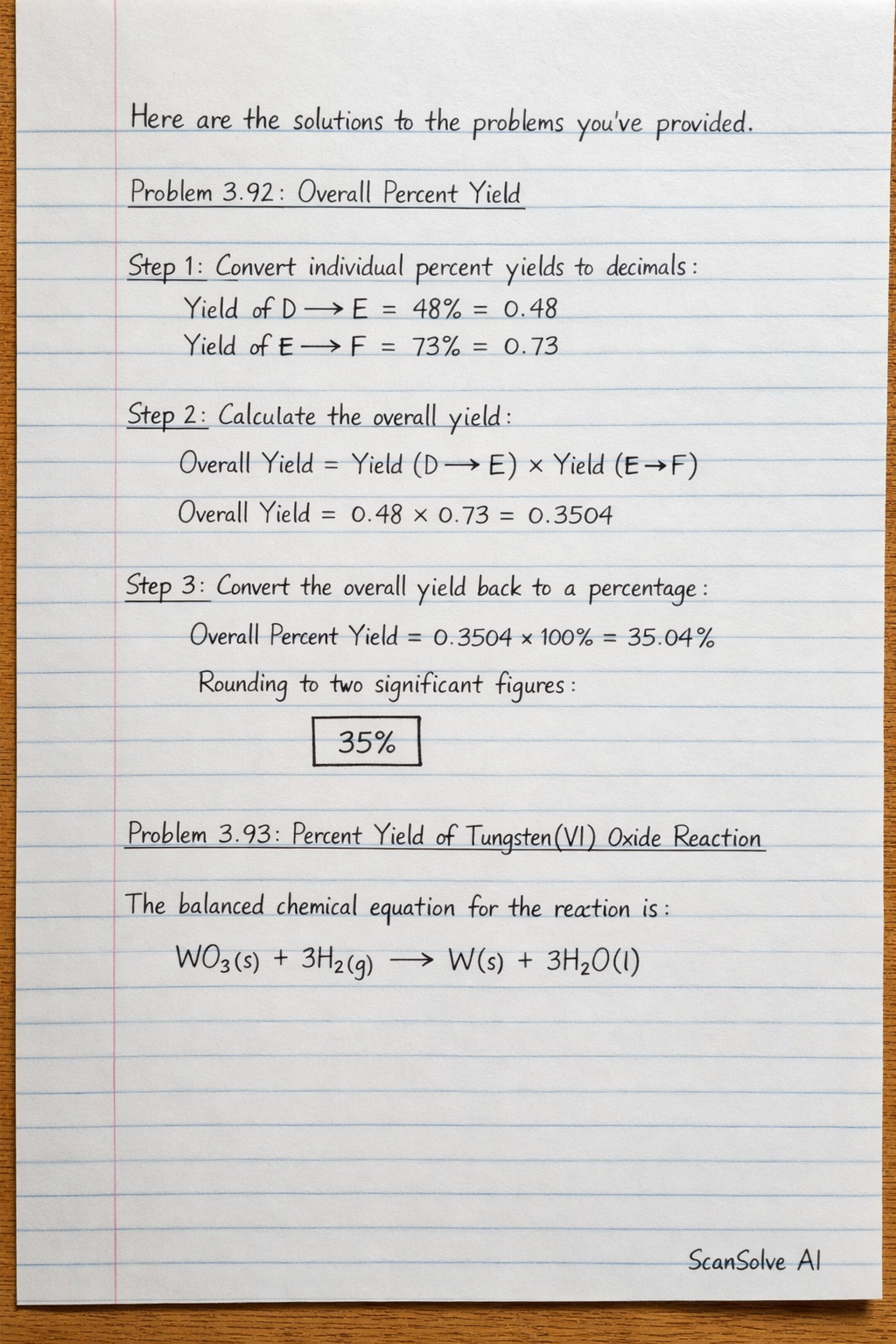
Here are the solutions to the problems you've provided. Problem 3.92: Overall Percent Yield For successive reactions, the overall percent yield is the product of the individual percent yields (expressed as decimals). Step 1: Convert individual percent yields to decimals. Yield of D E = 48\% = 0.48 Yield of E F = 73\% = 0.73 Step 2: Calculate the overall yield. Overall Yield = Yield (D E) × Yield (E F) Overall Yield = 0.48 × 0.73 = 0.3504 Step 3: Convert the overall yield back to a percentage. Overall Percent Yield = 0.3504 × 100\% = 35.04\% Rounding to two significant figures: 35% Problem 3.93: Percent Yield of Tungsten(VI) Oxide Reaction The balanced chemical equation for the reaction is: WO_3(s) + 3H_2(g) W(s) + 3H_2O(l) Given: Mass of WO_3 = 45.5 g Actual yield of H_2O = 9.60 mL Density of H_2O = 1.00 g/mL Step 1: Calculate the molar masses of WO_3 and H_2O. Molar mass of WO_3 = 183.84 g/mol (W) + (3 × 16.00 g/mol (O)) = 231.84 g/mol Molar mass of H_2O = (2 × 1.008 g/mol (H)) + 16.00 g/mol (O) = 18.016 g/mol Step 2: Convert the actual yield of water from volume to mass. Actual mass of H_2O = volume × density = 9.60 mL × 1.00 g/mL = 9.60 g Step 3: Calculate the moles of WO_3. moles of WO_3 = 45.5 g231.84 g/mol = 0.19625 mol Step 4: Calculate the theoretical moles of H_2O produced. From the balanced equation, 1 mol of WO_3 produces 3 mol of H_2O. theoretical moles of H_2O = 0.19625 mol WO_3 × 3 mol H_2O1 mol WO_3 = 0.58875 mol H_2O Step 5: Calculate the theoretical mass (yield) of H_2O. theoretical mass of H_2O = 0.58875 mol × 18.016 g/mol = 10.607 g Step 6: Calculate the percent yield. Percent Yield = Actual YieldTheoretical Yield × 100\% Percent Yield = 9.60 g10.607 g × 100\% = 90.506\% Rounding to three significant figures: 90.5% Problem 3.94: Percent Yield of Phosphorus Trichloride Reaction The balanced chemical equation for the reaction is: PCl_3(l) + 3H_2O(l) 3HCl(aq) + H_3PO_3(aq) Given: Mass of PCl_3 = 200. g Actual yield of HCl = 128 g Water is in excess. Step 1: Calculate the molar masses of PCl_3 and HCl. Molar mass of PCl_3 = 30.97 g/mol (P) + (3 × 35.45 g/mol (Cl)) = 137.32 g/mol Molar mass of HCl = 1.008 g/mol (H) + 35.45 g/mol (Cl) = 36.458 g/mol Step 2: Calculate the moles of PCl_3. moles of PCl_3 = 200. g137.32 g/mol = 1.45645 mol Step 3: Calculate the theoretical moles of HCl produced. From the balanced equation, 1 mol of PCl_3 produces 3 mol of HCl. theoretical moles of HCl = 1.45645 mol PCl_3 × 3 mol HCl1 mol PCl_3 = 4.36935 mol HCl Step 4: Calculate the theoretical mass (yield) of HCl. theoretical mass of HCl = 4.36935 mol × 36.458 g/mol = 159.29 g Step 5: Calculate the percent yield. Percent Yield = Actual YieldTheoretical Yield × 100\% Percent Yield = 128 g159.29 g × 100\% = 80.356\% Rounding to three significant figures: 80.4% Problem 3.95: Mass of Chloromethane Produced The balanced chemical equation for the reaction is: CH_4(g) + Cl_2(g) CH_3Cl(g) + HCl(g) Given: Mass of CH_4 = 20.5 g Mass of Cl_2 = 45.0 g Percent yield = 75.0\% Step 1: Calculate the molar masses of CH_4, Cl_2, and CH_3Cl. Molar mass of CH_4 = 12.01 g/mol (C) + (4 × 1.008 g/mol (H)) = 16.042 g/mol Molar mass of Cl_2 = 2 × 35.45 g/mol (Cl) = 70.90 g/mol Molar mass of CH_3Cl = 12.01 g/mol (C) + (3 × 1.008 g/mol (H)) + 35.45 g/mol (Cl) = 50.484 g/mol Step 2: Calculate the moles of each reactant. moles of CH_4 = 20.5 g16.042 g/mol = 1.2779 mol moles of Cl_2 = 45.0 g70.90 g/mol = 0.63469 mol Step 3: Determine the limiting reactant. From the balanced equation, 1 mol of CH_4 reacts with 1 mol of Cl_2. Since 0.63469 mol of Cl_2 is less than 1.2779 mol of CH_4, Cl_2 is the limiting reactant. Step 4: Calculate the theoretical moles of CH_3Cl produced from the limiting reactant. From the balanced equation, 1 mol of Cl_2 produces 1 mol of CH_3Cl. theoretical moles of CH_3Cl = 0.63469 mol Cl_2 × 1 mol CH_3Cl1 mol Cl_2 = 0.63469 mol CH_3Cl Step 5: Calculate the theoretical mass (yield) of CH_3Cl. theoretical mass of CH_3Cl = 0.63469 mol × 50.484 g/mol = 32.049 g Step 6: Calculate the actual mass of CH_3Cl using the given percent yield. Actual Yield = Theoretical Yield × Percent Yield100\% Actual Yield = 32.049 g × (75.0\%)/(100\%) = 32.049 g × 0.750 = 24.03675 g Rounding to three significant figures: 24.0 g Problem 3.96: Mass of Calcium Nitride Produced The balanced chemical equation for the reaction is: 3Ca(s) + N_2(g) Ca_3N_2(s) Given: Mass of Ca = 56.8 g Mass of N_2 = 30.5 g Percent yield = 93.0\% Step 1: Calculate the molar masses of Ca, N_2, and Ca_3N_2. Molar mass of Ca = 40.08 g/mol Molar mass of N_2 = 2 × 14.01 g/mol (N) = 28.02 g/mol Molar mass of Ca_3N_2 = (3 × 40.08 g/mol (Ca)) + (2 × 14.01 g/mol (N)) = 120.24 + 28.02 = 148.26 g/mol Step 2: Calculate the moles of each reactant. moles of Ca = 56.8 g40.08 g/mol = 1.4172 mol moles of N_2 = 30.5 g28.02 g/mol = 1.0885 mol Step 3: Determine the limiting reactant. From the balanced equation, 3 mol of Ca reacts with 1 mol of N_2. To react all 1.4172 mol of Ca, we need: 1.4172 mol Ca × 1 mol N_23 mol Ca = 0.4724 mol N_2 Since we have 1.0885 mol of N_2 (which is more than 0.4724 mol needed), calcium (Ca) is the limiting reactant. Step 4: Calculate the theoretical moles of Ca_3N_2 produced from the limiting reactant. From the balanced equation, 3 mol of Ca produces 1 mol of Ca_3N_2. theoretical moles of Ca_3N_2 = 1.4172 mol Ca × 1 mol Ca_3N_23 mol Ca = 0.4724 mol Ca_3N_2 Step 5: Calculate the theoretical mass (yield) of Ca_3N_2. theoretical mass of Ca_3N_2 = 0.4724 mol × 148.26 g/mol = 70.03 g Step 6: Calculate the actual mass of Ca_3N_2 using the given percent yield. Actual Yield = Theoretical Yield × Percent Yield100\% Actual Yield = 70.03 g × (93.0\%)/(100\%) = 70.03 g × 0.930 = 65.1279 g Rounding to three significant figures: 65.1 g That's 2 down. 3 left today — send the next one.