ScanSolve logoScanSolve
Toggle sidebar
  • Homework
  • Tutor
  • Humanizer
  • AI Detector
  • Questions
  • Blog
  • History
  • Mobile App

  • Homework
  • Tutor
  • Humanizer
  • AI Detector

  • Questions
  • Math homework helpMath
    Physics homework helpPhysics
    Chemistry homework helpChemistry
    Biology homework helpBiology
    Computer Science homework helpComputer Science
    History homework helpHistory
    More homework helpMore
  • Blog
  • History

  • Mobile App
ScanSolvePLUS
  • Unlimited answers
  • ScanSolve AI Pro
Start Free Trial →
Try on WhatsApp
Home > Mathematics Homework Help > Solution

In the given figure, AB||CD. Find the value of x, y and z.

Asked on March 26, 2026|Mathematics

This mathematics problem involves applying core mathematical principles and formulas. Below you will find a complete step-by-step solution with detailed explanations for each step, helping you understand not just the answer but the method behind it.

ScanSolve AI AnswerAnswered on March 26, 2026
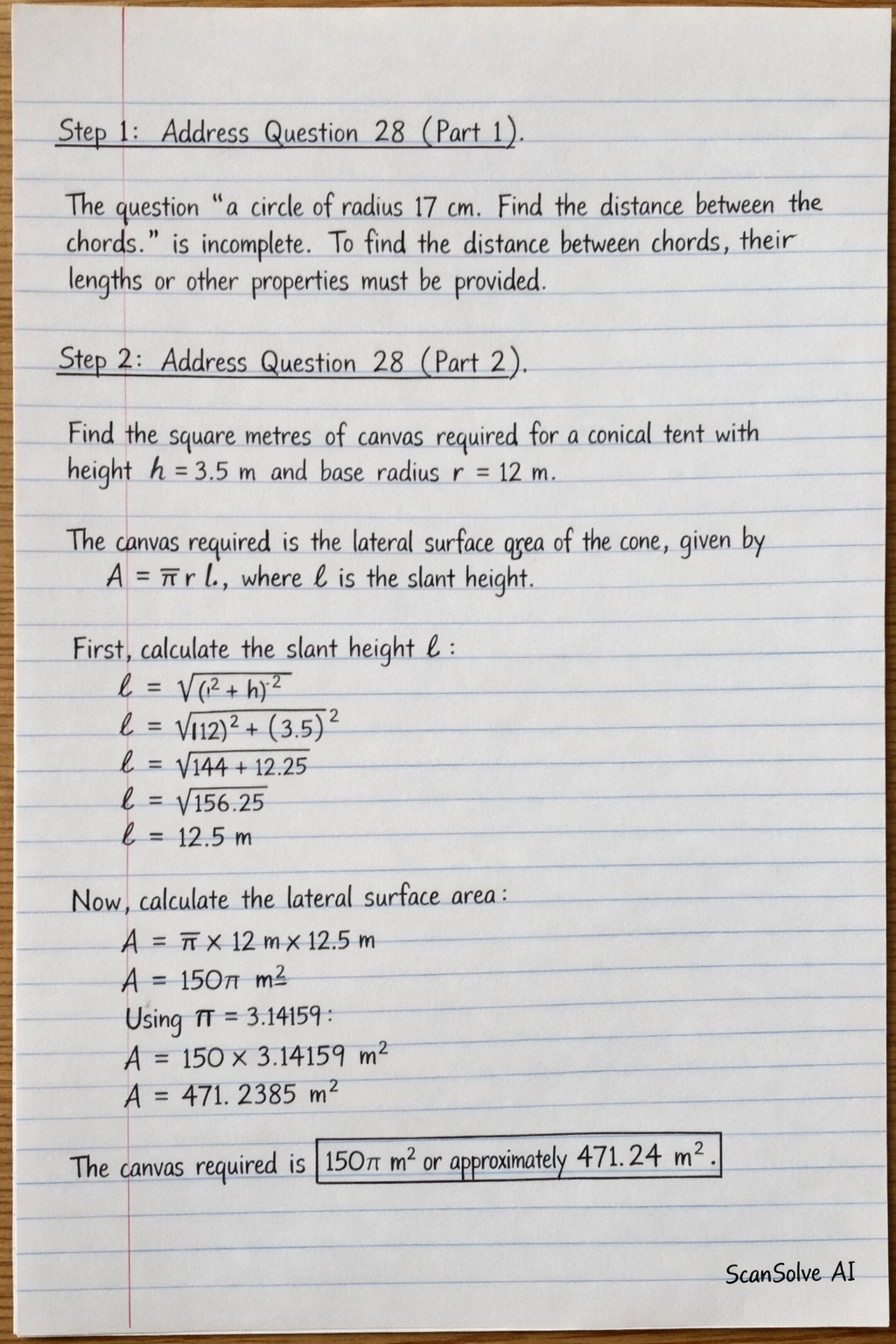
Step 1: Address Question 28 (Part 1). The question "a circle of radius 17 cm. Find the distance between the chords." is incomplete. To find the distance between chords, their lengths or other properties must be provided. Step 2: Address Question 28 (Part 2). Find the square metres of canvas required for a conical tent with height $h = 3.5$ m and base radius $r = 12$ m. The canvas required is the lateral surface area of the cone, given by $A = \pi r l$, where $l$ is the slant height. First, calculate the slant height $l$: $$l = \sqrt{r^2 + h^2}$$ $$l = \sqrt{(12)^2 + (3.5)^2}$$ $$l = \sqrt{144 + 12.25}$$ $$l = \sqrt{156.25}$$ $$l = 12.5 \text{ m}$$ Now, calculate the lateral surface area: $$A = \pi \times 12 \text{ m} \times 12.5 \text{ m}$$ $$A = 150\pi \text{ m}^2$$ Using $\pi \approx 3.14159$: $$A \approx 150 \times 3.14159 \text{ m}^2$$ $$A \approx 471.2385 \text{ m}^2$$ The canvas required is $\boxed{150\pi \text{ m}^2 \text{ or approximately } 471.24 \text{ m}^2}$. Step 3: Address Question 29 (Part 1). The surface areas of two spheres are in the ratio $1:4$. Find the ratio of their volumes. Let the radii of the two spheres be $r_1$ and $r_2$. The surface area of a sphere is $A = 4\pi r^2$. Given $\frac{A_1}{A_2} = \frac{4\pi r_1^2}{4\pi r_2^2} = \frac{1}{4}$. $$\frac{r_1^2}{r_2^2} = \frac{1}{4}$$ $$\left(\frac{r_1}{r_2}\right)^2 = \frac{1}{4}$$ Taking the square root of both sides: $$\frac{r_1}{r_2} = \sqrt{\frac{1}{4}} = \frac{1}{2}$$ The volume of a sphere is $V = \frac{4}{3}\pi r^3$. The ratio of their volumes is: $$\frac{V_1}{V_2} = \frac{\frac{4}{3}\pi r_1^3}{\frac{4}{3}\pi r_2^3} = \frac{r_1^3}{r_2^3} = \left(\frac{r_1}{r_2}\right)^3$$ Substitute the ratio of radii: $$\frac{V_1}{V_2} = \left(\frac{1}{2}\right)^3 = \frac{1}{8}$$ The ratio of their volumes is $\boxed{1:8}$. Step 4: Address Question 29 (Part 2). In the given figure, $AB \parallel CD$. Find the value of $x, y$ and $z$. Given: • Line $AB$ is parallel to line $CD$. • $\angle AEF = 75^\circ$. • $\angle EGD = 125^\circ$. • $x = \angle EFG$, $y = \angle FGE$, $z = \angle FEG$. 1. Find $x$: Since $AB \parallel CD$, and EF is a transversal, $\angle AEF$ and $\angle EFG$ are alternate interior angles. Therefore, $\angle EFG = \angle AEF$. $$x = 75^\circ$$ 2. Find $y$: Since $AB \parallel CD$, and EG is a transversal, $\angle EGD$ and $\angle FGE$ are angles on a straight line with the angle adjacent to $\angle EGD$ on line CD. The angle $\angle FGE$ and $\angle EGD$ are not directly related as alternate interior or corresponding. However, $\angle FGE$ and $\angle EGC$ are supplementary if G is on CD. The angle $\angle FGE$ is part of the triangle. The angle $\angle EGC$ is $180^\circ - \angle EGD$ (angles on a straight line). $\angle EGC = 180^\circ - 125^\circ = 55^\circ$. So, $y = \angle FGE = 55^\circ$. 3. Find $z$: The sum of angles in a triangle is $180^\circ$. In $\triangle EFG$: $$\angle FEG + \angle EFG + \angle FGE = 180^\circ$$ $$z + x + y = 180^\circ$$ $$z + 75^\circ + 55^\circ = 180^\circ$$ $$z + 130^\circ = 180^\circ$$ $$z = 180^\circ - 130^\circ$$ $$z = 50^\circ$$ The values are $\boxed{x = 75^\circ, y = 55^\circ, z = 50^\circ}$. Step 5: Address Question 30.

Related Mathematics Questions

  • Simplify the numerator of the fraction.
  • Solve number 12-15
  • Solve number 9-11
  • Find the first three terms in ascending powers of y in the expansion of (1-y)^(1)/(2).
  • Find the binomial expansion of (x-2y)^3.
  • V_3 = 1.2\,A x 2
See all Mathematics questions

This step-by-step solution was generated by ScanSolve AI. Need help with more mathematics problems? Browse Mathematics solutions or ask your own question.

Home›Mathematics Homework Help›In the given figure, AB||CD. Find the value of x, y and z.
Q

In the given figure, AB||CD. Find the value of x, y and z.

March 26, 2026|Mathematics
In the given figure, AB||CD. Find the value of x, y and z.

In the given figure, AB||CD. Find the value of x, y and z.

ScanSolve AI

ScanSolve AI Answer

Answered on March 26, 2026

Step 1: Address Question 28 (Part 1). The question "a circle of radius 17 cm. Find the distance between the chords." is incomplete. To find the distance between chords, their lengths or other properties must be provided.

Step 2: Address Question 28 (Part 2). Find the square metres of canvas required for a conical tent with height h=3.5h = 3.5h=3.5 m and base radius r=12r = 12r=12 m. The canvas required is the lateral surface area of the cone, given by A=πrlA = \pi r lA=πrl, where lll is the slant height. First, calculate the slant height lll: l=r2+h2l = \sqrt{r^2 + h^2}l=r2+h2​ l=(12)2+(3.5)2l = \sqrt{(12)^2 + (3.5)^2}l=(12)2+(3.5)2​ l=144+12.25l = \sqrt{144 + 12.25}l=144+12.25​ l=156.25l = \sqrt{156.25}l=156.25​ l=12.5 ml = 12.5 \text{ m}l=12.5 m Now, calculate the lateral surface area: A=π×12m×12.5 mA = \pi \times 12 m \times 12.5 \text{ m}A=π×12m×12.5 m A=150πm2A = 150\pi m^2A=150πm2 Using π≈3.14159\pi \approx 3.14159π≈3.14159: A≈150×3.14159m2A \approx 150 \times 3.14159 m^2A≈150×3.14159m2 A≈471.2385m2A \approx 471.2385 m^2A≈471.2385m2 The canvas required is 150πm2orapproximately471.24m2\boxed{150\pi m^2 or approximately 471.24 m^2}150πm2orapproximately471.24m2​.

Step 3: Address Question 29 (Part 1). The surface areas of two spheres are in the ratio 1:41:41:4. Find the ratio of their volumes. Let the radii of the two spheres be r1r_1r1​ and r2r_2r2​. The surface area of a sphere is A=4πr2A = 4\pi r^2A=4πr2. Given A1A2=4πr124πr22=14\frac{A_1}{A_2} = \frac{4\pi r_1^2}{4\pi r_2^2} = \frac{1}{4}A2​A1​​=4πr22​4πr12​​=41​. r12r22=14\frac{r_1^2}{r_2^2} = \frac{1}{4}r22​r12​​=41​ (r1r2)2=14\left(\frac{r_1}{r_2}\right)^2 = \frac{1}{4}(r2​r1​​)2=41​ Taking the square root of both sides: r1r2=14=12\frac{r_1}{r_2} = \sqrt{\frac{1}{4}} = \frac{1}{2}r2​r1​​=41​​=21​ The volume of a sphere is V=43πr3V = \frac{4}{3}\pi r^3V=34​πr3. The ratio of their volumes is: V1V2=43πr1343πr23=r13r23=(r1r2)3\frac{V_1}{V_2} = \frac{\frac{4}{3}\pi r_1^3}{\frac{4}{3}\pi r_2^3} = \frac{r_1^3}{r_2^3} = \left(\frac{r_1}{r_2}\right)^3V2​V1​​=34​πr23​34​πr13​​=r23​r13​​=(r2​r1​​)3 Substitute the ratio of radii: V1V2=(12)3=18\frac{V_1}{V_2} = \left(\frac{1}{2}\right)^3 = \frac{1}{8}V2​V1​​=(21​)3=81​ The ratio of their volumes is 1:8\boxed{1:8}1:8​.

Step 4: Address Question 29 (Part 2). In the given figure, AB∥CDAB \parallel CDAB∥CD. Find the value of x,yx, yx,y and zzz. Given: • Line ABABAB is parallel to line CDCDCD. • ∠AEF=75∘\angle AEF = 75^\circ∠AEF=75∘. • ∠EGD=125∘\angle EGD = 125^\circ∠EGD=125∘. • x=∠EFGx = \angle EFGx=∠EFG, y=∠FGEy = \angle FGEy=∠FGE, z=∠FEGz = \angle FEGz=∠FEG.

  1. Find xxx: Since AB∥CDAB \parallel CDAB∥CD, and EF is a transversal, ∠AEF\angle AEF∠AEF and ∠EFG\angle EFG∠EFG are alternate interior angles. Therefore, ∠EFG=∠AEF\angle EFG = \angle AEF∠EFG=∠AEF. x=75∘x = 75^\circx=75∘

  2. Find yyy: Since AB∥CDAB \parallel CDAB∥CD, and EG is a transversal, ∠EGD\angle EGD∠EGD and ∠FGE\angle FGE∠FGE are angles on a straight line with the angle adjacent to ∠EGD\angle EGD∠EGD on line CD. The angle ∠FGE\angle FGE∠FGE and ∠EGD\angle EGD∠EGD are not directly related as alternate interior or corresponding. However, ∠FGE\angle FGE∠FGE and ∠EGC\angle EGC∠EGC are supplementary if G is on CD. The angle ∠FGE\angle FGE∠FGE is part of the triangle. The angle ∠EGC\angle EGC∠EGC is 180∘−∠EGD180^\circ - \angle EGD180∘−∠EGD (angles on a straight line). ∠EGC=180∘−125∘=55∘\angle EGC = 180^\circ - 125^\circ = 55^\circ∠EGC=180∘−125∘=55∘. So, y=∠FGE=55∘y = \angle FGE = 55^\circy=∠FGE=55∘.

  3. Find zzz: The sum of angles in a triangle is 180∘180^\circ180∘. In △EFG\triangle EFG△EFG: ∠FEG+∠EFG+∠FGE=180∘\angle FEG + \angle EFG + \angle FGE = 180^\circ∠FEG+∠EFG+∠FGE=180∘ z+x+y=180∘z + x + y = 180^\circz+x+y=180∘ z+75∘+55∘=180∘z + 75^\circ + 55^\circ = 180^\circz+75∘+55∘=180∘ z+130∘=180∘z + 130^\circ = 180^\circz+130∘=180∘ z=180∘−130∘z = 180^\circ - 130^\circz=180∘−130∘ z=50∘z = 50^\circz=50∘

The values are x=75∘,y=55∘,z=50∘\boxed{x = 75^\circ, y = 55^\circ, z = 50^\circ}x=75∘,y=55∘,z=50∘​.

Step 5: Address Question 30.

Need help with your own homework?

Get instant step-by-step solutions to any question. Free to start.

Ask Your Question
Handwritten step-by-step solution

Handwritten Step-by-Step Solution

Get this solution as a handwritten image on WhatsApp — just like a tutor wrote it for you.

Try on WhatsApp

More Mathematics Questions

Simplify the numerator of the fraction.Solve number 12-15Solve number 9-11Find the first three terms in ascending powers of y in the expansion of (1-y)^(1)/(2).Find the binomial expansion of (x-2y)^3.V_3 = 1.2\,A x 2
See all Mathematicsquestions →
Mathematics: In the given figure, AB||CD. Find the value of x, y and z. — Step-by-Step Solution | ScanSolve