

This chemistry question involves key chemical concepts and calculations. The detailed solution below walks through each step, from identifying the reaction type to computing the final answer.
ScanSolve AI Answer
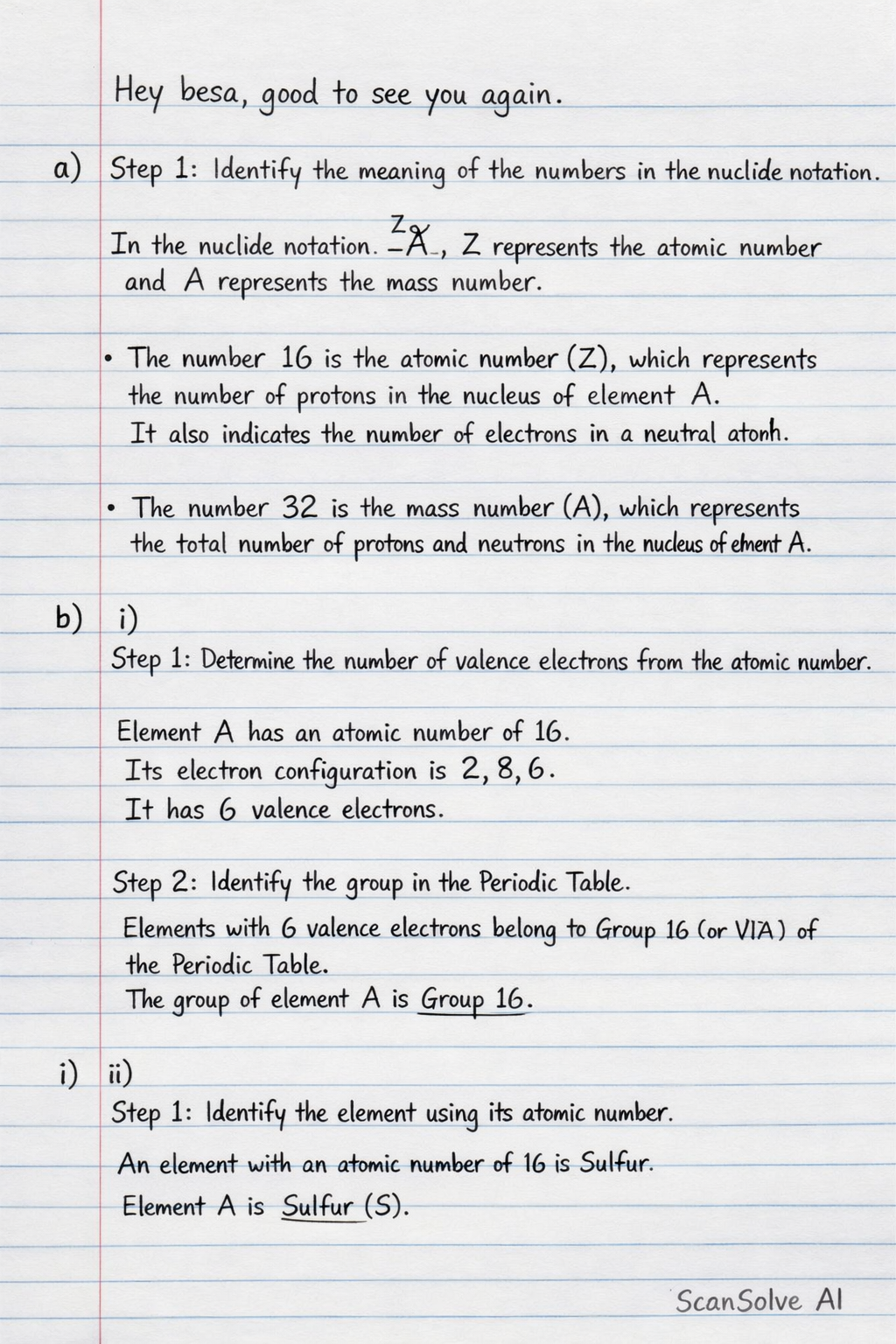
a) Step 1: Identify the meaning of the numbers in the nuclide notation. In the nuclide notation ^A_ZX, Z represents the atomic number and A represents the mass number. • The number 16 is the atomic number (Z), which represents the number of protons in the nucleus of element A. It also indicates the number of electrons in a neutral atom. • The number 32 is the mass number (A), which represents the total number of protons and neutrons in the nucleus of element A. b) i) Step 1: Determine the number of valence electrons from the atomic number. Element A has an atomic number of 16. Its electron configuration is 2, 8, 6. It has 6 valence electrons. Step 2: Identify the group in the Periodic Table. Elements with 6 valence electrons belong to Group 16 (or VIA) of the Periodic Table. The group of element A is Group 16. ii) Step 1: Identify the element using its atomic number. An element with an atomic number of 16 is Sulfur. Element A is Sulfur (S). c) i) Step 1: Determine the valence electrons for Sulfur and Hydrogen. Sulfur (S) has 6 valence electrons. Hydrogen (H) has 1 valence electron. Step 2: Draw the dot and cross diagram for the compound formed between Sulfur and Hydrogen. Sulfur needs 2 electrons to complete its octet, and each hydrogen needs 1 electron to complete its duet. Thus, one sulfur atom will bond with two hydrogen atoms to form H_2S (hydrogen sulfide) through covalent bonding. H · ××S · H or H - · ·· ·S - H The dot and cross diagram for H_2S is: H × × S × H (where represents electrons from Sulfur and × represents electrons from Hydrogen) ii) Step 1: Describe the bonding in the compound formed in (c)(i), which is H_2S. The compound H_2S is formed between two non-metals (Hydrogen and Sulfur). They share electrons to achieve stable electron configurations, forming covalent bonds. Step 2: Describe the bonding in calcium oxide (CaO). Calcium oxide (CaO) is formed between a metal (Calcium, Group 2) and a non-metal (Oxygen, Group 16). Calcium loses 2 electrons to form Ca^2+ ions, and Oxygen gains 2 electrons to form O^2- ions. The electrostatic attraction between these oppositely charged ions forms an ionic bond. Step 3: Compare the two types of bonding. The compound formed between element A (Sulfur) and hydrogen (H_2S) exhibits covalent bonding, where electrons are shared between atoms. In contrast, calcium oxide (CaO) exhibits ionic bonding, where electrons are transferred from one atom to another, resulting in the formation of ions that are held together by strong electrostatic forces. Send me the next one 📸