
We read your photo as:
The student is asked to explain why data was collected until two successive readings agreed, plot a graph of volume of hydrogen against time, and determine the time at which the reaction went to compl
ScanSolve AI Answer
Answers
3 partsStep-by-step solution
5 stepsPart a
Why was data collected until two successive readings agreed?
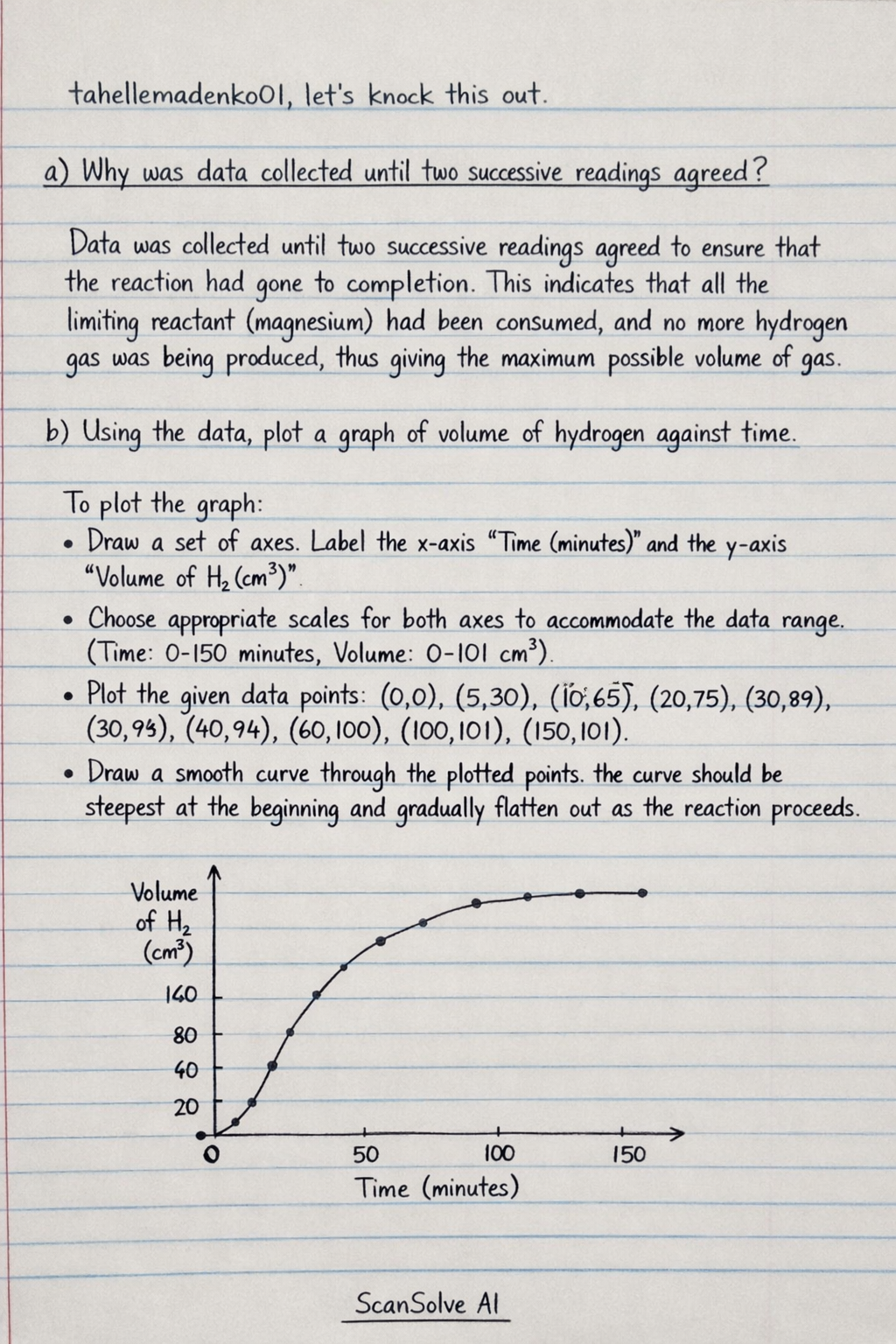
Data was collected until two successive readings agreed to ensure that the reaction had gone to completion. This indicates that all the limiting reactant (magnesium) had been consumed, and no more hydrogen gas was being produced, thus giving the maximum possible volume of gas.
Part b
Using the data, plot a graph of volume of hydrogen against time.
To plot the graph:
- Draw a set of axes. Label the x-axis "Time (minutes)" and the y-axis "Volume of H₂ (cm³)".
- Choose appropriate scales for both axes to accommodate the data range (Time: 0-150 minutes, Volume: 0-101 cm³).
- Plot the given data points: (0,0), (5,30), (10,50), (15,65), (20,75), (30,89), (40,94), (60,100), (100,101), (150,101).
- Draw a smooth curve through the plotted points. The curve should be steepest at the beginning and gradually flatten out as the reaction proceeds.
Part c(i)
Determine the time at which the reaction went to completion.
From the graph
The reaction went to completion when the volume of hydrogen gas stopped increasing. From the data, the volume reaches 101 cm³ at 100 minutes and remains 101 cm³ at 150 minutes. Therefore, the reaction completed at:
Part c(ii)
What volume of hydrogen gas was collected after 50 minutes?
To determine the volume at 50 minutes, you would read the value from the graph at minutes.
Based on linear interpolation between 40 minutes (94 cm³) and 60 minutes (100 cm³):
Volume at 50 min =
Volume at 50 min =
Volume at 50 min =
The volume of hydrogen gas collected after 50 minutes is approximately:
Part d
On the same axes, sketch the change that would be obtained if there were a little heating.
If there were a little heating:
- The initial rate of reaction would increase, so the curve would be steeper at the beginning.
- The reaction would reach completion faster, meaning the curve would flatten out at an earlier time.
- The final volume of hydrogen gas collected would remain the same (101 cm³) because the amount of limiting reactant (magnesium) is unchanged.
Part e
If the gas was collected at room temperature and pressure, determine the mass of magnesium ribbon that was used to produce the volume collected. (molar volume at r.t.p = 24000 cm³)
Write the balanced chemical equation.
From the equation, 1 mole of magnesium reacts to produce 1 mole of hydrogen gas.
Determine the total volume of hydrogen gas collected.
From part c(i), the maximum volume of hydrogen gas collected is .
Calculate the moles of hydrogen gas produced.
Molar volume at r.t.p =
Calculate the moles of magnesium used.
From the balanced equation, the mole ratio of Mg : H₂ is 1:1.
Calculate the mass of magnesium ribbon used.
Molar mass of Mg =
Rounding to three significant figures:
Try one yourself
A new problem that tests the same skill.
Still stuck on this one?
Ask a follow-up, and the answer starts from this question.
More Chemistry Questions
Handwritten Step-by-Step Solution
Get this as a handwritten image on WhatsApp — like a tutor wrote it for you.
Try on WhatsApp