

This chemistry question involves key chemical concepts and calculations. The detailed solution below walks through each step, from identifying the reaction type to computing the final answer.
ScanSolve AI Answer
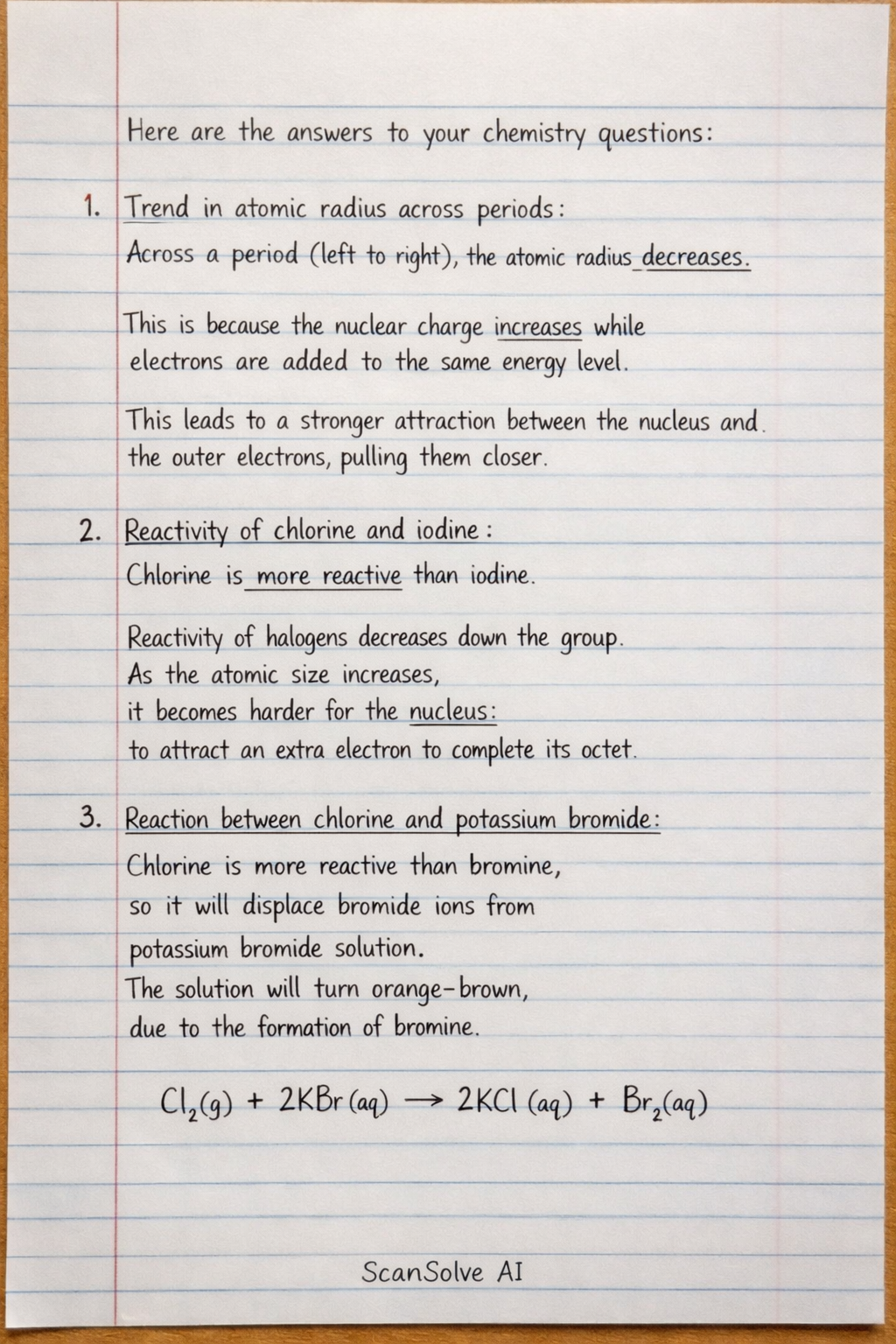
Here are the answers to your chemistry questions: 1. Trend in atomic radius across periods: Across a period from left to right, the atomic radius decreases. This is because the nuclear charge increases while electrons are added to the same principal energy level, leading to a stronger attraction between the nucleus and the outermost electrons, pulling them closer. 2. Reactivity of chlorine and iodine: Chlorine is more reactive than iodine. Reactivity of halogens decreases down the group because the atomic size increases, making it harder for the nucleus to attract an additional electron to complete its octet. 3. Reaction between chlorine and potassium bromide: Chlorine, being more reactive than bromine, will displace bromide ions from potassium bromide solution. The solution will turn orange-brown due to the formation of bromine. Cl_2(g) + 2KBr_(aq) → 2KCl_(aq) + Br_2(aq) 4. Why thermal stability of carbonates increases down the group: The thermal stability of carbonates increases down a group because the size of the metal cation increases. Larger cations have a lower charge density, which means they have a weaker polarizing effect on the carbonate ion (CO_3^2-). This results in less distortion of the carbonate ion, making it more stable and harder to decompose by heat. 5. Patterns in properties of Period 3 Compounds: Metallic to Non-metallic character: Elements transition from strong metallic character (Na, Mg) to metalloid (Al, Si) and then to non-metallic character (P, S, Cl, Ar) across the period. Nature of Oxides: Oxides change from basic (Na_2O, MgO) to amphoteric (Al_2O_3) and then to acidic (SiO_2, P_4O_10, SO_3, Cl_2O_7). 6. Two uses of halogens: Chlorine* is used in water purification and as a disinfectant. Fluorine* compounds are used in toothpaste (as fluoride) to prevent tooth decay. 7. Acid strength of hydrogen halides: The acid strength of hydrogen halides increases down the group. The order of increasing acid strength is HF < HCl < HBr < HI. This is because the bond strength between hydrogen and the halogen decreases as the halogen atom size increases, making it easier for the H-X bond to break and release H^+ ions in solution. That's 2 down. 3 left today — send the next one.