Give Reaction for Hydrogenation

Chemistry

ScanSolve AI Answer

Answer

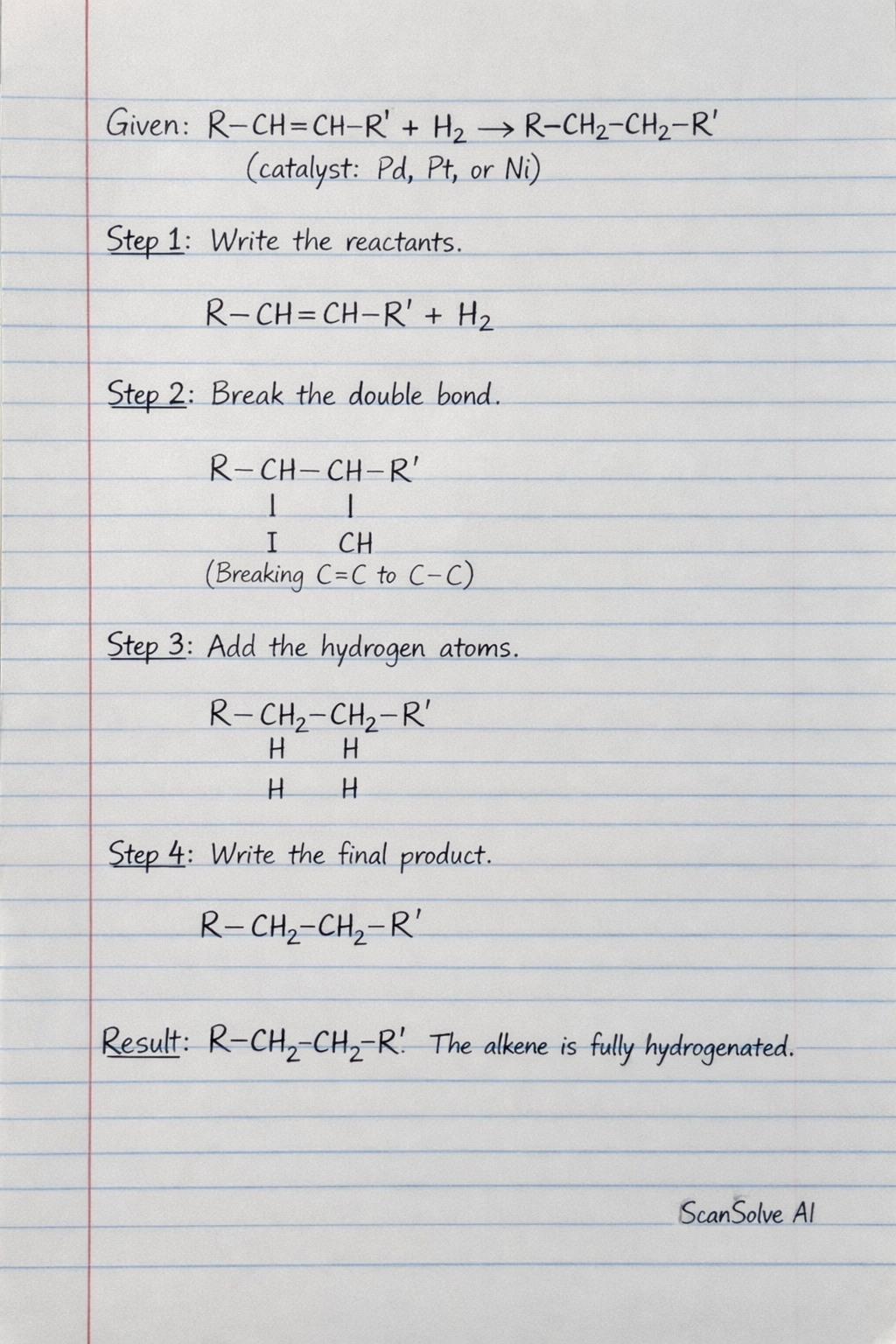
R-CH=CH-R’+H2catalystRCH2CH2-R’\text{R-CH=CH-R'} + H_2 \xrightarrow{catalyst} R-CH_2-CH_2\text{-R'}

Hydrogenation is a chemical reaction that involves the addition of hydrogen (H2\text{H}_2) to an unsaturated compound (like an alkene, alkyne, or aromatic compound) to form a saturated compound. This process typically requires a catalyst, such as palladium (Pd), platinum (Pt), or nickel (Ni).

The general reaction for the hydrogenation of an alkene is:

\text{R-CH=CH-R' + H_2 \xrightarrow{catalyst} R-CH_2-CH_2-R'}

Here, R\text{R} and R’\text{R'} represent alkyl or aryl groups.

What's next? Send 'em!

Was this helpful?

Need help with your own homework?

Get instant step-by-step solutions to any question. Free to start.

Ask Your Question
Handwritten step-by-step solution preview

Handwritten Step-by-Step Solution

Get this as a handwritten image on WhatsApp — like a tutor wrote it for you.

Try on WhatsApp

Still have questions?

Quick Answer

Hydrogenation is a chemical reaction that involves the addition of hydrogen (H_2) to an unsaturated compound (like an alkene, alkyne, or aromatic compound) to form a saturated compound.

Give Reaction for Hydrogenation
Chemistry

This chemistry question involves key chemical concepts and calculations. The detailed solution below walks through each step, from identifying the reaction type to computing the final answer.

ScanSolve AI Answer
Hydrogenation is a chemical reaction that involves the addition of hydrogen (H_2) to an unsaturated compound (like an alkene, alkyne, or aromatic compound) to form a saturated compound. This process typically requires a catalyst, such as palladium (Pd), platinum (Pt), or nickel (Ni). The general reaction for the hydrogenation of an alkene is: R-CH=CH-R' + H_2 catalyst R-CH_2-CH_2-R' Here, R and R' represent alkyl or aryl groups. What's next? Send 'em!