
We read your photo as:
Write two postulates of Dalton's atomic model. Explain the law of constant proportion with example.
ScanSolve AI Answer
Step-by-step solution
5 stepshere are the solutions to the questions:
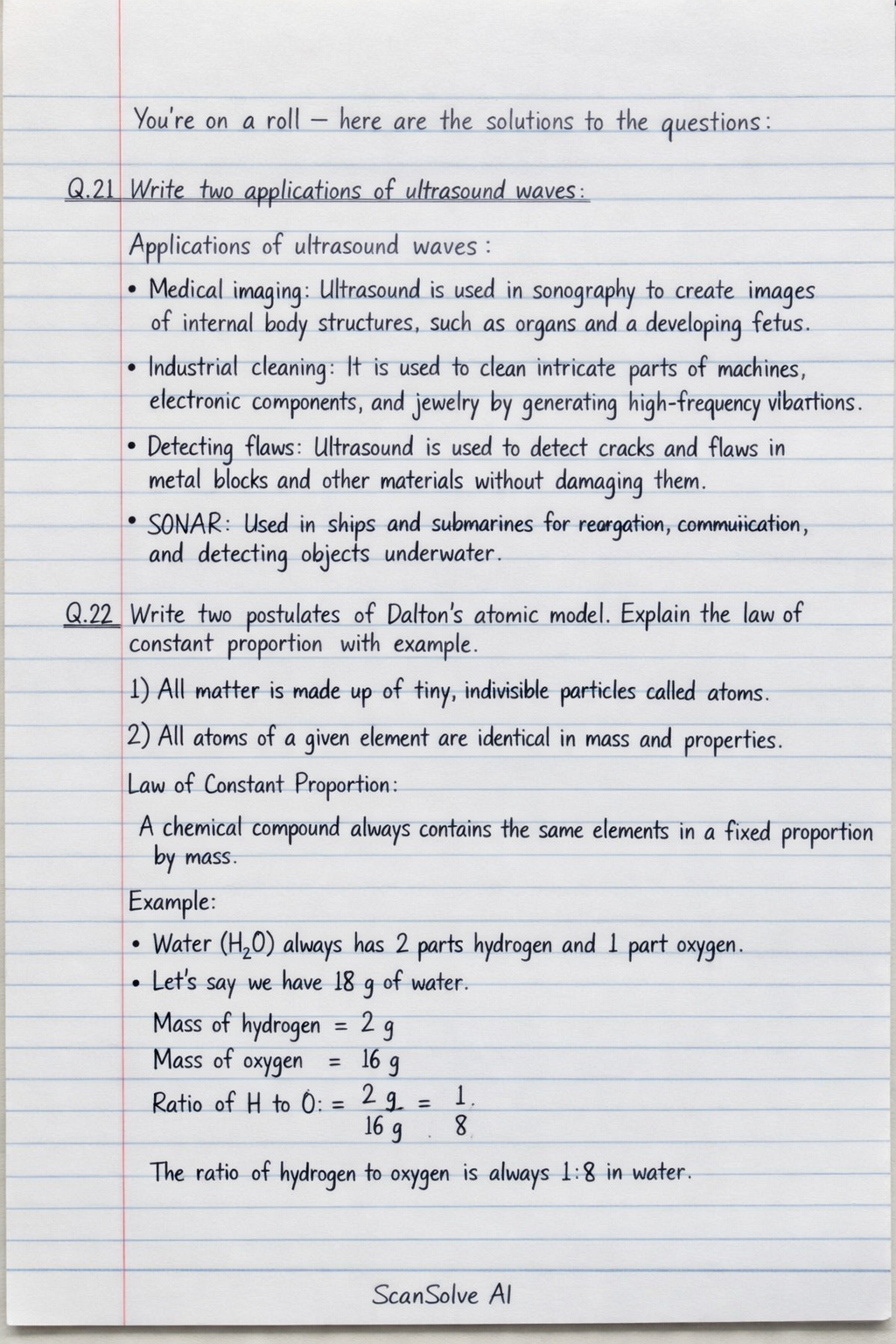
Q.21 Write two applications of ultrasound waves.
- Applications of ultrasound waves:
- Medical imaging: Ultrasound is used in sonography to create images of internal body structures, such as organs and a developing fetus.
- Industrial cleaning: It is used to clean intricate parts of machines, electronic components, and jewelry by generating high-frequency vibrations.
- Detecting flaws: Ultrasound is used to detect cracks and flaws in metal blocks and other materials without damaging them.
- SONAR: Used in ships and submarines for navigation, communication, and detecting objects underwater.
Q.22 Write two postulates of Dalton's atomic model. Explain the law of constant proportion with example.
-
Two postulates of Dalton's atomic model:
- All matter is made of very tiny particles called atoms.
- Atoms are indivisible particles which cannot be created or destroyed in a chemical reaction.
- Atoms of a given element are identical in mass and chemical properties.
- Atoms of different elements have different masses and chemical properties.
-
Law of Constant Proportion (or Law of Definite Proportions): This law states that in a chemical substance, the elements are always present in definite proportions by mass, regardless of the source or method of preparation. Example: Water () always consists of hydrogen and oxygen combined in a fixed mass ratio of . This means that for every 1 gram of hydrogen, there will always be 8 grams of oxygen in a sample of pure water.
Q.23 (i) A person holds a bundle of hay over his head for 30 min and gets tired. Has he done some work or not? Justify.
Answer: No, he has not done any work in the scientific sense.
Justification: In physics, work is defined as the product of force and displacement in the direction of the force (). When a person holds a bundle of hay over their head, they exert an upward force to counteract gravity, but there is no displacement of the hay in the direction of the force (the hay is stationary). Since displacement is zero, the work done is zero. The person gets tired due to muscular effort and energy expenditure within their body, but this does not constitute work done on the hay.
Q.23 (ii) Explain the law of conservation of energy with two examples?
-
Law of Conservation of Energy: This law states that energy can neither be created nor destroyed; it can only be transformed from one form to another. The total energy in an isolated system remains constant.
-
Examples:
- Falling object: When a ball is dropped from a height, its potential energy (due to height) is converted into kinetic energy (due to motion) as it falls. The sum of its potential and kinetic energy (total mechanical energy) remains constant throughout the fall (ignoring air resistance).
- Swinging pendulum: At the highest points of its swing, a pendulum has maximum potential energy and zero kinetic energy. As it swings downwards, potential energy is converted into kinetic energy, reaching maximum kinetic energy at the lowest point. This continuous conversion between potential and kinetic energy demonstrates that total energy is conserved.
Q.23 OR (ii) Prove that the kinetic energy of a body of mass m moving with velocity v is given by, .
Proof:
Consider a body of mass initially at rest (). A constant force acts on the body, causing it to accelerate uniformly () over a distance , reaching a final velocity .
According to Newton's second law of motion, the force applied is
The work done () by the force on the body is given by
From the third equation of motion, relating initial velocity, final velocity, acceleration, and displacement
Since the body starts from rest, :
Solving for displacement :
Substitute equation (1) and (3) into equation (2)
According to the work-energy theorem, the work done on an object is equal to the change in its kinetic energy.
Since the initial kinetic energy was zero (as ), the final kinetic energy () is equal to the work done.
Therefore, the kinetic energy of a body of mass moving with velocity is:
Still stuck on this one?
Ask a follow-up, and the answer starts from this question.
More Chemistry Questions
Handwritten Step-by-Step Solution
Get this as a handwritten image on WhatsApp — like a tutor wrote it for you.
Try on WhatsApp