An outline of kinetic theory of matter and gas laws; Melting, vaporization, boiling, freezing, condensation. The laws of Boyle,Charles Graham and Dalton (law of partial pressure ) combined gas law, molar volume and atomicity of gases The ideal gas equation (PV=nRT) Relationship between vapour density of gases and the relative molecule mass
This physics problem tests your understanding of fundamental physical laws and their applications. The step-by-step solution below breaks down the problem using relevant equations and physical reasoning.
ScanSolve AI Answer
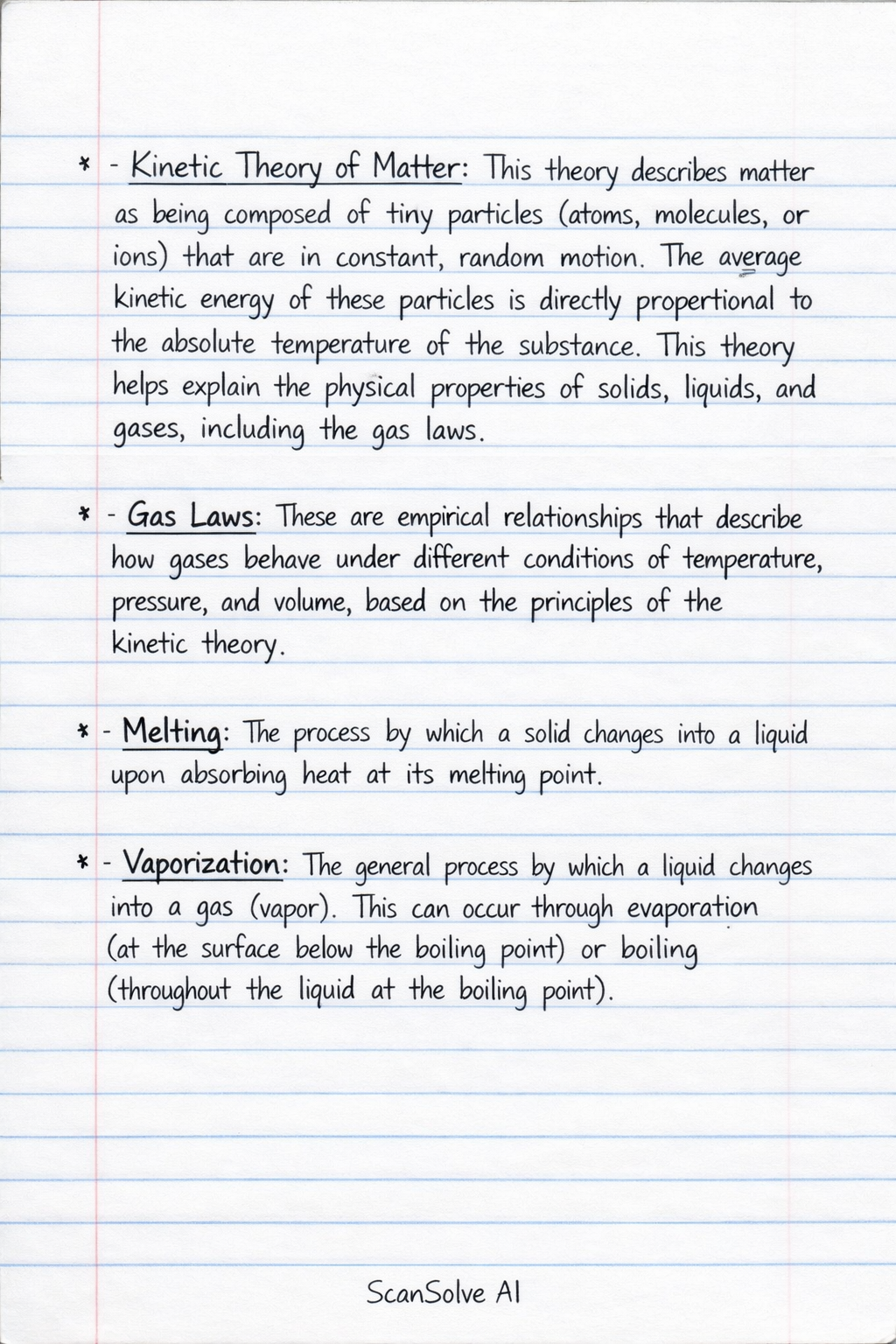
Kinetic Theory of Matter: This theory describes matter as being composed of tiny particles (atoms, molecules, or ions) that are in constant, random motion. The average kinetic energy of these particles is directly proportional to the absolute temperature of the substance. This theory helps explain the physical properties of solids, liquids, and gases, including the gas laws.
Gas Laws: These are empirical relationships that describe how gases behave under different conditions of temperature, pressure, and volume, based on the principles of the kinetic theory.
Melting: The process by which a solid changes into a liquid upon absorbing heat at its melting point.
Vaporization: The general process by which a liquid changes into a gas (vapor). This can occur through evaporation (at the surface below the boiling point) or boiling (throughout the liquid at the boiling point).
Boiling: A specific type of vaporization where a liquid rapidly changes into a gas throughout the bulk of the liquid when its vapor pressure equals the external atmospheric pressure.
Freezing: The process by which a liquid changes into a solid upon releasing heat at its freezing point.
Condensation: The process by which a gas (vapor) changes into a liquid upon releasing heat.
Boyle's Law: States that for a fixed mass of gas at constant temperature, the pressure of the gas is inversely proportional to its volume.
$$P_1V_1 = P_2V_2$$
Charles's Law: States that for a fixed mass of gas at constant pressure, the volume of the gas is directly proportional to its absolute temperature (in Kelvin).
$$\frac{V_1}{T_1} = \frac{V_2}{T_2}$$
Graham's Law of Diffusion: States that the rate of diffusion or effusion of a gas is inversely proportional to the square root of its molar mass.
$$\frac{\text{Rate}_1}{\text{Rate}_2} = \sqrt{\frac{M_2}{M_1}}$$
Dalton's Law of Partial Pressures: States that the total pressure exerted by a mixture of non-reacting gases is equal to the sum of the partial pressures of the individual gases.
$$P_{\text{total}} = P_1 + P_2 + P_3 + \dots$$
Combined Gas Law: Combines Boyle's, Charles's, and Gay-Lussac's laws, relating pressure, volume, and temperature for a fixed amount of gas.
$$\frac{P_1V_1}{T_1} = \frac{P_2V_2}{T_2}$$
Molar Volume: The volume occupied by one mole of any gas at a specific temperature and pressure. At Standard Temperature and Pressure (STP: $0^\circ\text{C}$ or $273.15 \text{ K}$ and $1 \text{ atm}$ or $101.325 \text{ kPa}$), the molar volume of an ideal gas is approximately $22.4 \text{ L}$.
Atomicity of Gases: Refers to the number of atoms present in one molecule of an element in its gaseous state. For example, oxygen ($\text{O}_2$) has an atomicity of 2, helium ($\text{He}$) has an atomicity of 1.
The Ideal Gas Equation: Relates the pressure, volume, temperature, and number of moles of an ideal gas.
$$PV = nRT$$
Where:
$P$ = pressure
$V$ = volume
$n$ = number of moles
$R$ = ideal gas constant ($0.0821 \text{ L}\cdot\text{atm}\cdot\text{mol}^{-1}\cdot\text{K}^{-1}$ or $8.314 \text{ J}\cdot\text{mol}^{-1}\cdot\text{K}^{-1}$)
$T$ = absolute temperature (in Kelvin)
Relationship between Vapour Density of Gases and the Relative Molecular Mass: Vapour density (VD) is the ratio of the mass of a certain volume of a gas to the mass of the same volume of hydrogen gas at the same temperature and pressure. Since, by Avogadro's law, equal volumes of gases contain the same number of molecules, the ratio of their masses is equal to the ratio of their molecular masses.
$$\text{VD} = \frac{\text{Mass of } x \text{ volume of gas}}{\text{Mass of } x \text{ volume of hydrogen}}$$
Since hydrogen is diatomic ($\text{H}_2$) with a relative molecular mass of approximately $2$, the relationship is:
$$\text{Relative Molecular Mass} = 2 \times \text{Vapour Density}$$
An outline of kinetic theory of matter and gas laws; Melting, vaporization, boiling, freezing, condensation. The laws of Boyle,Charles Graham and Dalton (law of partial pressure ) combined gas law, molar volume and atomicity of gases The ideal gas equation (PV=nRT) Relationship between vapour density of gases and the relative molecule mass
|Physics
ScanSolve AI Answer
Kinetic Theory of Matter: This theory describes matter as being composed of tiny particles (atoms, molecules, or ions) that are in constant, random motion. The average kinetic energy of these particles is directly proportional to the absolute temperature of the substance. This theory helps explain the physical properties of solids, liquids, and gases, including the gas laws.
Gas Laws: These are empirical relationships that describe how gases behave under different conditions of temperature, pressure, and volume, based on the principles of the kinetic theory.
Melting: The process by which a solid changes into a liquid upon absorbing heat at its melting point.
Vaporization: The general process by which a liquid changes into a gas (vapor). This can occur through evaporation (at the surface below the boiling point) or boiling (throughout the liquid at the boiling point).
Boiling: A specific type of vaporization where a liquid rapidly changes into a gas throughout the bulk of the liquid when its vapor pressure equals the external atmospheric pressure.
Freezing: The process by which a liquid changes into a solid upon releasing heat at its freezing point.
Condensation: The process by which a gas (vapor) changes into a liquid upon releasing heat.
Boyle's Law: States that for a fixed mass of gas at constant temperature, the pressure of the gas is inversely proportional to its volume.
P1V1=P2V2
Charles's Law: States that for a fixed mass of gas at constant pressure, the volume of the gas is directly proportional to its absolute temperature (in Kelvin).
T1V1=T2V2
Graham's Law of Diffusion: States that the rate of diffusion or effusion of a gas is inversely proportional to the square root of its molar mass.
Rate2Rate1=M1M2
Dalton's Law of Partial Pressures: States that the total pressure exerted by a mixture of non-reacting gases is equal to the sum of the partial pressures of the individual gases.
Ptotal=P1+P2+P3+…
Combined Gas Law: Combines Boyle's, Charles's, and Gay-Lussac's laws, relating pressure, volume, and temperature for a fixed amount of gas.
T1P1V1=T2P2V2
Molar Volume: The volume occupied by one mole of any gas at a specific temperature and pressure. At Standard Temperature and Pressure (STP: 0∘C or 273.15 K and 1 atm or 101.325 kPa), the molar volume of an ideal gas is approximately 22.4 L.
Atomicity of Gases: Refers to the number of atoms present in one molecule of an element in its gaseous state. For example, oxygen (O2) has an atomicity of 2, helium (He) has an atomicity of 1.
The Ideal Gas Equation: Relates the pressure, volume, temperature, and number of moles of an ideal gas.
PV=nRT
Where:
P = pressure
V = volume
n = number of moles
R = ideal gas constant (0.0821L\cdotatm\cdotmol−1\cdotK−1 or 8.314J\cdotmol−1\cdotK−1)
T = absolute temperature (in Kelvin)
Relationship between Vapour Density of Gases and the Relative Molecular Mass: Vapour density (VD) is the ratio of the mass of a certain volume of a gas to the mass of the same volume of hydrogen gas at the same temperature and pressure. Since, by Avogadro's law, equal volumes of gases contain the same number of molecules, the ratio of their masses is equal to the ratio of their molecular masses.
VD=MassofxvolumeofhydrogenMassofxvolumeofgas
Since hydrogen is diatomic (H2) with a relative molecular mass of approximately 2, the relationship is:
Relative Molecular Mass=2×Vapour Density
Need help with your own homework?
Get instant step-by-step solutions to any question. Free to start.