
Solve the E question on half life
ScanSolve AI Answer
Answer
Step-by-step solution
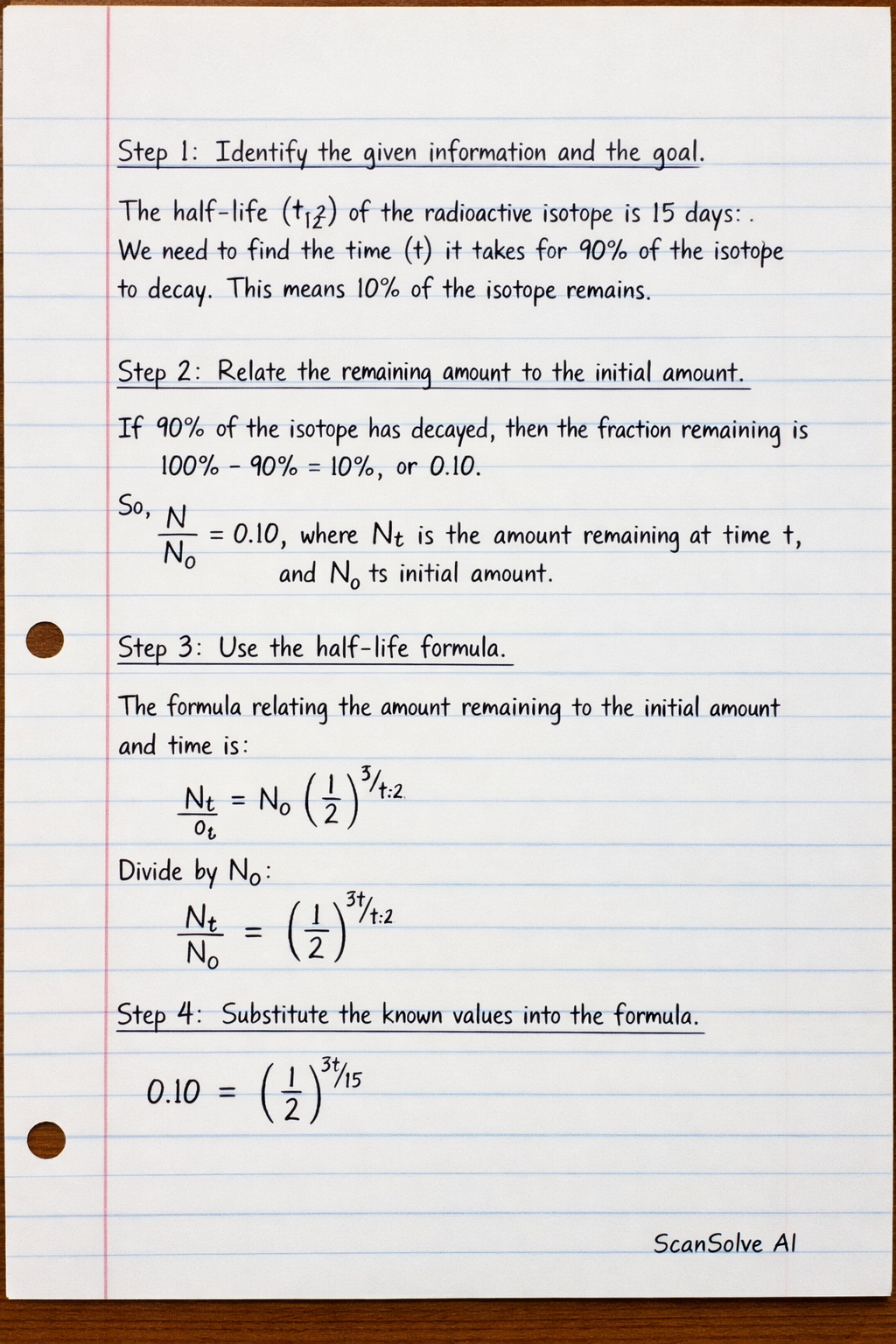
6 stepsIdentify the given information and the goal.
The half-life () of the radioactive isotope is 15 days. We need to find the time () it takes for 90% of the isotope to decay. This means 10% of the isotope remains.
Relate the remaining amount to the initial amount.
If 90% of the isotope has decayed, then the fraction remaining is , or 0.10.
So, , where is the amount remaining at time , and is the initial amount.Use the half-life formula.
The formula relating the amount remaining to the initial amount and time is:
Divide by :
Substitute the known values into the formula.
Solve for by taking the logarithm of both sides.
Take the natural logarithm (ln) of both sides:
Using the logarithm property :
We know that .
So,Isolate and calculate its value.
Rounding to a reasonable number of significant figures:
The time it will take for 90% of the isotope to decay is approximately .
Try one yourself
A new problem that tests the same skill.
Still stuck on this one?
Ask a follow-up, and the answer starts from this question.
More Physics Questions
Handwritten Step-by-Step Solution
Get this as a handwritten image on WhatsApp — like a tutor wrote it for you.
Try on WhatsApp