
We read your photo as:
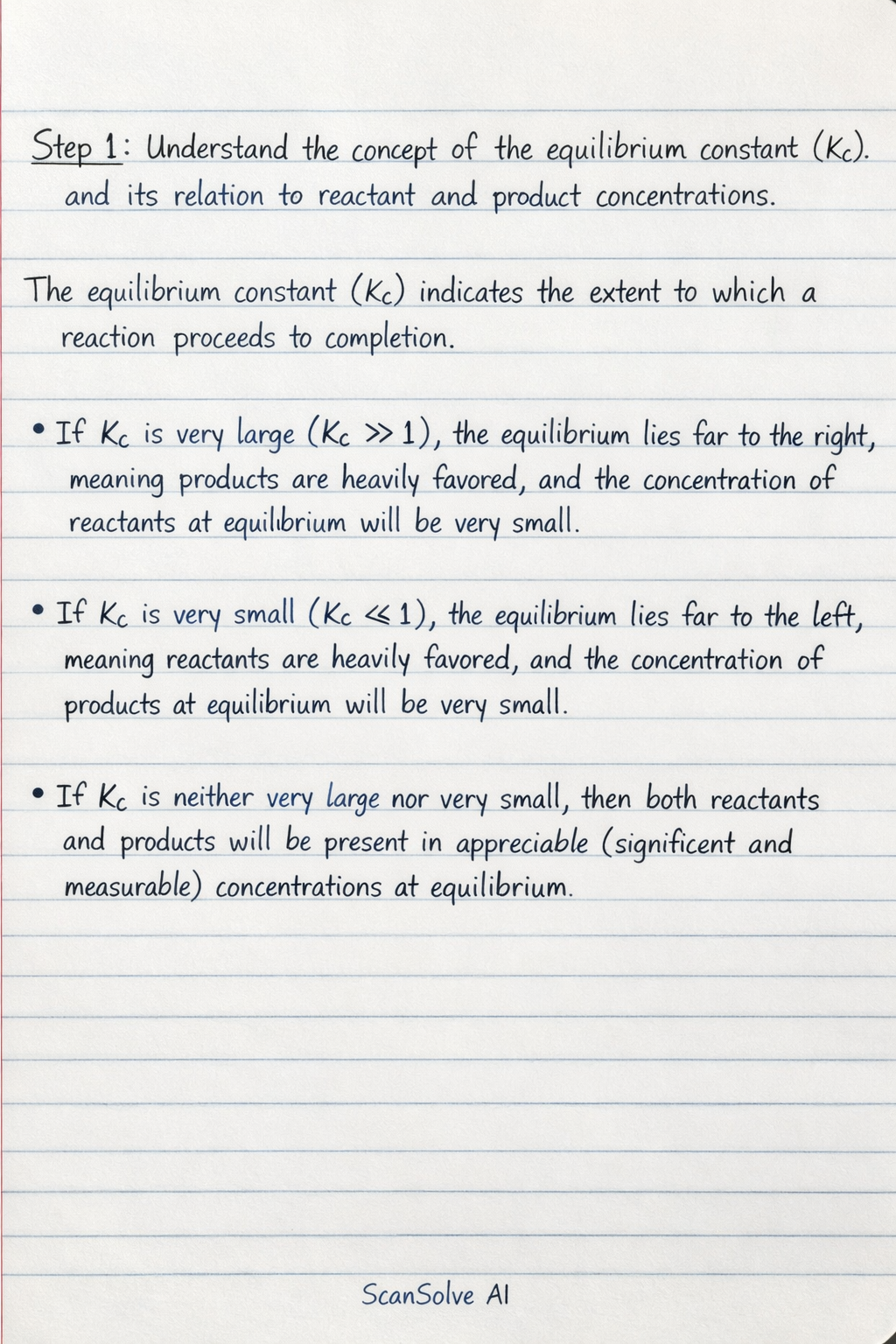
Understand the concept of the equilibrium constant (K_c) and its relation to reactant and product concentrations.
ScanSolve AI Answer
Answer
Step-by-step solution
3 stepsUnderstand the concept of the equilibrium constant () and its relation to reactant and product concentrations.
The equilibrium constant () indicates the extent to which a reaction proceeds to completion.
- If is very large (), the equilibrium lies far to the right, meaning products are heavily favored, and the concentration of reactants at equilibrium will be very small.
- If is very small (), the equilibrium lies far to the left, meaning reactants are heavily favored, and the concentration of products at equilibrium will be very small.
- If is neither very large nor very small, then both reactants and products will be present in appreciable (significant and measurable) concentrations at equilibrium.
Determine the range of for appreciable concentrations.
In general chemistry, a common rule of thumb is that if the equilibrium constant is between and , then both reactants and products will be present in appreciable concentrations at equilibrium. Outside this range, one set of species (either reactants or products) will be present in very low concentrations.
Compare with the given options.
The options are:
a) to
b) to
c) to
d) to
Based on the established chemical principle, the range to corresponds to the condition where appreciable concentrations of both reactants and products are present.
The final answer is .
Try one yourself
A new problem that tests the same skill.
Still stuck on this one?
Ask a follow-up, and the answer starts from this question.
More Chemistry Questions
Handwritten Step-by-Step Solution
Get this as a handwritten image on WhatsApp — like a tutor wrote it for you.
Try on WhatsApp