ScanSolve logoScanSolve
Toggle sidebar
  • Homework
  • Tutor
  • Humanizer
  • AI Detector
  • Questions
  • Blog
  • History
  • Mobile App

  • Homework
  • Tutor
  • Humanizer
  • AI Detector

  • Questions
  • Math homework helpMath
    Physics homework helpPhysics
    Chemistry homework helpChemistry
    Biology homework helpBiology
    Computer Science homework helpComputer Science
    History homework helpHistory
    More homework helpMore
  • Blog
  • History

  • Mobile App
ScanSolvePLUS
  • Unlimited answers
  • ScanSolve AI Pro
Start Free Trial →
Try on WhatsApp
Home > Chemistry Homework Help > Solution

Use phenolphthalein to identify the base.

Asked on March 26, 2026|Chemistry

This chemistry question involves key chemical concepts and calculations. The detailed solution below walks through each step, from identifying the reaction type to computing the final answer.

ScanSolve AI AnswerAnswered on March 26, 2026
Here are the solutions for Exercise 3.12: 1. You are provided separate solutions of $\text{NaCl}$, $\text{HCl}$, $\text{NaOH}$ and Phenolphthalein. All the solutions are colorless. How would you recognize the solutions of acid, base and salt? Step 1: Use phenolphthalein to identify the base. Add a few drops of phenolphthalein indicator to each of the three unknown solutions ($\text{NaCl}$, $\text{HCl}$, $\text{NaOH}$). The solution that turns pink is the base, $\text{NaOH}$. The other two solutions ($\text{NaCl}$ and $\text{HCl}$) will remain colorless. Step 2: Distinguish between the acid and the salt. To the remaining two colorless solutions, add a small piece of a reactive metal like magnesium or zinc, or a carbonate like sodium carbonate. • The solution that produces effervescence (gas bubbles) is the acid, $\text{HCl}$. (e.g., $\text{Mg}(\text{s}) + \text{2HCl}(\text{aq}) \to \text{MgCl}_2(\text{aq}) + \text{H}_2(\text{g})$ or $\text{Na}_2\text{CO}_3(\text{s}) + \text{2HCl}(\text{aq}) \to \text{2NaCl}(\text{aq}) + \text{H}_2\text{O}(\text{l}) + \text{CO}_2(\text{g})$) • The solution that shows no visible reaction is the salt, $\text{NaCl}$. 2. Suggest at least three methods for the preparation of salts. 1. Neutralization reaction: Reaction between an acid and a base. Example: $\text{HCl}(\text{aq}) + \text{NaOH}(\text{aq}) \to \text{NaCl}(\text{aq}) + \text{H}_2\text{O}(\text{l})$ 2. Reaction of an acid with a reactive metal: Example: $\text{H}_2\text{SO}_4(\text{aq}) + \text{Zn}(\text{s}) \to \text{ZnSO}_4(\text{aq}) + \text{H}_2(\text{g})$ 3. Reaction of an acid with a metal oxide: Example: $\text{2HNO}_3(\text{aq}) + \text{CuO}(\text{s}) \to \text{Cu(NO}_3)_2(\text{aq}) + \text{H}_2\text{O}(\text{l})$ 4. Precipitation (double decomposition) reaction: Mixing two soluble salt solutions to form an insoluble salt. Example: $\text{AgNO}_3(\text{aq}) + \text{NaCl}(\text{aq}) \to \text{AgCl}(\text{s}) + \text{NaNO}_3(\text{aq})$ 3. Classify the following salts as soluble or insoluble in water: a. $\text{NH}_4\text{Cl}$: $\boxed{\text{Soluble}}$ (All ammonium salts and most chlorides are soluble) b. $\text{K}_3\text{PO}_4$: $\boxed{\text{Soluble}}$ (All alkali metal salts are soluble) c. $\text{FeCO}_3$: $\boxed{\text{Insoluble}}$ (Most carbonates are insoluble, except for alkali metal and ammonium carbonates) d. $\text{AgCl}$: $\boxed{\text{Insoluble}}$ (Silver chloride is an exception to the general solubility of chlorides) e. $\text{AgNO}_3$: $\boxed{\text{Soluble}}$ (All nitrates are soluble) f. $\text{CaCl}_2$: $\boxed{\text{Soluble}}$ (Most chlorides are soluble) g. $\text{PbSO}_4$: $\boxed{\text{Insoluble}}$ (Lead(II) sulfate is an exception to the general solubility of sulfates) h. $\text{Na}_2\text{S}$: $\boxed{\text{Soluble}}$ (All alkali metal sulfides are soluble) i. $\text{CaSO}_4$: $\boxed{\text{Insoluble}}$ (Calcium sulfate is sparingly soluble, generally considered insoluble in qualitative analysis) j. $\text{BaCO}_3$: $\boxed{\text{Insoluble}}$ (Most carbonates are insoluble, except for alkali metal and ammonium carbonates) 4. Why do aqueous solutions of soluble salts conduct electricity? Aqueous solutions of soluble salts conduct electricity because when dissolved in water, the salts dissociate into free-moving positive and negative ions. These ions act as charge carriers, allowing the electric current to flow through the solution. 5. Which carbonates do not decompose on heating? The carbonates of alkali metals (Group 1 elements like sodium and potassium) generally do not decompose on heating, or they require very high temperatures to do so. For example, $\text{Na}_2\text{CO}_3$ and $\text{K}_2\text

Related Chemistry Questions

  • Identify the base and exponents.
  • Identify the atomic number.
  • Acid, bases and salt
  • SECTION A: PHYSICAL CHEMISTRY
  • The image provided is the cover page of a chemistry examination paper. It contains general instructions and information...
  • I) Compound Words
See all Chemistry questions

This step-by-step solution was generated by ScanSolve AI. Need help with more chemistry problems? Browse Chemistry solutions or ask your own question.

Home›Chemistry Homework Help›Use phenolphthalein to identify the base.
Q

Use phenolphthalein to identify the base.

March 26, 2026|Chemistry
Use phenolphthalein to identify the base.

Use phenolphthalein to identify the base.

ScanSolve AI

ScanSolve AI Answer

Answered on March 26, 2026

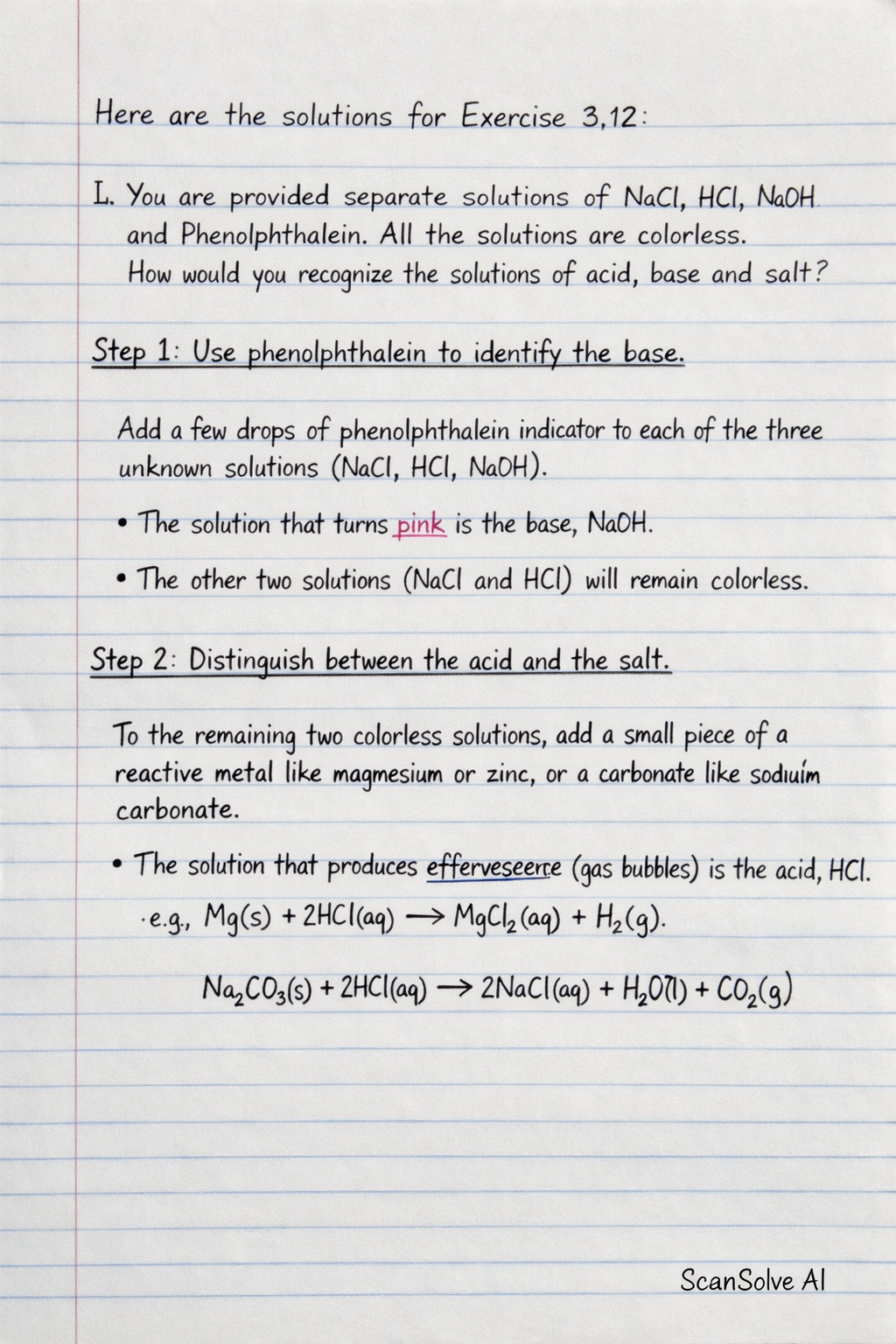
Here are the solutions for Exercise 3.12:

1. You are provided separate solutions of NaCl\text{NaCl}NaCl, HCl\text{HCl}HCl, NaOH\text{NaOH}NaOH and Phenolphthalein. All the solutions are colorless. How would you recognize the solutions of acid, base and salt? Step 1: Use phenolphthalein to identify the base. Add a few drops of phenolphthalein indicator to each of the three unknown solutions (NaCl\text{NaCl}NaCl, HCl\text{HCl}HCl, NaOH\text{NaOH}NaOH). The solution that turns pink is the base, NaOH\text{NaOH}NaOH. The other two solutions (NaCl\text{NaCl}NaCl and HCl\text{HCl}HCl) will remain colorless. Step 2: Distinguish between the acid and the salt. To the remaining two colorless solutions, add a small piece of a reactive metal like magnesium or zinc, or a carbonate like sodium carbonate. • The solution that produces effervescence (gas bubbles) is the acid, HCl\text{HCl}HCl. (e.g., Mg(s)+2HCl(aq)→MgCl2(aq)+H2(g)\text{Mg}(s) + 2HCl(aq) \to MgCl_2(aq) + H_2(g)Mg(s)+2HCl(aq)→MgCl2​(aq)+H2​(g) or Na2CO3(s)+2HCl(aq)→2NaCl(aq)+H2O(l)+CO2(g)\text{Na}_2CO_3(s) + 2HCl(aq) \to 2NaCl(aq) + H_2O(l) + CO_2(g)Na2​CO3​(s)+2HCl(aq)→2NaCl(aq)+H2​O(l)+CO2​(g)) • The solution that shows no visible reaction is the salt, NaCl\text{NaCl}NaCl.

2. Suggest at least three methods for the preparation of salts.

  1. Neutralization reaction: Reaction between an acid and a base. Example: HCl(aq)+NaOH(aq)→NaCl(aq)+H2O(l)\text{HCl}(aq) + NaOH(aq) \to NaCl(aq) + H_2O(l)HCl(aq)+NaOH(aq)→NaCl(aq)+H2​O(l)
  2. Reaction of an acid with a reactive metal: Example: H2SO4(aq)+Zn(s)→ZnSO4(aq)+H2(g)\text{H}_2SO_4(aq) + Zn(s) \to ZnSO_4(aq) + H_2(g)H2​SO4​(aq)+Zn(s)→ZnSO4​(aq)+H2​(g)
  3. Reaction of an acid with a metal oxide: Example: 2HNO3(aq)+CuO(s)→Cu(NO3)2(aq)+H2O(l)\text{2HNO}_3(aq) + CuO(s) \to Cu(NO_3)_2(aq) + H_2O(l)2HNO3​(aq)+CuO(s)→Cu(NO3​)2​(aq)+H2​O(l)
  4. Precipitation (double decomposition) reaction: Mixing two soluble salt solutions to form an insoluble salt. Example: AgNO3(aq)+NaCl(aq)→AgCl(s)+NaNO3(aq)\text{AgNO}_3(aq) + NaCl(aq) \to AgCl(s) + NaNO_3(aq)AgNO3​(aq)+NaCl(aq)→AgCl(s)+NaNO3​(aq)

3. Classify the following salts as soluble or insoluble in water:

  • a. NH4Cl\text{NH}_4\text{Cl}NH4​Cl: Soluble\boxed{Soluble}Soluble​ (All ammonium salts and most chlorides are soluble)
  • b. K3PO4\text{K}_3PO_4K3​PO4​: Soluble\boxed{Soluble}Soluble​ (All alkali metal salts are soluble)
  • c. FeCO3\text{FeCO}_3FeCO3​: Insoluble\boxed{Insoluble}Insoluble​ (Most carbonates are insoluble, except for alkali metal and ammonium carbonates)
  • d. AgCl\text{AgCl}AgCl: Insoluble\boxed{Insoluble}Insoluble​ (Silver chloride is an exception to the general solubility of chlorides)
  • e. AgNO3\text{AgNO}_3AgNO3​: Soluble\boxed{Soluble}Soluble​ (All nitrates are soluble)
  • f. CaCl2\text{CaCl}_2CaCl2​: Soluble\boxed{Soluble}Soluble​ (Most chlorides are soluble)
  • g. PbSO4\text{PbSO}_4PbSO4​: Insoluble\boxed{Insoluble}Insoluble​ (Lead(II) sulfate is an exception to the general solubility of sulfates)
  • h. Na2S\text{Na}_2\text{S}Na2​S: Soluble\boxed{Soluble}Soluble​ (All alkali metal sulfides are soluble)
  • i. CaSO4\text{CaSO}_4CaSO4​: Insoluble\boxed{Insoluble}Insoluble​ (Calcium sulfate is sparingly soluble, generally considered insoluble in qualitative analysis)
  • j. BaCO3\text{BaCO}_3BaCO3​: Insoluble\boxed{Insoluble}Insoluble​ (Most carbonates are insoluble, except for alkali metal and ammonium carbonates)

4. Why do aqueous solutions of soluble salts conduct electricity? Aqueous solutions of soluble salts conduct electricity because when dissolved in water, the salts dissociate into free-moving positive and negative ions. These ions act as charge carriers, allowing the electric current to flow through the solution.

5. Which carbonates do not decompose on heating? The carbonates of alkali metals (Group 1 elements like sodium and potassium) generally do not decompose on heating, or they require very high temperatures to do so. For example, Na2CO3\text{Na}_2CO_3Na2​CO3​ and $\text{K}_2\text

Need help with your own homework?

Get instant step-by-step solutions to any question. Free to start.

Ask Your Question
Handwritten step-by-step solution

Handwritten Step-by-Step Solution

Get this solution as a handwritten image on WhatsApp — just like a tutor wrote it for you.

Try on WhatsApp

More Chemistry Questions

Identify the base and exponents.Identify the atomic number.Acid, bases and saltSECTION A: PHYSICAL CHEMISTRYThe image provided is the cover page of a chemistry examination paper. It contains general instructi…I) Compound Words
See all Chemistryquestions →