We read your photo as:

Using Graham's Law of Diffusion, determine the molar mass of an unknown gas if ethane (C2H6) diffuses at a rate of 3.6 imes 10⁻⁶ mol/h and the unknown gas diffuses at 1.3 imes 10⁻⁶ mol/h?

Chemistry

ScanSolve AI Answer

Answers

2 parts
a

1.618\text{1.618}

b

1.037\text{1.037}

Step-by-step solution

6 steps

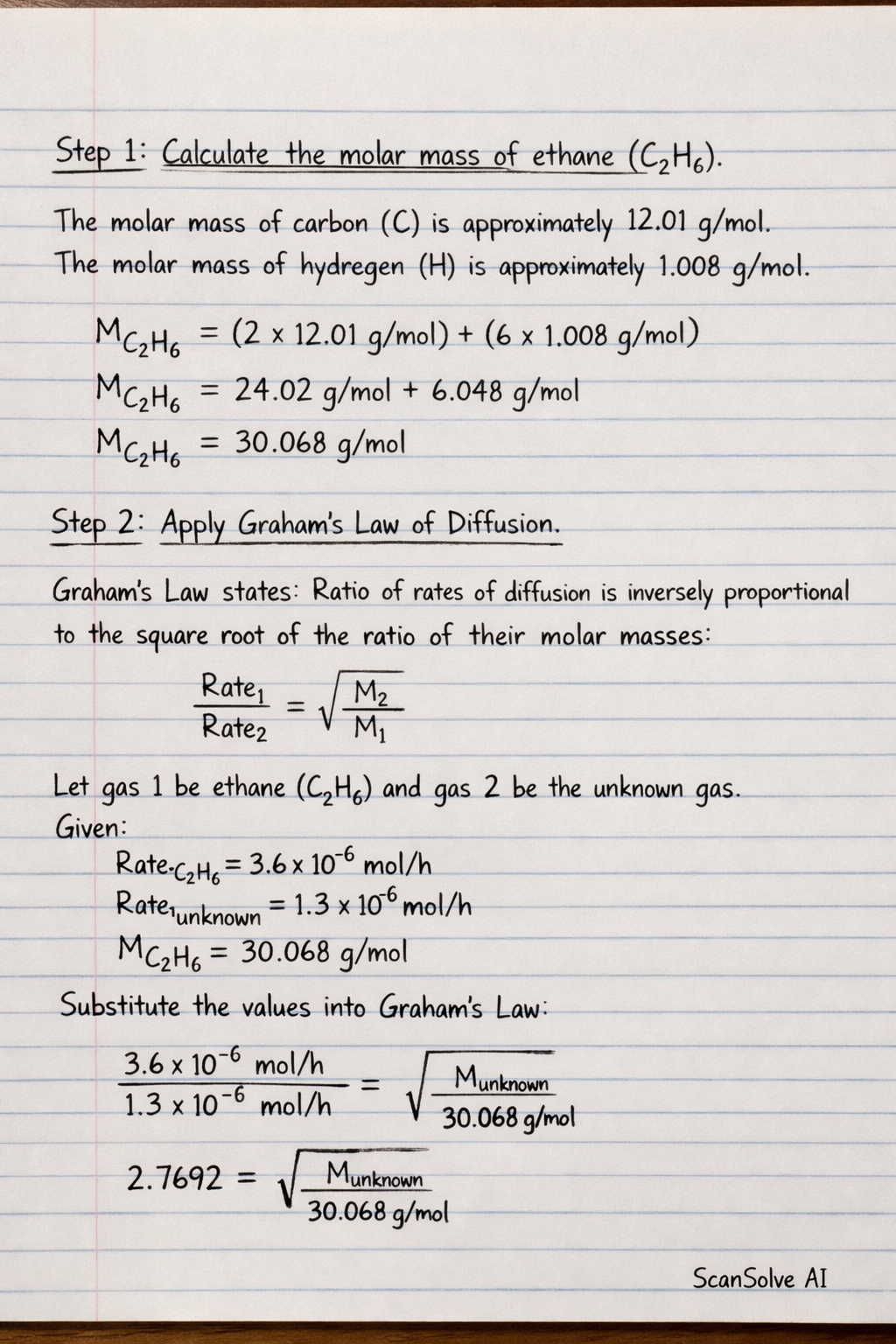
Step 1: Calculate the molar mass of ethane (C2H6C_2H_6).
The molar mass of carbon (C) is approximately 12.01 g/mol.
The molar mass of hydrogen (H) is approximately 1.008 g/mol.

MC2H6=(2×12.01 g/mol)+(6×1.008 g/mol)M_{C_2H_6} = (2 \times 12.01 \text{ g/mol}) + (6 \times 1.008 \text{ g/mol}) MC2H6=24.02 g/mol+6.048 g/molM_{C_2H_6} = 24.02 \text{ g/mol} + 6.048 \text{ g/mol} MC2H6=30.068 g/molM_{C_2H_6} = 30.068 \text{ g/mol}

Step 2: Apply Graham's Law of Diffusion.
Graham's Law states that the ratio of the rates of diffusion of two gases is inversely proportional to the square root of the ratio of their molar masses:

Rate1Rate2=M2M1\frac{\text{Rate}_1}{\text{Rate}_2} = \sqrt{\frac{M_2}{M_1}}

Let gas 1 be ethane (C2H6C_2H_6) and gas 2 be the unknown gas.
Given:
RateC2H6=3.6×10⁻⁶_{C_2H_6} = 3.6 \times 10^{-6} mol/h
Rateunknown=1.3×10⁻⁶_{unknown} = 1.3 \times 10^{-6} mol/h
MC2H6=30.068M_{C_2H_6} = 30.068 g/mol

Substitute the values into Graham's Law:

3.6×10⁻⁶ mol/h1.3×10−6 mol/h=Munknown30.068 g/mol\frac{3.6 \times 10^{-6} \text{ mol/h}}{1.3 \times 10^{-6} \text{ mol/h}} = \sqrt{\frac{M_{unknown}}{30.068 \text{ g/mol}}} 2.7692=Munknown30.068 g/mol2.7692 = \sqrt{\frac{M_{unknown}}{30.068 \text{ g/mol}}}

Step 3: Solve for the molar mass of the unknown gas (MunknownM_{unknown}).
Square both sides of the equation:

(2.7692)2=Munknown30.068 g/mol(2.7692)^2 = \frac{M_{unknown}}{30.068 \text{ g/mol}} 7.6685=Munknown30.068 g/mol7.6685 = \frac{M_{unknown}}{30.068 \text{ g/mol}} Munknown=7.6685×30.068 g/molM_{unknown} = 7.6685 \times 30.068 \text{ g/mol} Munknown=230.56 g/molM_{unknown} = 230.56 \text{ g/mol}

Rounding to two significant figures (based on the given rates):

Munknown=230 g/molM_{unknown} = 230 \text{ g/mol}

The molar mass of the unknown gas is 230 g/mol\boxed{\text{230 g/mol}}.


Part a· 3 steps

Kr and O2_2

  1. Determine the molar masses of Kr and O2_2.

    Molar mass of Krypton (Kr) = 83.80 g/mol
    Molar mass of Oxygen (O2O_2) = 2×16.00 g/mol=32.00 g/mol2 \times 16.00 \text{ g/mol} = 32.00 \text{ g/mol}

  2. Identify which gas diffuses more rapidly.

    The gas with the lower molar mass diffuses more rapidly. Since MO2M_{O_2} (32.00 g/mol) is less than MKrM_{Kr} (83.80 g/mol), oxygen (O2O_2) diffuses more rapidly.

  3. Calculate the relative rates of diffusion.

    Using Graham's Law:

    RateO2RateKr=MKrMO2\frac{\text{Rate}_{O_2}}{\text{Rate}_{Kr}} = \sqrt{\frac{M_{Kr}}{M_{O_2}}} RateO2RateKr=83.80 g/mol32.00 g/mol\frac{\text{Rate}_{O_2}}{\text{Rate}_{Kr}} = \sqrt{\frac{83.80 \text{ g/mol}}{32.00 \text{ g/mol}}} RateO2RateKr=2.61875\frac{\text{Rate}_{O_2}}{\text{Rate}_{Kr}} = \sqrt{2.61875} RateO2RateKr=1.618\frac{\text{Rate}_{O_2}}{\text{Rate}_{Kr}} = 1.618

    Oxygen (O2O_2) diffuses more rapidly. The relative rate is 1.618\boxed{\text{1.618}}.

Part b

1.037\text{1.037}

N2_2 and acetylene (C2_2H2_2)

  1. Determine the molar masses of N2_2 and C2_2H2_2.

    Molar mass of Nitrogen (N2N_2) = 2×14.01 g/mol=28.02 g/mol2 \times 14.01 \text{ g/mol} = 28.02 \text{ g/mol}
    Molar mass of Acetylene (C2H2C_2H_2) = (2×12.01 g/mol)+(2×1.008 g/mol)(2 \times 12.01 \text{ g/mol}) + (2 \times 1.008 \text{ g/mol})

    MC2H2=24.02 g/mol+2.016 g/molM_{C_2H_2} = 24.02 \text{ g/mol} + 2.016 \text{ g/mol} MC2H2=26.036 g/molM_{C_2H_2} = 26.036 \text{ g/mol}
  2. Identify which gas diffuses more rapidly.

    The gas with the lower molar mass diffuses more rapidly. Since MC2H2M_{C_2H_2} (26.036 g/mol) is less than MN2M_{N_2} (28.02 g/mol), acetylene (C2H2C_2H_2) diffuses more rapidly.

  3. Calculate the relative rates of diffusion.

    Using Graham's Law:

    RateC2H2RateN2=MN2MC2H2\frac{\text{Rate}_{C_2H_2}}{\text{Rate}_{N_2}} = \sqrt{\frac{M_{N_2}}{M_{C_2H_2}}} RateC2H2RateN2=28.02 g/mol26.036 g/mol\frac{\text{Rate}_{C_2H_2}}{\text{Rate}_{N_2}} = \sqrt{\frac{28.02 \text{ g/mol}}{26.036 \text{ g/mol}}} RateC2H2RateN2=1.076125\frac{\text{Rate}_{C_2H_2}}{\text{Rate}_{N_2}} = \sqrt{1.076125} RateC2H2RateN2=1.037\frac{\text{Rate}_{C_2H_2}}{\text{Rate}_{N_2}} = 1.037

    Acetylene (C2H2C_2H_2) diffuses more rapidly. The relative rate is 1.037\boxed{\text{1.037}}.

Was this helpful?

Try one yourself

A new problem that tests the same skill.

Still stuck on this one?

Ask a follow-up, and the answer starts from this question.

Got a different question?Ask your own question
Handwritten step-by-step solution preview

Handwritten Step-by-Step Solution

Get this as a handwritten image on WhatsApp — like a tutor wrote it for you.

Try on WhatsApp