

This chemistry question involves key chemical concepts and calculations. The detailed solution below walks through each step, from identifying the reaction type to computing the final answer.
ScanSolve AI Answer
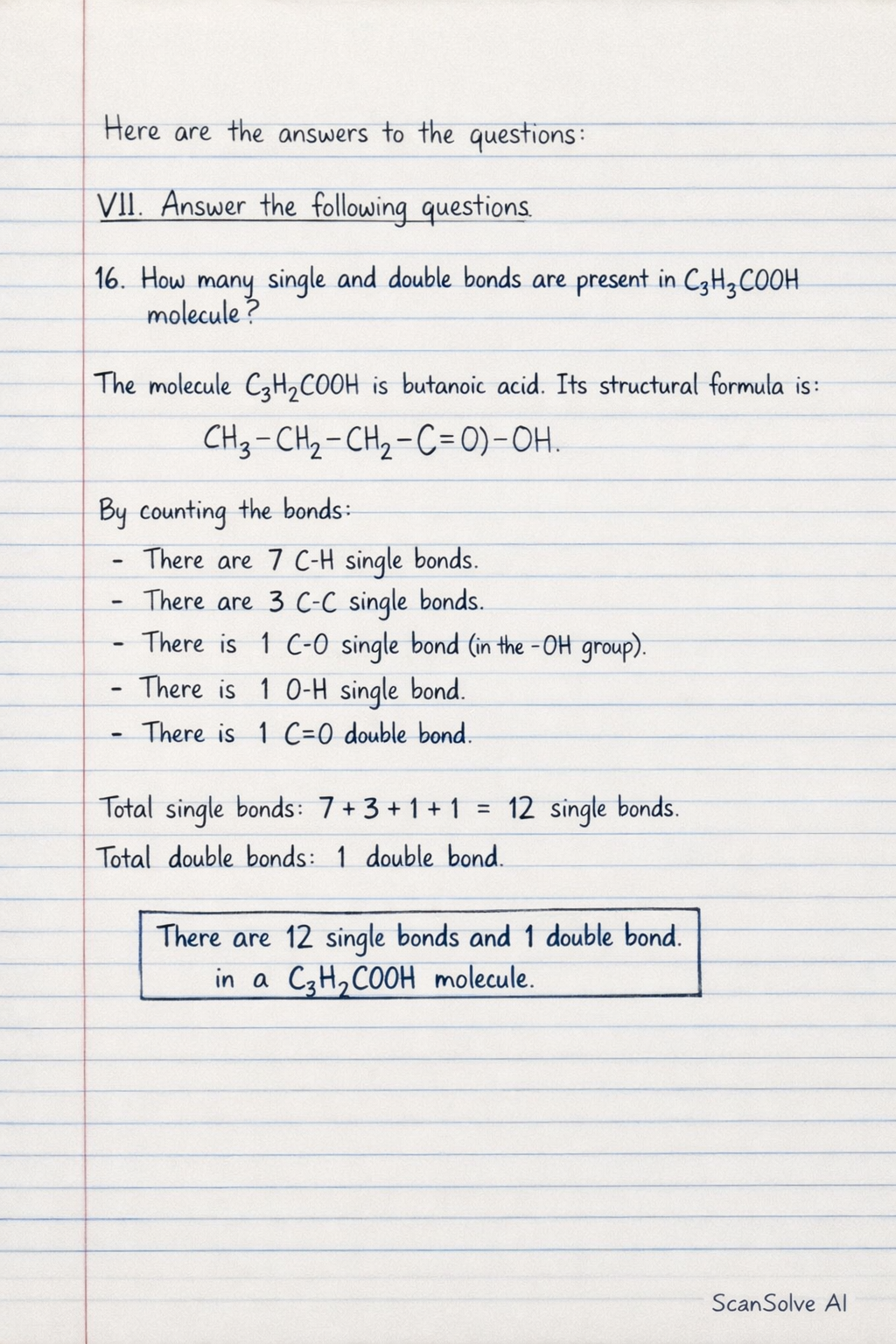
Here are the answers to the questions: VII. Answer the following questions 16. How many single and double bonds are present in C₃H₇COOH molecule? The molecule C₃H₇COOH is butanoic acid. Its structural formula is CH₃-CH₂-CH₂-C(=O)-OH. By counting the bonds: • There are 7 C-H single bonds. • There are 3 C-C single bonds. • There is 1 C-O single bond (in the -OH group). • There is 1 O-H single bond. • There is 1 C=O double bond. Total single bonds: 7 + 3 + 1 + 1 = 12 single bonds. Total double bonds: 1 double bond. There are 12 single bonds and 1 double bond in a C₃H₇COOH molecule. 17. Observe the given equation. 2Pb(NO₃)₂ → X PbO + Y NO₂ + Z O₂. Which numbers respectively will be in the positions X, Y and Z when this equation is balanced? The given unbalanced equation is: 2Pb(NO_3)_2 → X PbO + Y NO_2 + Z O_2 Step 1: Balance Lead (Pb) atoms. On the reactant side, there are 2 Pb atoms. On the product side, there are X Pb atoms. So, X = 2. The equation becomes: 2Pb(NO_3)_2 → 2PbO + Y NO_2 + Z O_2 Step 2: Balance Nitrogen (N) atoms. On the reactant side, there are 2 × 2 = 4 N atoms. On the product side, there are Y N atoms. So, Y = 4. The equation becomes: 2Pb(NO_3)_2 → 2PbO + 4NO_2 + Z O_2 Step 3: Balance Oxygen (O) atoms. On the reactant side, there are 2 × 3 × 2 = 12 O atoms. On the product side, there are (2 × 1 from PbO) + (4 × 2 from NO_2) + (2 × Z from O_2) O atoms. 12 = 2 + 8 + 2Z 12 = 10 + 2Z 2 = 2Z Z = 1 The balanced equation is: 2Pb(NO_3)_2 → 2PbO + 4NO_2 + 1O_2 The numbers in positions X, Y, and Z are X=2, Y=4, Z=1. 18. Which metal among aluminium and copper is used as reducing agent in the extraction of manganese metal? Why? Aluminium is used as a reducing agent in the extraction of manganese metal. Reason: Aluminium is more reactive than manganese. In the reactivity series, aluminium is placed above manganese, indicating its greater tendency to lose electrons and get oxidized. This strong reducing power allows aluminium to reduce manganese oxides to manganese metal. For example, 3MnO_2 + 4Al → 2Al_2O_3 + 3Mn. Copper is less reactive than manganese and thus cannot act as a reducing agent for manganese oxides. III. Answer the following questions 19. While diluting an acid, water should not be added to acid. Why? When diluting a concentrated acid, especially sulfuric acid, water should not be added directly to the acid because the reaction is highly exothermic. Adding water to acid causes the less dense water to float on top of the acid. The intense heat generated at the interface can cause the water to boil violently and instantly, turning into steam. This can lead to the acid splashing out of the container, causing severe burns and potential injury. Instead, acid should always be added slowly to water with constant stirring. 20. Write the name, molecular formula and structural formula of the compound obtained when one hydrogen atom of ethane is replaced by -CHO group. Step 1: Identify the starting compound and the replacement group. Starting compound: Ethane (C_2H_6, structural formula CH_3-CH_3). Replacement group: -CHO (aldehyde group). Step 2: Replace one hydrogen atom with the -CHO group. Replacing one H from ethane (CH_3-CH_3) with