
We read your photo as:
Determine the voltage of the electrochemical cell. Zn(s) + 2e- -> Zn E°= -0.76 V, Ni2+ (aq) + 2e- -> Ni E°= -0.25 V. State what would be observed when ethanoic acid reacts with CaCO3. Calculate the volume of oxygen required to burn completely 4 moles of C3H8 at s.t.p.
ScanSolve AI Answer
Answers
2 partsStep-by-step solution
7 stepsHere are the answers to the questions:
Part a· 3 steps
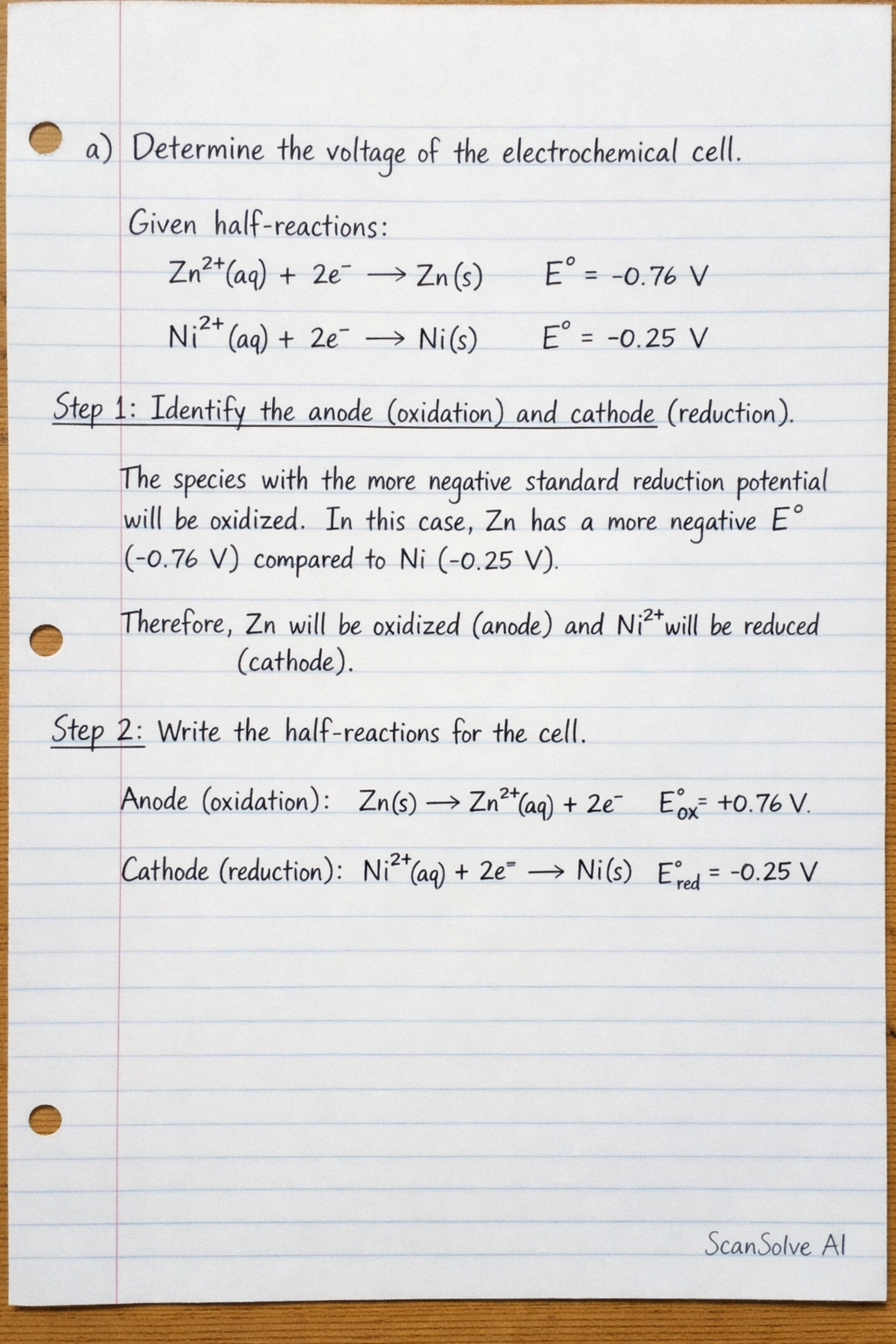
Determine the voltage of the electrochemical cell.
Given half-reactions:
Identify the anode (oxidation) and cathode (reduction).
The species with the more negative standard reduction potential will be oxidized. In this case, has a more negative () compared to ().
Therefore, will be oxidized (anode) and will be reduced (cathode).Write the half-reactions for the cell.
Anode (oxidation):
Cathode (reduction):Calculate the standard cell voltage ().
The voltage of the electrochemical cell is .
Part b
State what would be observed when ethanoic acid reacts with .
When ethanoic acid (an acid) reacts with calcium carbonate (a carbonate), carbon dioxide gas is produced.
The observation would be the effervescence or fizzing of a colourless gas.
Part c
Calculate the volume of oxygen required to burn completely of at s.t.p.
(H = 1.0, C = 12.0, O = 16.0, 1 mole of gas occupies at s.t.p.)
Write the balanced chemical equation for the complete combustion of propane ().
Determine the mole ratio between and .
From the balanced equation, of reacts with of .
Calculate the moles of required for of .
Calculate the volume of at s.t.p.
At s.t.p., of any gas occupies .
The volume of oxygen required is .
Try one yourself
A new problem that tests the same skill.
Still stuck on this one?
Ask a follow-up, and the answer starts from this question.
More Chemistry Questions
Handwritten Step-by-Step Solution
Get this as a handwritten image on WhatsApp — like a tutor wrote it for you.
Try on WhatsApp