
We read your photo as:
Calculate the voltage produced by the cell Sn(s)|Sn2+|Ag(s) at 25°C given: [Sn2+]=0.15 M [Ag+]=1.7 M
ScanSolve AI Answer
Answer
Step-by-step solution
4 stepsIdentify the half-cells and their roles.
The galvanic cell consists of a hydrogen half-cell and a magnesium half-cell. The standard reduction potential for the hydrogen half-cell (Standard Hydrogen Electrode, SHE) is defined as .
Magnesium is a more reactive metal than hydrogen, indicating it has a greater tendency to be oxidized. Therefore, the magnesium electrode will act as the anode (where oxidation occurs), and the hydrogen electrode will act as the cathode (where reduction occurs).
Write the half-reactions for the anode and cathode.
Anode (oxidation):
Cathode (reduction):
Write the overall cell reaction.
Adding the anode and cathode half-reactions:
Calculate the standard reduction potential for the magnesium half-cell.
The cell potential () is given as 2.36 V. The formula for the standard cell potential is:
Substituting the known values:
Solving for :
Still stuck on this one?
Ask a follow-up, and the answer starts from this question.
More Chemistry Questions
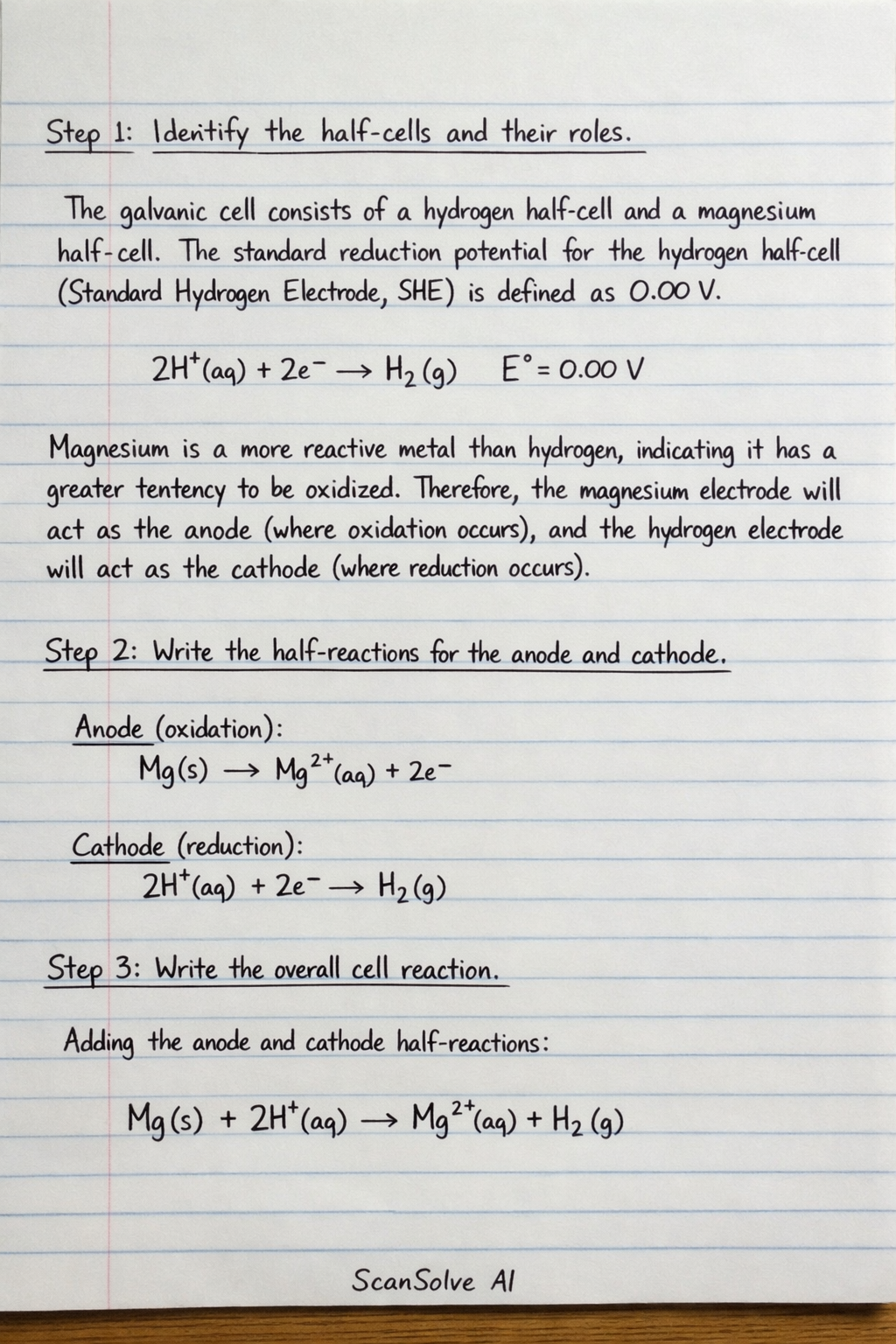
Handwritten Step-by-Step Solution
Get this as a handwritten image on WhatsApp — like a tutor wrote it for you.
Try on WhatsApp