
We read your photo as:
What volume of a molar solution of tetraoxosulphate (VI) acid would exactly neutralize 25.0cm of potassium hydroxide solution containing 21.0g of the alkali in 250cm³? (K=39, H=1,0=16).
ScanSolve AI Answer
Answer
Step-by-step solution
7 stepsTo solve this problem, we need to determine the concentration of the potassium hydroxide solution, then calculate the moles of potassium hydroxide used in the neutralization, and finally use the stoichiometry of the reaction to find the volume of sulfuric acid required.
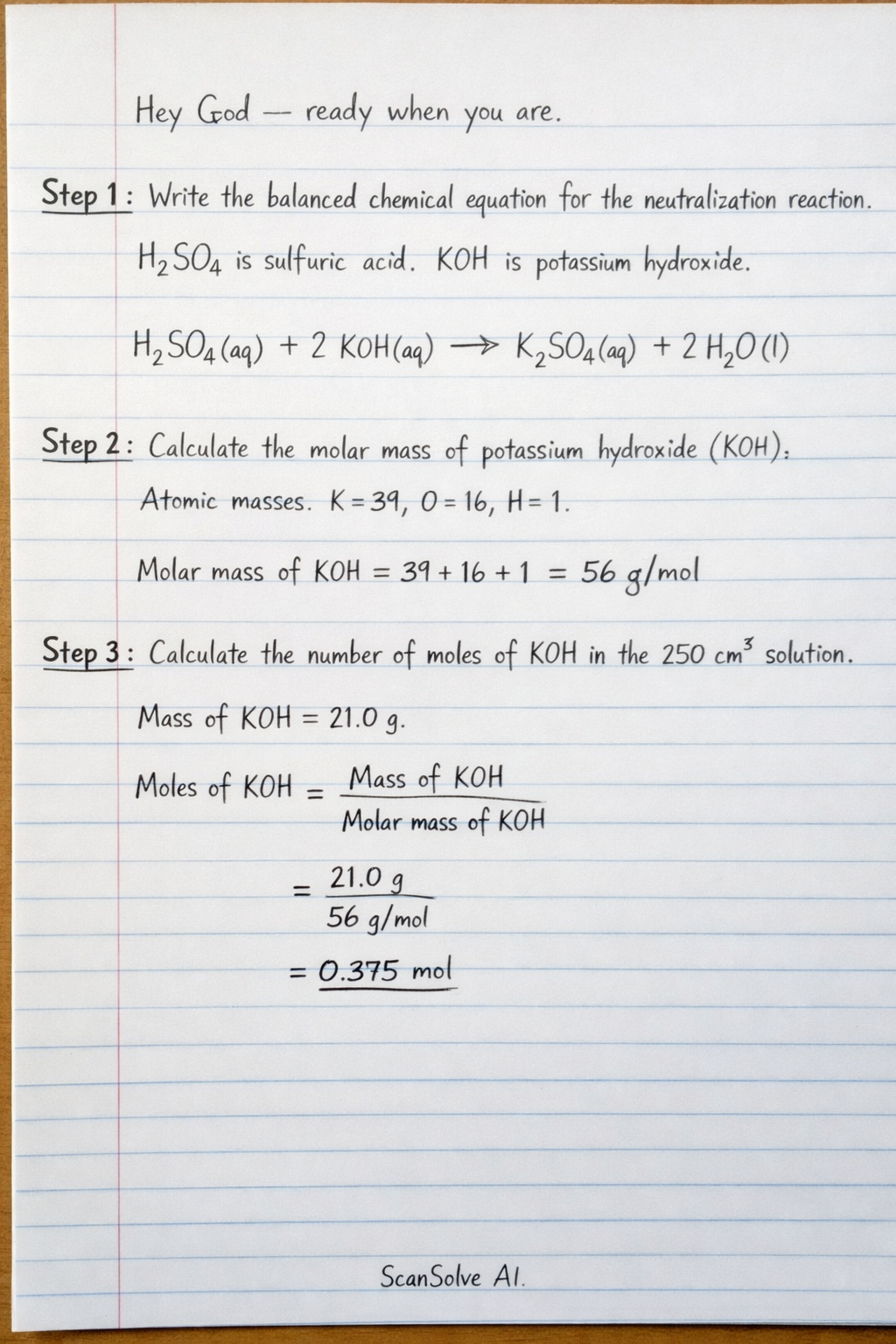
Write the balanced chemical equation for the neutralization reaction.
Tetraoxosulphate (VI) acid is . Potassium hydroxide is .
Calculate the molar mass of potassium hydroxide ().
Given atomic masses: K = 39, O = 16, H = 1.
Calculate the number of moles of in the 250 cm³ solution.
Mass of .
Calculate the concentration of the solution.
Volume of solution = 250 cm³ = 0.250 dm³.
Calculate the number of moles of used in the neutralization (25.0 cm³).
Volume of used = 25.0 cm³ = 0.025 dm³.
Determine the moles of required for neutralization.
From the balanced equation, 1 mole of reacts with 2 moles of .
Calculate the volume of the molar solution required.
A "molar solution" means the concentration is 1 mol/dm³.
Convert the volume to cm³:
The volume of a molar solution of tetraoxosulphate (VI) acid required is .
Try one yourself
A new problem that tests the same skill.
Still stuck on this one?
Ask a follow-up, and the answer starts from this question.
More Chemistry Questions
Handwritten Step-by-Step Solution
Get this as a handwritten image on WhatsApp — like a tutor wrote it for you.
Try on WhatsApp