
We read your photo as:
Calculate the volume of oxygen evolved at STP during the electrolysis of acidified water with a current of 2.5 A for 1.5 minutes.
ScanSolve AI Answer
This answer stops before the end.
It was cut off when it was first written. Ask ScanSolve this question again for the full working.
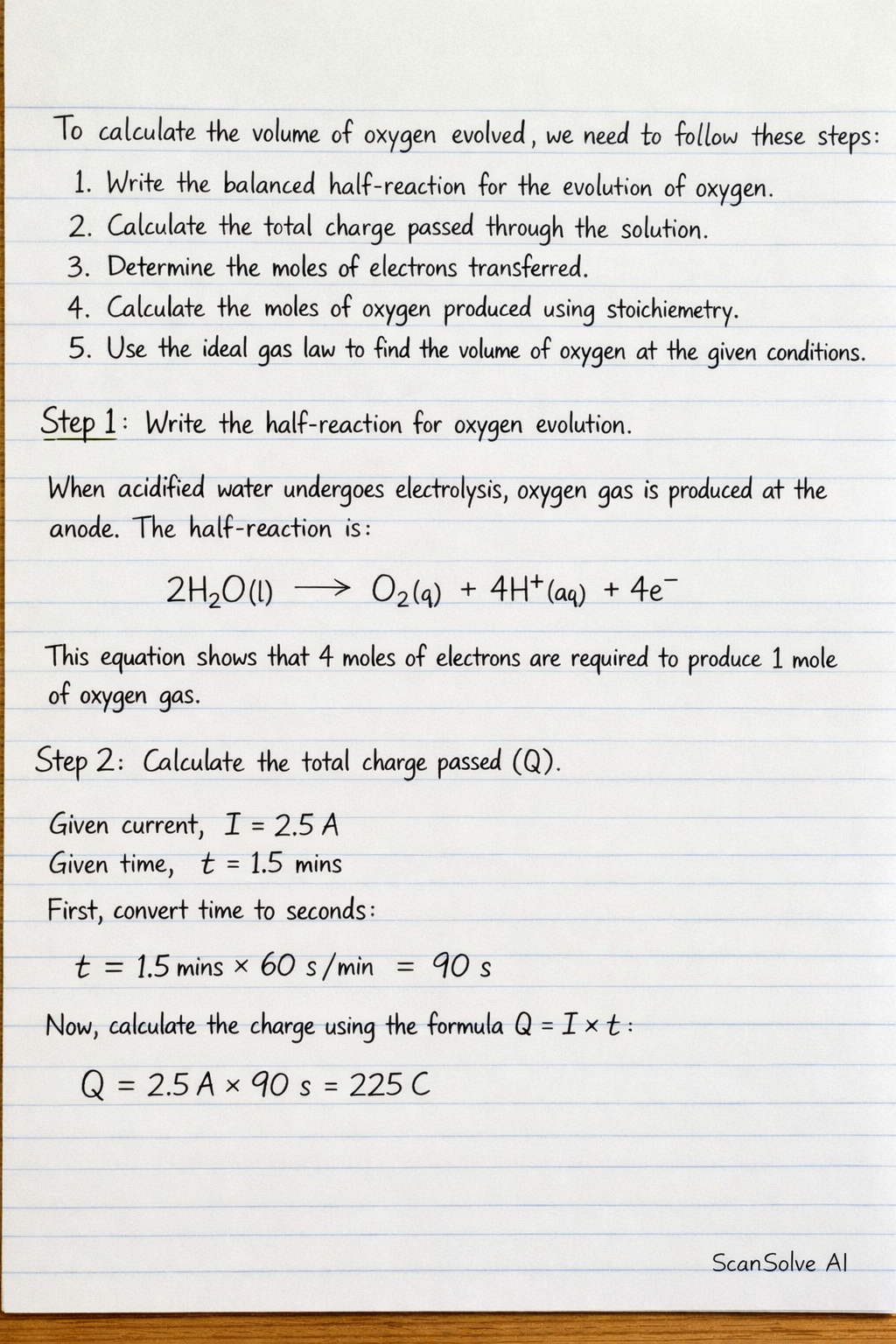
To calculate the volume of oxygen evolved, we need to follow these steps:
- Write the balanced half-reaction for the evolution of oxygen.
- Calculate the total charge passed through the solution.
- Determine the moles of electrons transferred.
- Calculate the moles of oxygen produced using stoichiometry.
- Use the ideal gas law to find the volume of oxygen at the given conditions.
Step 1: Write the half-reaction for oxygen evolution.
When acidified water undergoes electrolysis, oxygen gas is produced at the anode. The half-reaction is:
This equation shows that 4 moles of electrons are required to produce 1 mole of oxygen gas.
Step 2: Calculate the total charge passed ().
Given current,
Given time,
First, convert time to seconds:
Now, calculate the charge using the formula :
Step 3: Determine the moles of electrons transferred ().
Given Faraday's constant,
The moles of electrons transferred are:
Step 4: Calculate the moles of oxygen produced ().
From the half-reaction, 4 moles of electrons produce 1 mole of .
Step 5: Use the ideal gas law to find the volume of oxygen ().
The ideal gas law is .
We need to solve for : .
Given conditions:
Temperature,
Pressure, (which is Pascals, Pa)
Moles of ,
The ideal gas constant, (or )
Substitute the values into the ideal gas law:
Convert the volume from cubic meters to cubic centimeters:
Still stuck on this one?
Ask a follow-up, and the answer starts from this question.
More Chemistry Questions
Handwritten Step-by-Step Solution
Get this as a handwritten image on WhatsApp — like a tutor wrote it for you.
Try on WhatsApp