
We read your photo as:
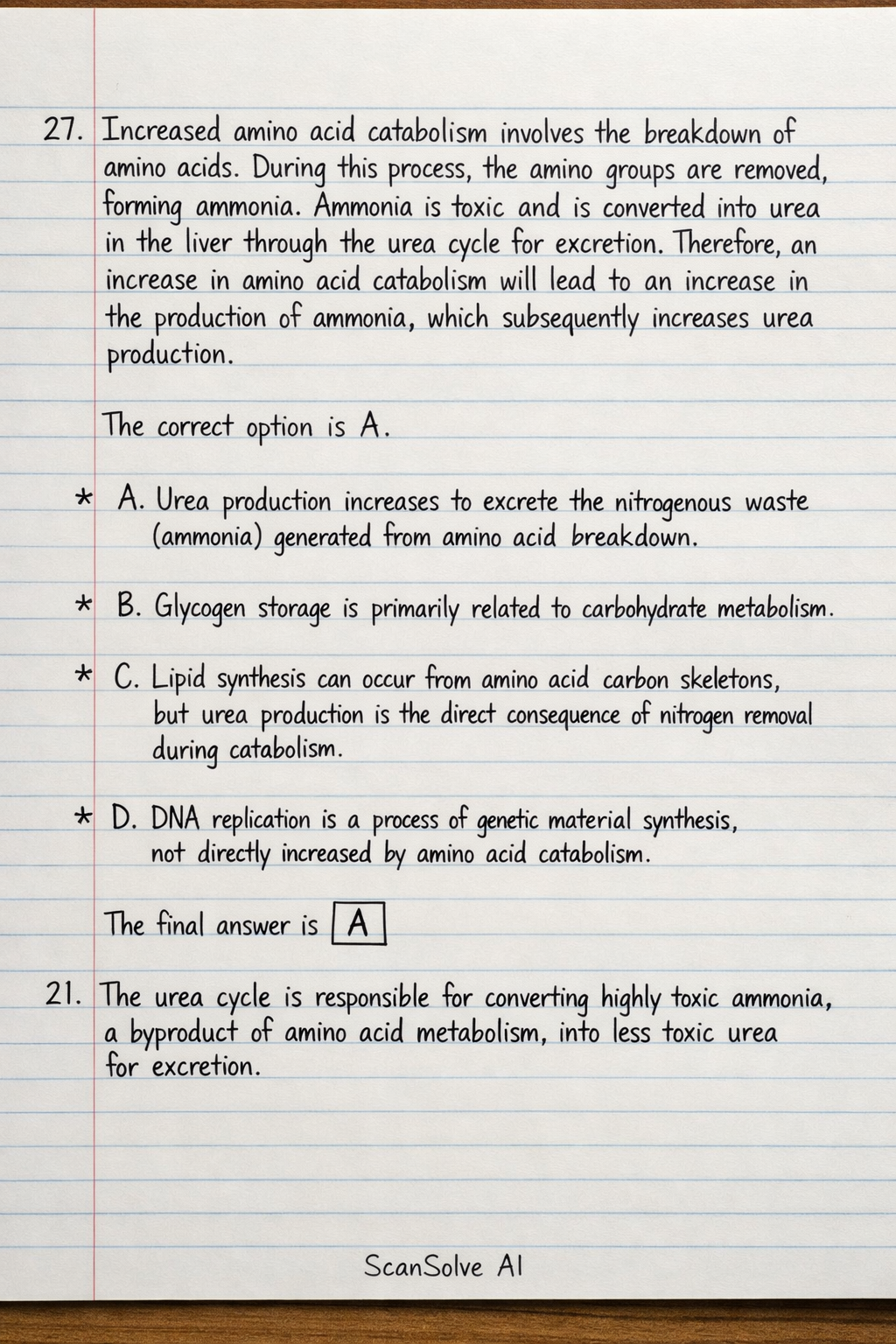
Increased amino acid catabolism involves the breakdown of amino acids. During this process, the amino groups are removed, forming ammonia. Ammonia is toxic and is converted into urea in the liver
Computer Science
ScanSolve AI Answer
Answer
A
- Increased amino acid catabolism involves the breakdown of amino acids. During this process, the amino groups are removed, forming ammonia. Ammonia is toxic and is converted into urea in the liver through the urea cycle for excretion. Therefore, an increase in amino acid catabolism will lead to an increase in the production of ammonia, which subsequently increases urea production.
The correct option is A.
- A. Urea production increases to excrete the nitrogenous waste (ammonia) generated from amino acid breakdown.
- B. Glycogen storage is primarily related to carbohydrate metabolism.
- C. Lipid synthesis can occur from amino acid carbon skeletons, but urea production is the direct consequence of nitrogen removal during catabolism.
- D. DNA replication is a process of genetic material synthesis, not directly increased by amino acid catabolism.
The final answer is
- The urea cycle is responsible for converting highly toxic ammonia, a byproduct of amino acid metabolism, into less toxic urea for excretion.
The correct option is B.
- A. Hypoglycemia is a low blood sugar condition, not the primary direct consequence of a urea cycle defect.
- B. A defect in the urea cycle means that ammonia cannot be efficiently converted to urea, leading to the accumulation of toxic nitrogen compounds (primarily ammonia) in the body.
- C. Increased lipid storage is not a direct consequence of a urea cycle defect.
- D. Reduced protein synthesis only is not the primary or most direct consequence; the immediate danger is ammonia toxicity.
The final answer is
Was this helpful?
Try one yourself
A new problem that tests the same skill.
Still stuck on this one?
Ask a follow-up, and the answer starts from this question.
Got a different question?Ask your own question
More Computer Science Questions
QThe urea cycle's main function is to convert toxic ammonia into urea for excretion. This process…QExplain the following processes: Aestivation, DeaminationQExplain the catabolism of phenylalanine to tyrosine, special products of tyrosine and tryptophan…QWrite on the essay of the following (1) Malpighian tubules (2) Nitrogenous wastes such as…QA) The main function of nitrifying bacteria is to convert ammonia (NH3) or ammonium ions (NH4^+)…
Handwritten Step-by-Step Solution
Get this as a handwritten image on WhatsApp — like a tutor wrote it for you.
Try on WhatsApp