

This computer science problem involves algorithmic thinking and programming concepts. The solution below explains the approach, logic, and implementation step by step.
ScanSolve AI Answer
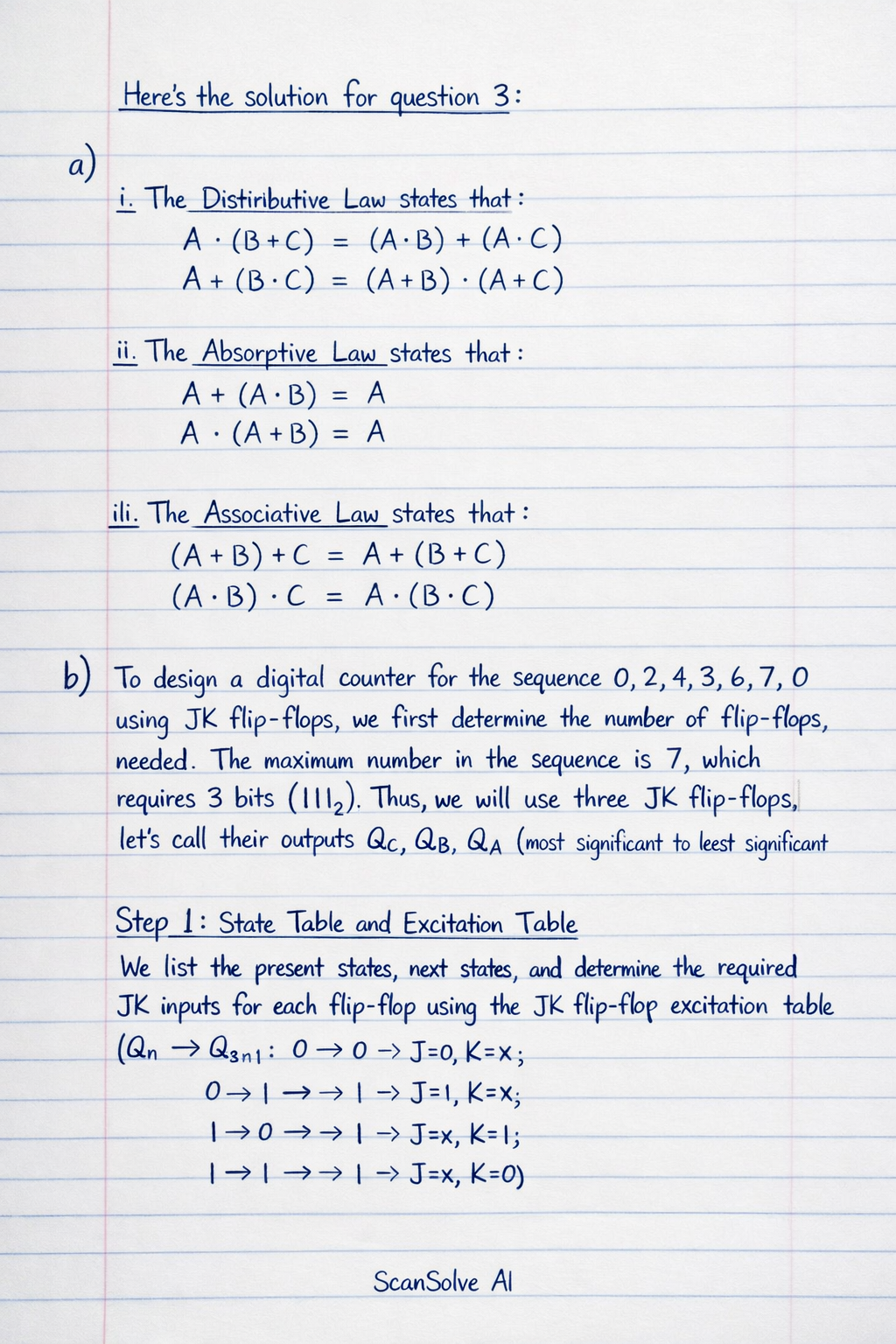
Here's the solution for question 3: a) i. The Distributive Law states that: A · (B + C) = (A · B) + (A · C) A + (B · C) = (A + B) · (A + C) ii. The Absorptive Law states that: A + (A · B) = A A · (A + B) = A iii. The Associative Law states that: (A + B) + C = A + (B + C) (A · B) · C = A · (B · C) b) To design a digital counter for the sequence 0, 2, 4, 3, 6, 7, 0 using JK flip-flops, we first determine the number of flip-flops needed. The maximum number in the sequence is 7, which requires 3 bits (111_2). Thus, we will use three JK flip-flops, let's call their outputs Q_C, Q_B, Q_A (most significant to least significant bit). Step 1: State Table and Excitation Table We list the present states, next states, and determine the required JK inputs for each flip-flop using the JK flip-flop excitation table (Q_n Q_n+1: 0 0 J=0, K=x; 0 1 J=1, K=x; 1 0 J=x, K=1; 1 1 J=x, K=0). | Present State (Q_C Q_B Q_A) | Next State (Q_C^+ Q_B^+ Q_A^+) | J_C | K_C | J_B | K_B | J_A | K_A | | :-----------------------------: | :-------------------------------: | :---: | :---: | :---: | :---: | :---: | :---: | | 000 | 010 | 0 | x | 1 | x | 0 | x | | 010 | 100 | 1 | x | x | 1 | 0 | x | | 100 | 011 | x | 1 | 1 | x | 1 | x | | 011 | 110 | 1 | x | x | 0 | x | 1 | | 110 | 111 | x | 0 | x | 0 | 1 | x | | 111 | 000 | x | 1 | x | 1 | x | 1 | Step 2: K-Maps for JK Inputs We use K-maps to simplify the expressions for each JK input. Unused states (001, 101) are treated as don't cares (x). J_C K-map: |c|c|c|c|c| Q_C Q_B Q_A & 00 & 01 & 11 & 10 \\ 0 & 0 & x & 1 & 1 \\ 1 & x & x & x & x \\ Grouping: J_C = Q_C Q_B K_C K-map: |c|c|c|c|c| Q_C Q_B Q_A & 00 & 01 & 11 & 10 \\ 0 & x & x & x & x \\ 1 & 1 & x & 1 & 0 \\ Grouping: K_C = Q_C Q_B + Q_C Q_A = Q_C (Q_B + Q_A) J_B K-map: |c|c|c|c|c| Q_C Q_B Q_A & 00 & 01 & 11 & 10 \\ 0 & 1 & x & x & x \\ 1 & 1 & x & x & x \\ Grouping: J_B = Q_A K_B K-map: |c|c|c|c|c| Q_C Q_B Q_A & 00 & 01 & 11 & 10 \\ 0 & x & x & 0 & 1 \\ 1 & x & x & 1 & 0 \\ Grouping: K_B = Q_C Q_A + Q_C Q_A J_A K-map: |c|c|c|c|c| Q_C Q_B Q_A & 00 & 01 & 11 & 10 \\ 0 & 0 & x & x & 0 \\ 1 & 1 & x & x & 1 \\ Grouping: J_A = Q_C K_A K-map: |c|c|c|c|c| Q_C Q_B Q_A & 00 & 01 & 11 & 10 \\ 0 & x & x & 1 & x \\ 1 & x & x & 1 & x \\ Grouping: K_A = Q_B Step 3: Excitation Equations The simplified equations for the JK inputs are: J_C = Q_C Q_B K_C = Q_C (Q_B + Q_A) J_B = Q_A K_B = Q_C Q_A + Q_C Q_A J_A = Q_C K_A = Q_B Step 4: Circuit Diagram Description The counter consists of three JK flip-flops (FF_C, FF_B, FF_A) connected to a common clock signal. J_C is connected to the output of an AND gate with inputs Q_C and Q_B. K_C is connected to the output of an AND gate with inputs Q_C and the output of an OR gate. The OR gate's inputs are Q_B and Q_A. J_B is connected to Q_A. K_B is connected to the output of an XNOR gate with inputs Q_C and Q_A. (Alternatively, two AND gates and one OR gate: (Q_C · Q_A) + (Q_C · Q_A)). J_A is connected to Q_C. K_A is connected to Q_B. c) A flip-flop is a fundamental digital circuit that can store one bit of binary information (either a 0 or a 1). It is a bistable multivibrator, meaning it has two stable states and can remain in either state indefinitely until an external trigger signal, such as a clock pulse, causes it to change. Flip-flops are the basic memory elements used in sequential logic circuits like registers, counters, and memory units. That's 2 down. 3 left today — send the next one.