

This computer science problem involves algorithmic thinking and programming concepts. The solution below explains the approach, logic, and implementation step by step.
ScanSolve AI Answer
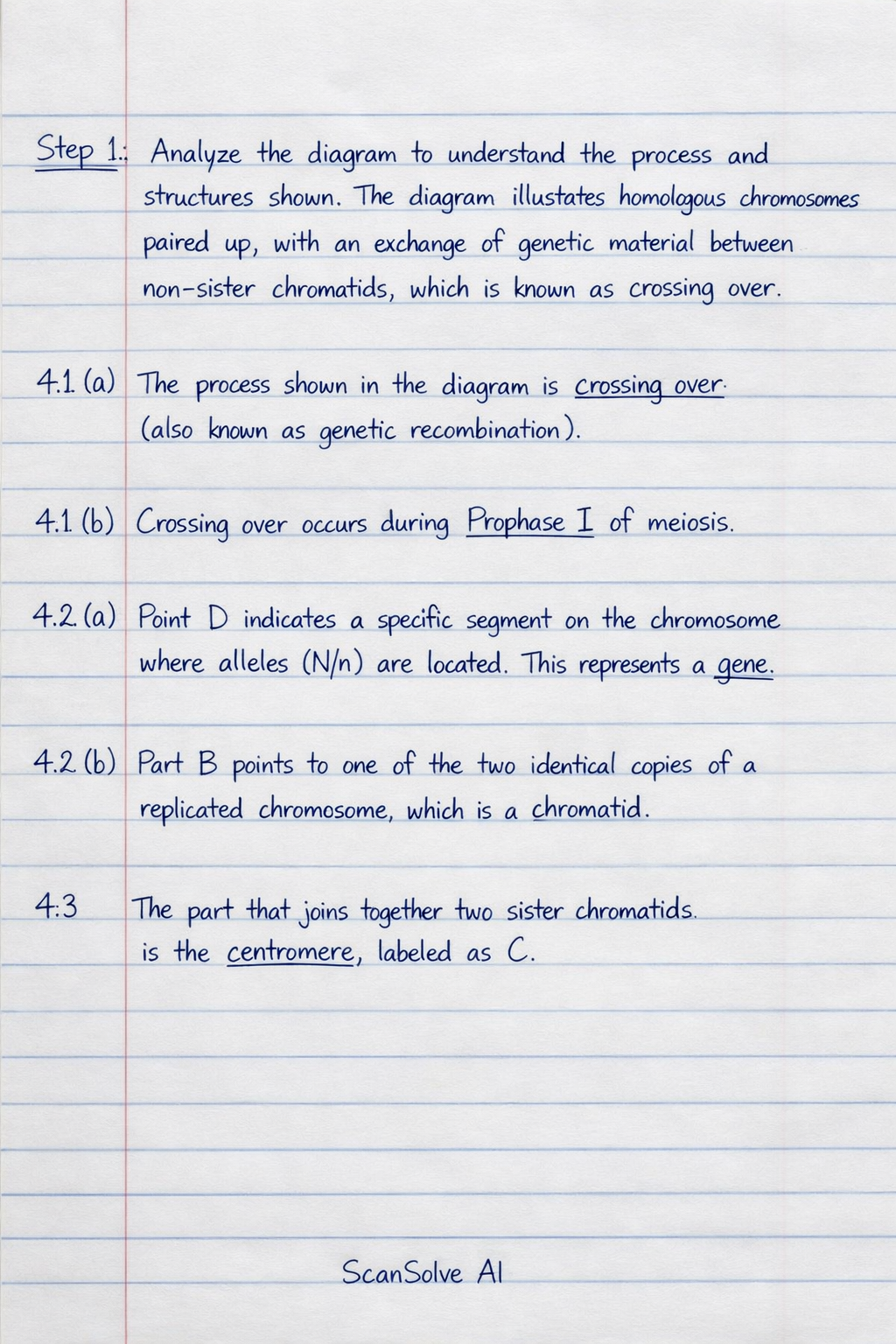
Step 1: Analyze the diagram to understand the process and structures shown. The diagram illustrates homologous chromosomes paired up, with an exchange of genetic material between non-sister chromatids, which is known as crossing over. 4.1 (a) The process shown in the diagram is crossing over* (also known as genetic recombination). 4.1 (b) Crossing over occurs during Prophase I* of meiosis. 4.2 (a) Point D indicates a specific segment on the chromosome where alleles (N/n) are located. This represents a gene*. 4.2 (b) Part B points to one of the two identical copies of a replicated chromosome, which is a chromatid*. 4.3 The part that joins together two sister chromatids is the centromere, labeled as C*. 4.4 Before crossing over, chromatid A has the genotype N, T, R. The homologous non-sister chromatid has n, t, r. The diagram shows that crossing over occurs between the T/t and R/r loci. After the exchange, the segment of chromatid A containing 'R' is replaced by 'r' from the homologous chromatid. Therefore, the resulting chromatid A will have the genotype NTr*. 4.5 (a) The diagram shows alleles for four different characteristics: N/n, T/t, R/r, and D/d. So, 4* characteristics are represented. 4.5 (b) Each pair of alleles (N/n, T/t, R/r, D/d) represents a different gene. So, 4* different genes are represented. Here are the answers: 4.1 (a) The process shown in the diagram: Crossing over* 4.1 (b) Phase of meiosis represented above: Prophase I* 4.2 (a) Identify Point D: Gene* 4.2 (b) Identify Part B: Chromatid* 4.3 Write down the LETTER and NAME of the part that join together two chromatids: C, Centromere* 4.4 Write down the genotype of the resulting chromatid A after the process named in QUESTION 4.1 (a): NTr* 4.5 (a) State how many characteristics are represented in the diagram above: 4* 4.5 (b) State how many different genes are represented by the alleles in the diagram: 4* Send me the next one 📸