
We read your photo as:
The process which involves the conversion of non-recyclable waste items into useable heat, electricity, or fuel through a variety of processes is known as?
ScanSolve AI Answer
Answer
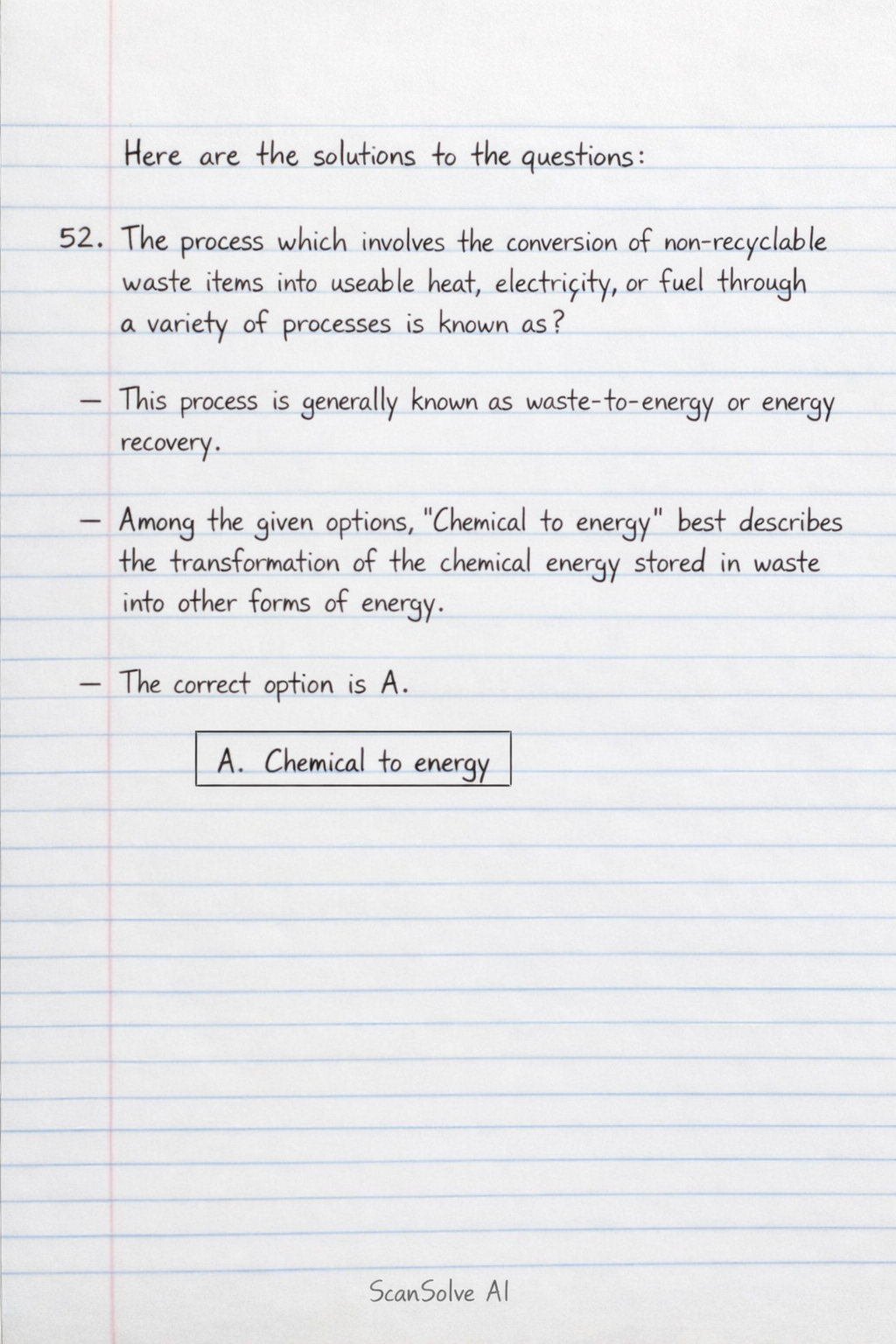
Here are the solutions to the questions:
52. The process which involves the conversion of non-recyclable waste items into useable heat, electricity, or fuel through a variety of processes is known as?
- This process is generally known as waste-to-energy or energy recovery. Among the given options, "Chemical to energy" best describes the transformation of the chemical energy stored in waste into other forms of energy.
- The correct option is A.
58. As a midwife working in a community, you have been asked to educate the community on the health benefits of recreation. Which of these will you stress on?
- I. It improves one's mental health (Correct: Recreation is known to improve mental well-being.)
- II. It improves one's self-esteem (Correct: Engaging in recreational activities can boost self-esteem.)
- III. It increases the risk of over weight (Incorrect: Recreation, especially physical activity, helps reduce the risk of overweight.)
- Therefore, statements I and II are correct.
- The correct option is B.
75. Some benefits of recreation include;
- I. It promotes boredom (Incorrect: Recreation typically alleviates boredom.)
- II. It promotes socialization (Correct: Many recreational activities involve social interaction.)
- III. It relaxes the mind (Correct: Recreation provides a break from daily stressors, promoting relaxation.)
- IV. It releases tension and stress (Correct: Recreational activities are effective stress relievers.)
- Therefore, statements II, III, and IV are correct.
- The correct option is D.
91. Which of these food preservation methods adds additional micronutrients to food to replace the lost nutrients during processing?
- Fortification is the process of adding micronutrients (like vitamins and minerals) to food to improve its nutritional value, often to replace nutrients lost during processing or to address public health deficiencies.
- The correct option is C.
92. Benefits of good habit are the following except
- A. Helps to maintain good health (Benefit)
- B. It gives social security (Benefit, e.g., through responsible actions)
- C. It gives bad perception of a person (Not a benefit; this is a negative outcome)
- D. The whole family is respected (Benefit, as good habits reflect positively on individuals and their families)
- The question asks for what is not a benefit.
- The correct option is C.
93. Which of this type of waste is generated from households, offices, hotels, shops, schools and other institutions?
- Waste generated from these sources is collectively known as municipal solid waste.
- The correct option is A.
94. Which of the following is not caused by the housefly?
- A. Trachoma (Can be mechanically transmitted by flies)
- B. Poliomyelitis (Can be mechanically transmitted by flies via fecal-oral route)
- C. Dengue fever (Transmitted by Aedes mosquitoes, not houseflies)
- D. Viral hepatitis (Some types, like Hepatitis A and E, can be mechanically transmitted by flies via fecal-oral route)
- The correct option is C.
95. Which of the following conditions is not suitable for a controlled method of excreta or sewage disposal?
- A. It does not give odour (Suitable condition)
- B. It is not exposed to the atmosphere (Suitable condition for hygiene)
- C. It should be accessible for children (Unsuitable condition; accessibility to children is dangerous and unhygienic)
- D. The waste does not pollute the ground surface (Suitable condition)
- The question asks for what is not suitable.
- The correct option is C.
96. The unpleasant odour that is exhaled as a result of poor oral care is called?
- Halitosis is the medical term for bad breath, often resulting from poor oral hygiene.
- The correct option is A.
97. In habit formation the activity that triggers the habitual behaviour is said to be...
- In habit formation, the trigger that prompts a habitual behavior is known as a context cue or simply a cue.
- The correct option is B.
98. The role of the community in health promotion practices can be achieved through which of the following means?
- I. Collaboration (Essential for collective action)
- II. Advocacy (For policy changes and awareness)
- III. Support (Providing resources and encouragement)
- IV. Self Help Initiatives (Empowering individuals and groups)
- All listed means are crucial for community involvement in health promotion.
- The correct option is A.
99. Which of the following is not a critical factor in the growth of dangerous food-borne bacteria?
- A. Moisture (Critical factor)
- B. Altitude (Not a direct critical factor for bacterial growth, though it can affect cooking)
- C. Temperature (Critical factor)
- D. Time (Critical factor)
- Factors like Food, Acidity, Temperature, Time, Oxygen, and Moisture (FATTOM) are critical for bacterial growth. Altitude is not one of them.
- The correct option is B.
100. Which of these signs is not an indication that food is unwholesome for consumption?
- A. Change in colour from the initial colour (Indication of spoilage)
- B. Foul smell (Indication of spoilage)
- C. Formation of mould (Indication of spoilage)
- D. Good flavour (Indication that food is likely wholesome and safe to eat)
- The question asks for what is not an indication of unwholesome food.
- The correct option is D.
Try one yourself
A new problem that tests the same skill.
Still stuck on this one?
Ask a follow-up, and the answer starts from this question.
More Computer Science Questions
Handwritten Step-by-Step Solution
Get this as a handwritten image on WhatsApp — like a tutor wrote it for you.
Try on WhatsApp