
This computer science problem involves algorithmic thinking and programming concepts. The solution below explains the approach, logic, and implementation step by step.
ScanSolve AI Answer
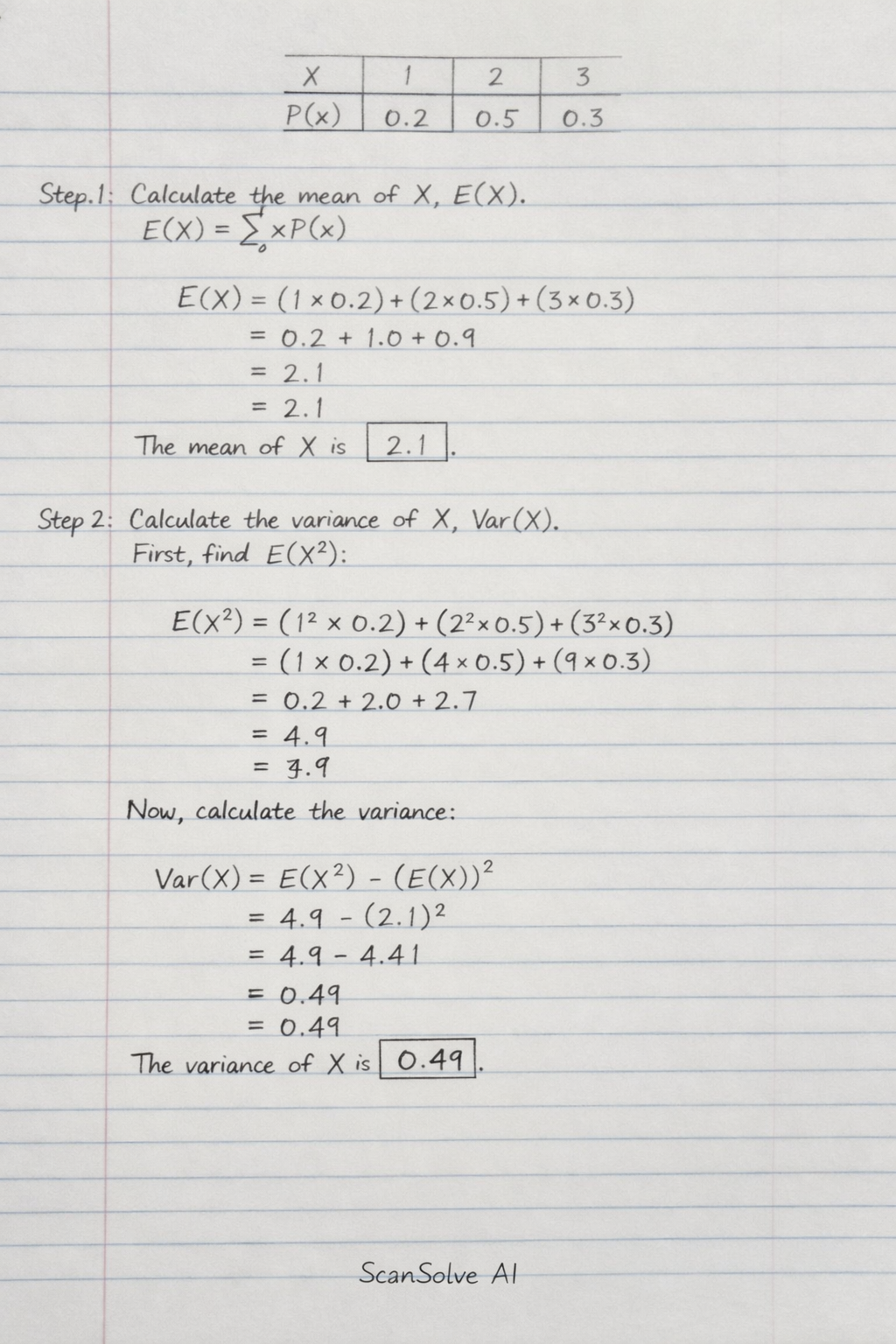
The discrete random variable X has the following probability distribution: |c|c|c|c| X & 1 & 2 & 3 \\ P(x) & 0.2 & 0.5 & 0.3 \\ Step 1: Calculate the mean of X, E(X). The mean of a discrete random variable is given by E(X) = x · P(x). E(X) &= (1 × 0.2) + (2 × 0.5) + (3 × 0.3) \\ &= 0.2 + 1.0 + 0.9 \\ &= 2.1 The mean of X is 2.1. Step 2: Calculate the variance of X, Var(X). First, we need to calculate E(X^2) = x^2 · P(x). E(X^2) &= (1^2 × 0.2) + (2^2 × 0.5) + (3^2 × 0.3) \\ &= (1 × 0.2) + (4 × 0.5) + (9 × 0.3) \\ &= 0.2 + 2.0 + 2.7 \\ &= 4.9 Now, we can calculate the variance using the formula Var(X) = E(X^2) - (E(X))^2. Var(X) &= 4.9 - (2.1)^2 \\ &= 4.9 - 4.41 \\ &= 0.49 The variance of X is 0.49. Step 3: Calculate the mean of g(X) = X^2. The mean of g(X) = X^2 is E(X^2), which we already calculated in Step 2. E(X^2) = 4.9 The mean of g(X) = X^2 is 4.9. Step 4: Calculate the variance of g(X) = X^2. To find Var(X^2), we need E((X^2)^2) = E(X^4). E(X^4) &= (1^4 × 0.2) + (2^4 × 0.5) + (3^4 × 0.3) \\ &= (1 × 0.2) + (16 × 0.5) + (81 × 0.3) \\ &= 0.2 + 8.0 + 24.3 \\ &= 32.5 Now, we can calculate Var(X^2) = E(X^4) - (E(X^2))^2. Var(X^2) &= 32.5 - (4.9)^2 \\ &= 32.5 - 24.01 \\ &= 8.49 The variance of g(X) = X^2 is 8.49. Step 5: Calculate the mean of the linear function g(X) = 2X+1. Using the property E(aX+b) = aE(X)+b: E(2X+1) &= 2E(X) + 1 \\ &= 2(2.1) + 1 \\ &= 4.2 + 1 \\ &= 5.2 The mean of g(X) = 2X+1 is 5.2. Step 6: Calculate the variance of the linear function g(X) = 2X+1. Using the property Var(aX+b) = a^2 Var(X): Var(2X+1) &= 2^2 Var(X) \\ &= 4 × 0.49 \\ &= 1.96 The variance of g(X) = 2X+1 is 1.96. That's 2 down. 3 left today — send the next one.