
We read your photo as:
A) Identify four ICT devices that can be used in the clinic. For each, state one function.
ScanSolve AI Answer
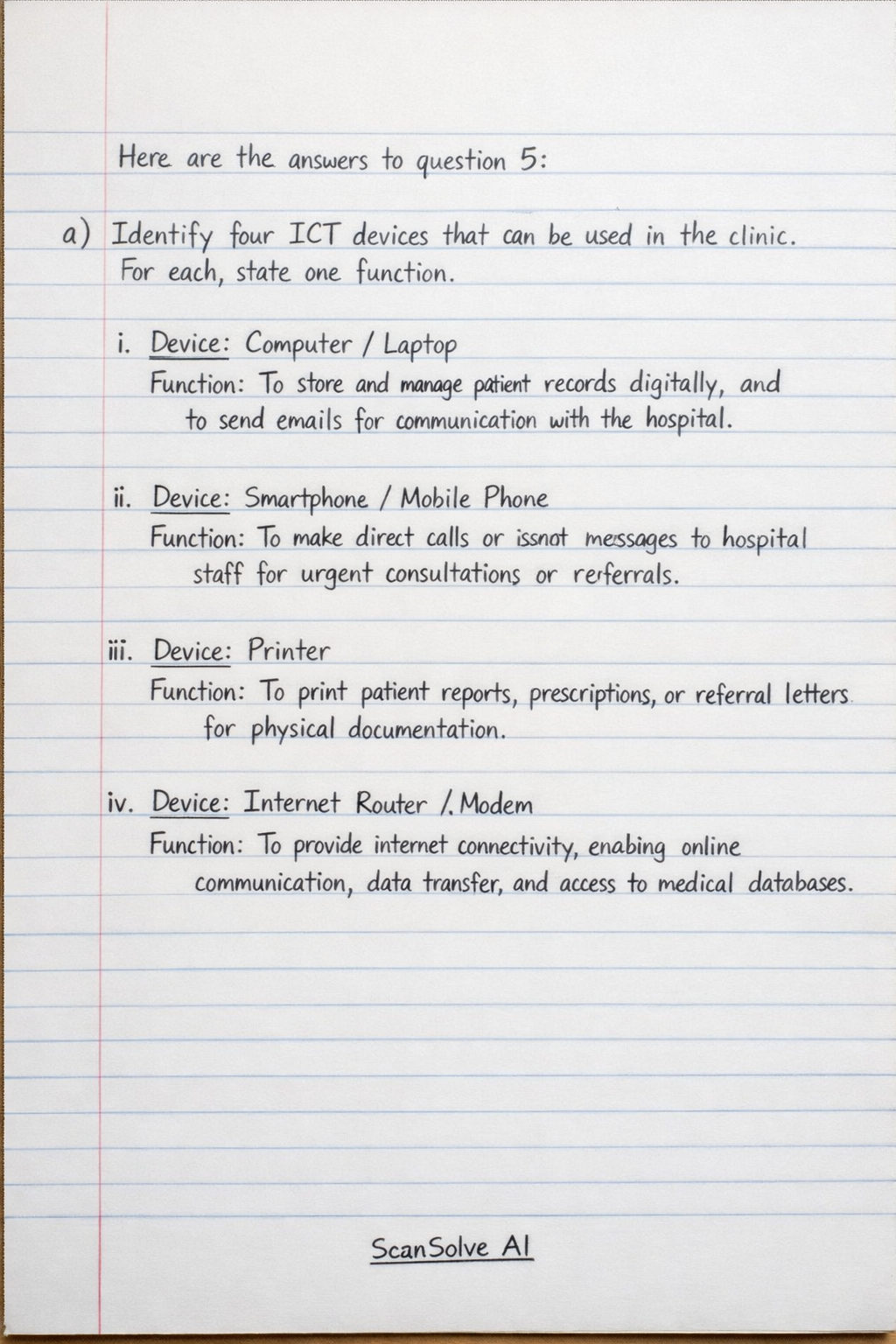
Here are the answers to question 5:
a) Identify four ICT devices that can be used in the clinic. For each, state one function.
i. Device: Computer/Laptop
Function: To store and manage patient records digitally, and to send emails for communication with the hospital.
ii. Device: Smartphone/Mobile Phone
Function: To make direct calls or send instant messages to hospital staff for urgent consultations or referrals.
iii. Device: Printer
Function: To print patient reports, prescriptions, or referral letters for physical documentation.
iv. Device: Internet Router/Modem
Function: To provide internet connectivity, enabling online communication, data transfer, and access to medical databases.
b) Explain three ways ICT can solve community problems like slow healthcare delivery.
i. Telemedicine and Remote Consultations: ICT enables doctors to conduct virtual consultations with patients in remote areas via video calls, reducing the need for travel and speeding up access to medical advice and diagnosis.
ii. Electronic Health Records (EHR): Digital patient records can be instantly shared between clinics and hospitals, allowing healthcare providers to quickly access a patient's medical history, test results, and treatment plans, which accelerates decision-making and treatment.
iii. Health Information Dissemination: ICT platforms like social media, SMS, and dedicated health apps can be used to rapidly disseminate crucial health information, public health alerts, and preventative care tips to a wide community, empowering individuals to manage their health better and reducing the burden on physical clinics.
c) State one advantage and one disadvantage of using smartphones for health communication.
Advantage: Accessibility and Speed: Smartphones allow for immediate communication (calls, messages) between patients and healthcare providers or between different healthcare facilities, which is crucial for urgent health queries or emergencies, and can be done from almost anywhere.
Disadvantage: Privacy and Security Risks: Sharing sensitive health information via smartphones can pose significant privacy and security risks if the devices or communication channels are not adequately encrypted or protected, potentially leading to data breaches.
Still stuck on this one?
Ask a follow-up, and the answer starts from this question.
More Computer Science Questions
Handwritten Step-by-Step Solution
Get this as a handwritten image on WhatsApp — like a tutor wrote it for you.
Try on WhatsApp