

This computer science problem involves algorithmic thinking and programming concepts. The solution below explains the approach, logic, and implementation step by step.
ScanSolve AI Answer
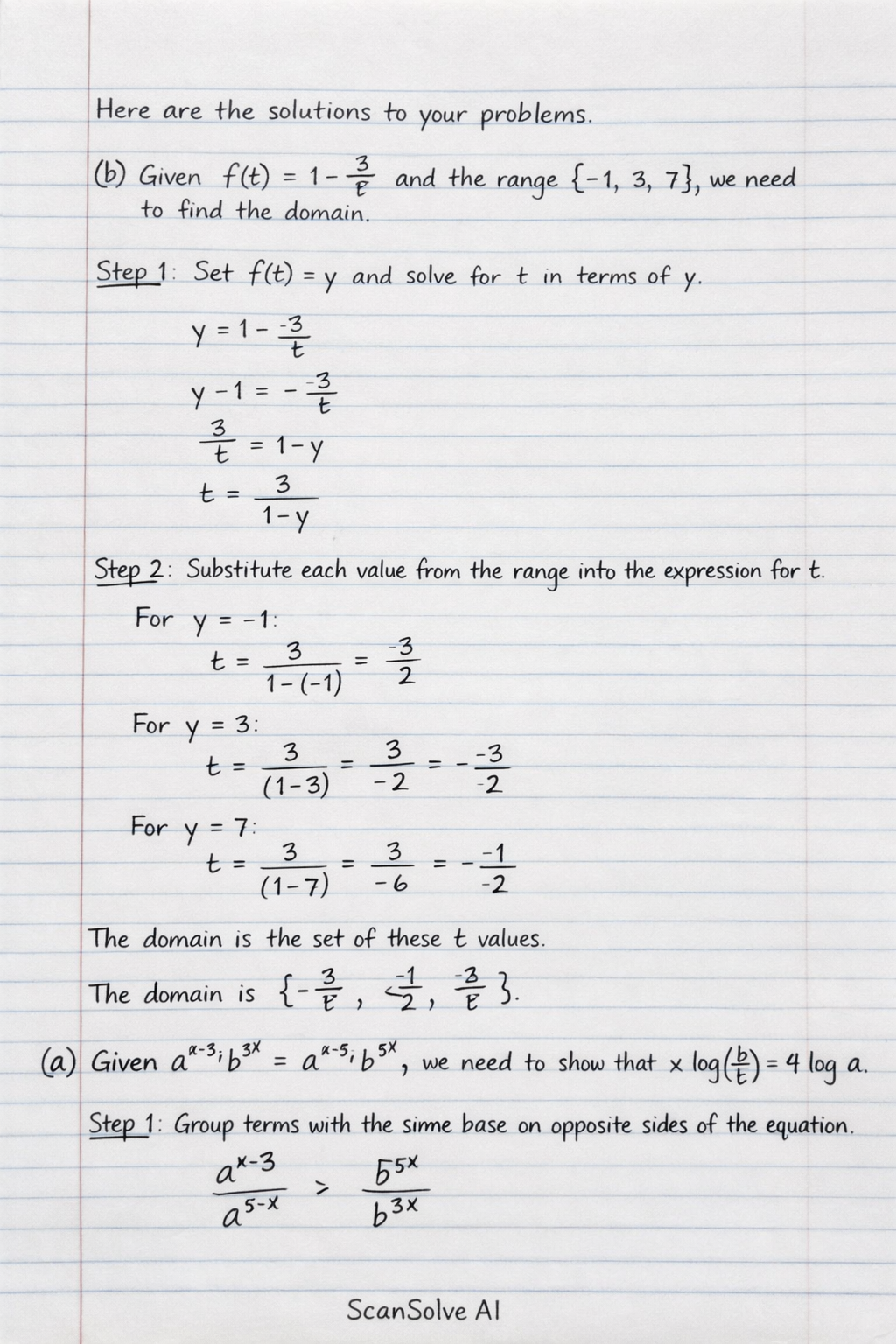
Here are the solutions to your problems. b) Given the function f(t) = 1 - (3)/(t) and the range \-1, 3, 7\, we need to find the domain. The range consists of the output values of f(t). We set f(t) equal to each value in the range and solve for t. Step 1: Set f(t) = y and solve for t in terms of y. y = 1 - (3)/(t) y - 1 = -(3)/(t) (3)/(t) = 1 - y t = (3)/(1 - y) Step 2: Substitute each value from the range into the expression for t. For y = -1: t = (3)/(1 - (-1)) = (3)/(1 + 1) = (3)/(2) For y = 3: t = (3)/(1 - 3) = (3)/(-2) = -(3)/(2) For y = 7: t = (3)/(1 - 7) = (3)/(-6) = -(1)/(2) The domain is the set of these t values. The domain is \-(3)/(2), -(1)/(2), (3)/(2)\. a) Given a^x-3b^3x = a^5-xb^5x, we need to show that x ((a)/(b)) = 4 a. Step 1: Group terms with the same base on opposite sides of the equation. a^x-3a^5-x = b^5xb^3x Step 2: Apply the exponent rule (m^p)/(m^q) = m^p-q. a^(x-3) - (5-x) = b^5x - 3x a^x-3-5+x = b^2x a^2x-8 = b^2x Step 3: Take the logarithm of both sides. (a^2x-8) = (b^2x) Step 4: Apply the logarithm rule (M^p) = p M. (2x-8) a = 2x b Step 5: Distribute and rearrange the terms to isolate x. 2x a - 8 a = 2x b 2x a - 2x b = 8 a Step 6: Factor out 2x from the left side. 2x ( a - b) = 8 a Step 7: Apply the logarithm rule M - N = ((M)/(N)). 2x ((a)/(b)) = 8 a Step 8: Divide both sides by 2. x ((a)/(b)) = 4 a This completes the proof.