
We read your photo as:
Two generators in parallel are sharing load on the busbar, if one of the generators dropping power to the other, explain possible causes and how to restore stable Para operation. (18MKS) Explain with a simple sketch, an earth fault lamp system (7 MKS)
ScanSolve AI Answer
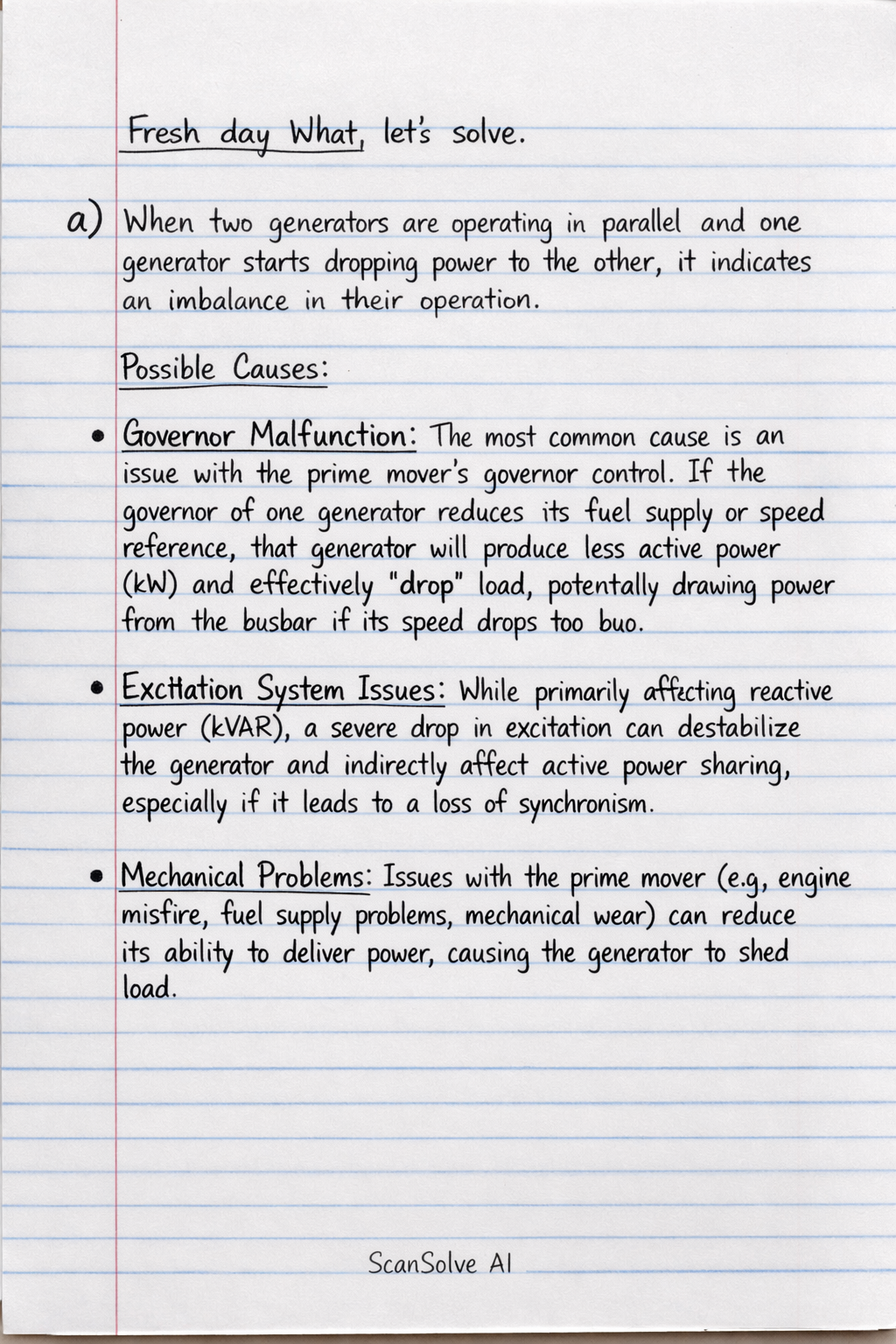
a) When two generators are operating in parallel and one generator starts dropping power to the other, it indicates an imbalance in their operation.
Possible Causes:
- Governor Malfunction: The most common cause is an issue with the prime mover's governor control. If the governor of one generator reduces its fuel supply or speed reference, that generator will produce less active power (kW) and effectively "drop" load, potentially drawing power from the busbar if its speed drops too low.
- Excitation System Issues: While primarily affecting reactive power (kVAR), a severe drop in excitation can destabilize the generator and indirectly affect active power sharing, especially if it leads to a loss of synchronism.
- Mechanical Problems: Issues with the prime mover (e.g., engine misfire, fuel supply problems, mechanical wear) can reduce its ability to deliver power, causing the generator to shed load.
- Electrical Faults: Internal faults within the generator windings or associated circuitry can cause it to cease contributing power or even act as a motor.
- Incorrect Droop Settings: If the governor droop characteristics are not correctly matched between the parallel generators, one may take more or less load than intended for a given frequency change.
How to Restore Stable Parallel Operation:
- Adjust Governor Settings: To restore active power sharing, increase the speed reference or fuel input to the generator that is dropping power. This will cause it to take on more load. Conversely, decrease the speed reference of the generator that is taking too much load.
- Check Excitation/AVR: Ensure the Automatic Voltage Regulators (AVRs) are functioning correctly and that excitation levels are balanced to maintain stable reactive power sharing and busbar voltage. Adjust excitation if necessary.
- Inspect Prime Mover: Investigate and rectify any mechanical issues with the prime mover, such as fuel system problems or engine malfunctions.
- Isolate and Repair: If a severe electrical fault or mechanical failure is suspected, the affected generator should be isolated from the busbar, shut down, and repaired before attempting to parallel it again.
- Verify Synchronization: Ensure that the generators remain in synchronism. If synchronism is lost, the faulty generator must be disconnected immediately.
b) An earth fault lamp system is a simple method used to detect an earth fault in an ungrounded (isolated) three-phase AC system. It typically consists of three incandescent lamps connected in a star configuration, with their common point connected to the earth. Each lamp is connected between a phase line and the common earth point.
Explanation:
In normal operation, with no earth fault, the system is balanced. Each lamp is connected between a phase and earth, and since the system is ungrounded, the earth potential is floating. The lamps will glow dimly and equally because they are effectively connected across the phase-to-neutral voltage (or a balanced fraction of the line voltage).
When an earth fault occurs on one phase (e.g., Phase A), that phase becomes directly connected to earth. This causes the voltage of Phase A with respect to earth to drop to zero. Consequently, the lamp connected to Phase A will go out or dim significantly. The other two lamps (connected to Phase B and Phase C) will then glow brighter because they now effectively see a higher voltage across them (closer to the line-to-line voltage, or the full phase voltage to earth through the fault). This change in brightness indicates which phase has the earth fault.
Simple Sketch:
\begin{tikzpicture}[scale=0.8]
    % Phases
    \draw (0,3) -- (1,3) node[left] {Phase A};
    \draw (0,1.5) -- (1,1.5) node[left] {Phase B};
    \draw (0,0) -- (1,0) node[left] {Phase C};

    % Lamps
    \draw (1,3) -- (2,3) node[lamp, draw, fill=yellow!20, minimum width=0.8cm, minimum height=0.4cm] (L1) {};
    \draw (1,1.5) -- (2,1.5) node[lamp, draw, fill=yellow!20, minimum width=0.8cm, minimum height=0.4cm] (L2) {};
    \draw (1,0) -- (2,0) node[lamp, draw, fill=yellow!20, minimum width=0.8cm, minimum height=0.4cm] (L3) {};

    % Common point and Earth
    \draw (L1.east) -- (3,1.5);
    \draw (L2.east) -- (3,1.5);
    \draw (L3.east) -- (3,1.5);
    \draw (3,1.5) -- (3,-1) node[ground] {};

    % Labels for normal operation
    \node at (L1.north) {\tiny Dimly Lit};
    \node at (L2.north) {\tiny Dimly Lit};
    \node at (L3.north) {\tiny Dimly Lit};
    \node at (4.5, 2.5) {Normal Operation};

    % Earth Fault Condition
    \draw[dashed, red, thick] (0,3) -- (0,-2) node[ground] {};
    \node[red] at (0.5,-1.5) {Earth Fault on Phase A};

    % Labels for fault condition
    \node[red] at (L1.north) {\tiny OFF};
    \node[red] at (L2.north) {\tiny Brighter};
    \node[red] at (L3.north) {\tiny Brighter};
    \node[red] at (4.5, 0.5) {Fault Condition};

\end{tikzpicture}
In the sketch, under normal operation, all three lamps (L1, L2, L3) glow dimly. If an earth fault occurs on Phase A (indicated by the dashed red line), lamp L1 will go out, while lamps L2 and L3 will glow brighter, signaling the fault.
Still stuck on this one?
Ask a follow-up, and the answer starts from this question.
More Computer Science Questions
Handwritten Step-by-Step Solution
Get this as a handwritten image on WhatsApp — like a tutor wrote it for you.
Try on WhatsApp