
We read your photo as:
If the following statements and expressions are typed in the Command Window, what MATLAB will produce >> pvec = 3:2:10, >> pvec(2) = 15, >> pvec(7) = 33, >> pvec([2:4 7]), >> linspace(5,11,3), >> logspace(2,4,3)?
ScanSolve AI Answer
Step-by-step solution
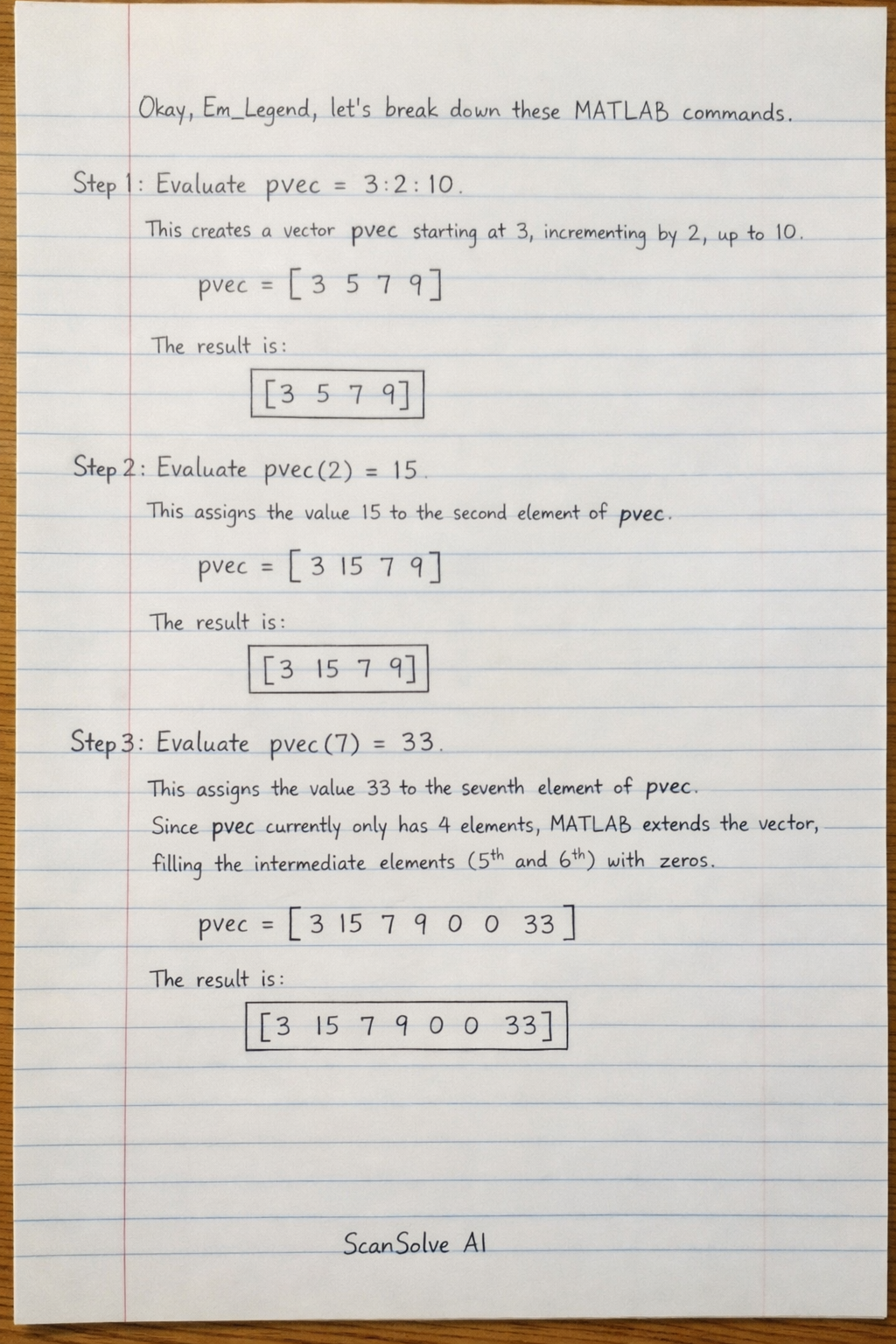
6 stepsOkay, Em_Legend, let's break down these MATLAB commands.
Evaluate
pvec = 3:2:10.This creates a vector
pvecstarting at 3, incrementing by 2, up to 10.The result is:
Evaluate
pvec(2) = 15.This assigns the value 15 to the second element of
pvec.The result is:
Evaluate
pvec(7) = 33.This assigns the value 33 to the seventh element of
pvec. Sincepveccurrently only has 4 elements, MATLAB extends the vector, filling the intermediate elements (5th and 6th) with zeros.The result is:
Evaluate
pvec([2:4 7]).This extracts elements from
pvecat indices 2, 3, 4, and 7.The result is:
Evaluate
linspace(5,11,3).This generates 3 linearly spaced points between 5 and 11.
The points are calculated as 5, , 11.The result is:
Evaluate
logspace(2,4,3).This generates 3 logarithmically spaced points between and .
The exponents are linearly spaced between 2 and 4.
The exponents are 2, , 4, which are .
The points are , , .The result is:
Still stuck on this one?
Ask a follow-up, and the answer starts from this question.
More Computer Science Questions
Handwritten Step-by-Step Solution
Get this as a handwritten image on WhatsApp — like a tutor wrote it for you.
Try on WhatsApp