
We read your photo as:
What do you understand by unary and binary operators? (b) What results will MATLAB produce on the Command Window if the following are typed >>-52, >>(-5)2, >>10-6/2, >>5*4/2+3?
ScanSolve AI Answer
Step-by-step solution
5 stepsPart a
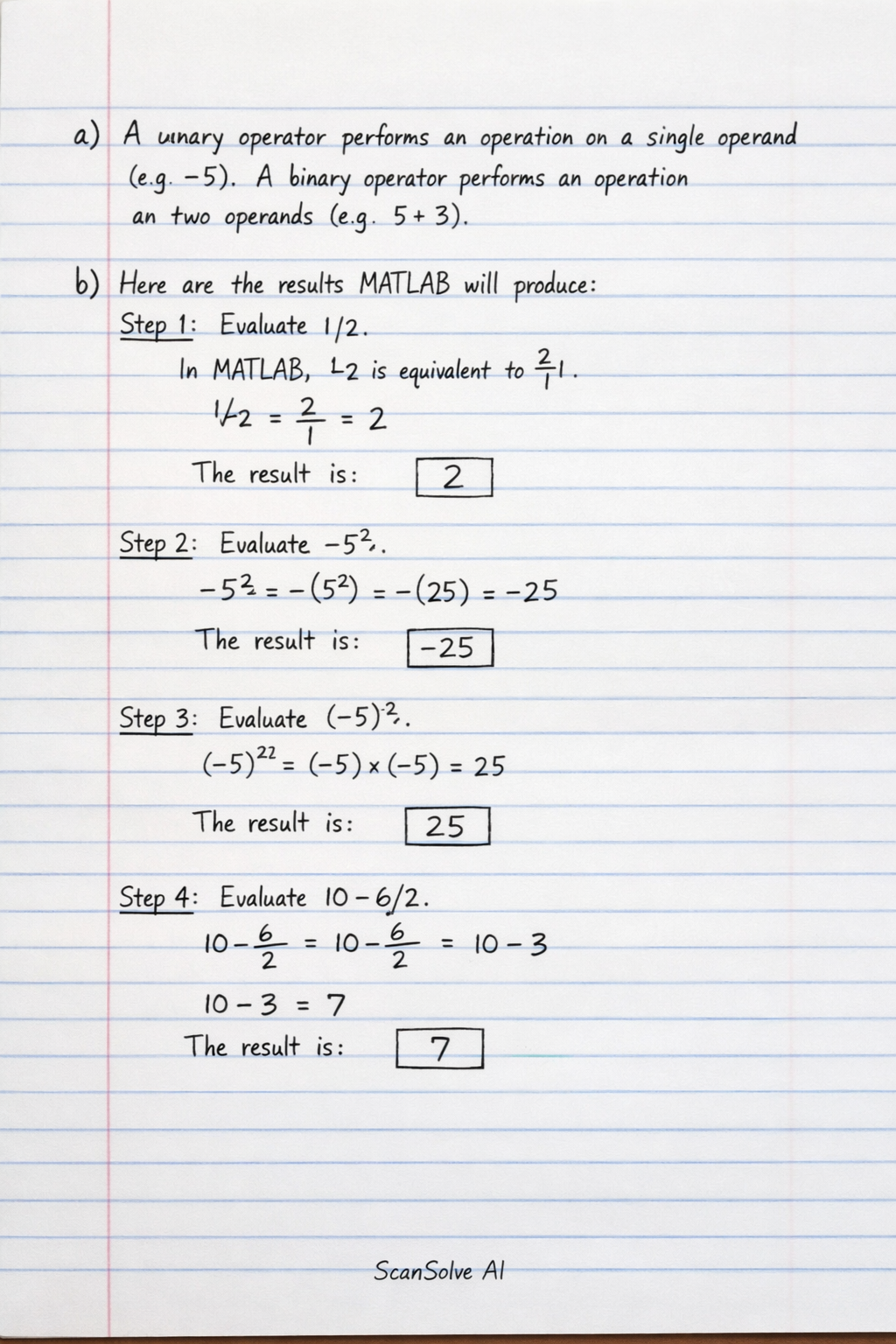
A unary operator performs an operation on a single operand (e.g., negation -5). A binary operator performs an operation on two operands (e.g., addition 5 + 3).
Part b· 5 steps
Here are the results MATLAB will produce
Evaluate
1\2.In MATLAB,
a\bis equivalent tob/a.1\verb|\2 = \frac{2}{1} = 2The result is:
Evaluate
-5^2.MATLAB follows the order of operations (PEMDAS/BODMAS). Exponentiation
^has higher precedence than unary negation-. So, is calculated first, then the negation is applied.The result is:
Evaluate
(-5)^2.Parentheses change the order of operations. Here, the negation is applied to 5 first, then the result is squared.
The result is:
Evaluate
10-6/2.Division
/has higher precedence than subtraction-.The result is:
Evaluate
5*4/2+3.Multiplication
*and division/have the same precedence and are evaluated from left to right. Addition+has lower precedence.The result is:
Still stuck on this one?
Ask a follow-up, and the answer starts from this question.
More Computer Science Questions
Handwritten Step-by-Step Solution
Get this as a handwritten image on WhatsApp — like a tutor wrote it for you.
Try on WhatsApp