

This computer science problem involves algorithmic thinking and programming concepts. The solution below explains the approach, logic, and implementation step by step.
ScanSolve AI Answer
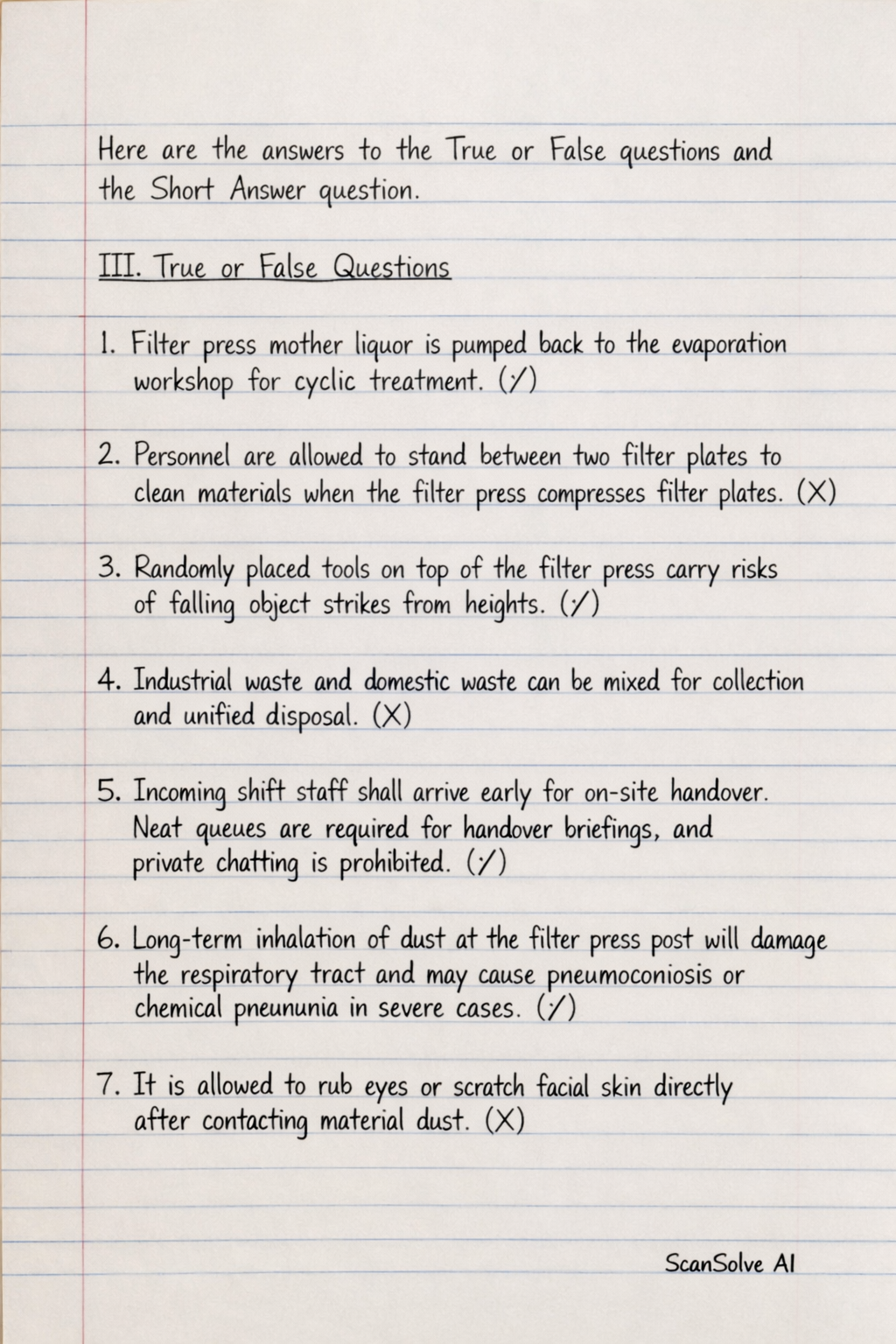
Here are the answers to the True or False questions and the Short Answer question. III. True or False Questions 1. Filter press mother liquor is pumped back to the evaporation workshop for cyclic treatment. (✓) 2. Personnel are allowed to stand between two filter plates to clean materials when the filter press compresses filter plates. (X) 3. Randomly placed tools on top of the filter press carry risks of falling object strikes from heights. (✓) 4. Industrial waste and domestic waste can be mixed for collection and unified disposal. (X) 5. Incoming shift staff shall arrive early for on-site handover. Neat queues are required for handover briefings, and private chatting is prohibited. (✓) 6. Long-term inhalation of dust at the filter press post will damage the respiratory tract and may cause pneumoconiosis or chemical pneumonia in severe cases. (✓) 7. It is allowed to rub eyes or scratch facial skin directly after contacting material dust. (X) 8. Sampling tools and all kinds of tools must be placed at fixed positions, and thorough post sanitation cleaning shall be completed before off-duty each shift. (✓) 9. Unresolved equipment faults of the current shift can be directly handed over to the next shift. (X) 10. Walkie-talkies and post telephones shall remain unblocked, and all calls must be responded to promptly. (✓) IV. Short Answer Question The main hazard sources at the filter press post include mechanical hazards, dust hazards, chemical hazards, and electrical hazards. Corresponding preventive measures are crucial for safety. Here are four types of hazard sources with complete prevention requirements: 1. Mechanical Hazards (Crushing/Shearing): Description: Risk of body parts being caught or crushed between moving filter plates, or by other rotating/moving machinery components. Prevention: Implement strict Lock-Out/Tag-Out (LOTO) procedures before maintenance. Ensure safety interlocks are functional. Never place hands or body parts near moving parts during operation. Conduct pre-operation checks* to confirm no personnel are in the danger zone. 2. Dust Hazards (Inhalation & Explosion): Description: Inhalation of fine dust particles can cause respiratory illnesses (e.g., pneumoconiosis). If the dust is combustible, it poses a risk of dust explosion. Prevention: Provide and enforce the use of appropriate Personal Protective Equipment (PPE), such as respirators. Install and maintain local exhaust ventilation (LEV) systems. Use dust explosion-proof electrical equipment in areas with combustible dust. Prohibit compressed air* for blowing dust. 3. Chemical Hazards (Splashes/Contact): Description: Exposure to corrosive, irritating, or toxic chemicals present in the slurry or mother liquor, leading to skin burns, eye injuries, or systemic poisoning. Prevention: Provide and enforce the use of appropriate PPE, including chemical-resistant gloves, safety goggles/face shields, and protective clothing. Ensure immediate access to eyewash stations and safety showers. Implement safe handling procedures* for chemicals. 4. Electrical Hazards (Electric Shock): Description: Risk of electric shock from faulty wiring, damaged insulation, ungrounded equipment, or contact with live parts, especially in wet environments. Prevention: Ensure all electrical equipment is properly grounded and regularly inspected. Implement Lock-Out/Tag-Out (LOTO) procedures for electrical maintenance. Use waterproof or splash-proof electrical enclosures in wet areas. Ensure qualified personnel* perform electrical work. 3 done, 2 left today. You're making progress.