
We read your photo as:
Classify signals into continuous-time vs discrete-time, periodic vs aperiodic, even vs odd, and energy vs power signals. Provide one mathematical example and sketch for each category.
Computer Science
ScanSolve AI Answer
This answer stops before the end.
It was cut off when it was first written. Ask ScanSolve this question again for the full working.
Here are the detailed answers to questions 1 to 5.
1a) Classify signals into continuous-time vs discrete-time, periodic vs aperiodic, even vs odd, and energy vs power signals. Provide one mathematical example and sketch for each category.
- Continuous-time vs Discrete-time Signals:
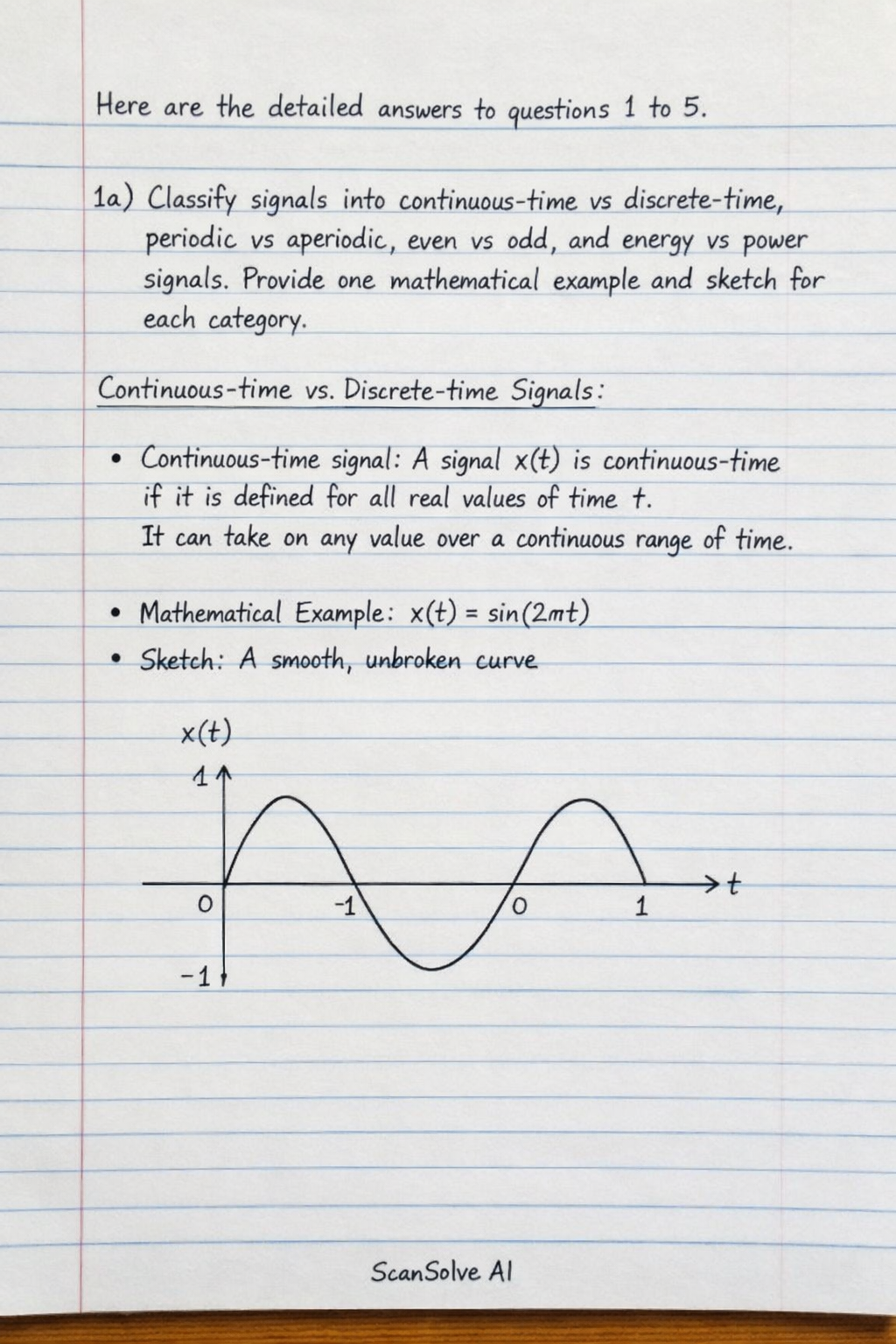
- Continuous-time signal: A signal is continuous-time if it is defined for all real values of time . It can take on any value over a continuous range of time.
- Mathematical Example:
- Sketch: A smooth, unbroken curve.
\begin{tikzpicture}
- Continuous-time signal: A signal is continuous-time if it is defined for all real values of time . It can take on any value over a continuous range of time.
Was this helpful?
Still stuck on this one?
Ask a follow-up, and the answer starts from this question.
Got a different question?Ask your own question
More Computer Science Questions
QCompare and contrast continuous-time and discrete-time signals, providing definitions, mathematical…QA continuous-time signal x(t) is shown in Figure (1) and a discrete-time signal x[n] is shown in…QDefine periodic function, even function, and Fourier series.QShow by means of neat labelled Waveforms of the odd harmonics and even harmonics.QDetermine the Fourier series representations for the given signals in Figure P3.22(a) and (b).
Handwritten Step-by-Step Solution
Get this as a handwritten image on WhatsApp — like a tutor wrote it for you.
Try on WhatsApp