Determine the Fourier series representations for the given signals in Figure P3.22(a) and (b).
|Mathematics
Determine the Fourier series representations for the given signals in Figure P3.22(a) and (b).
ScanSolve AI Answer
Answer
∑k=−∞,k=0∞kπj(−1)kejkπt
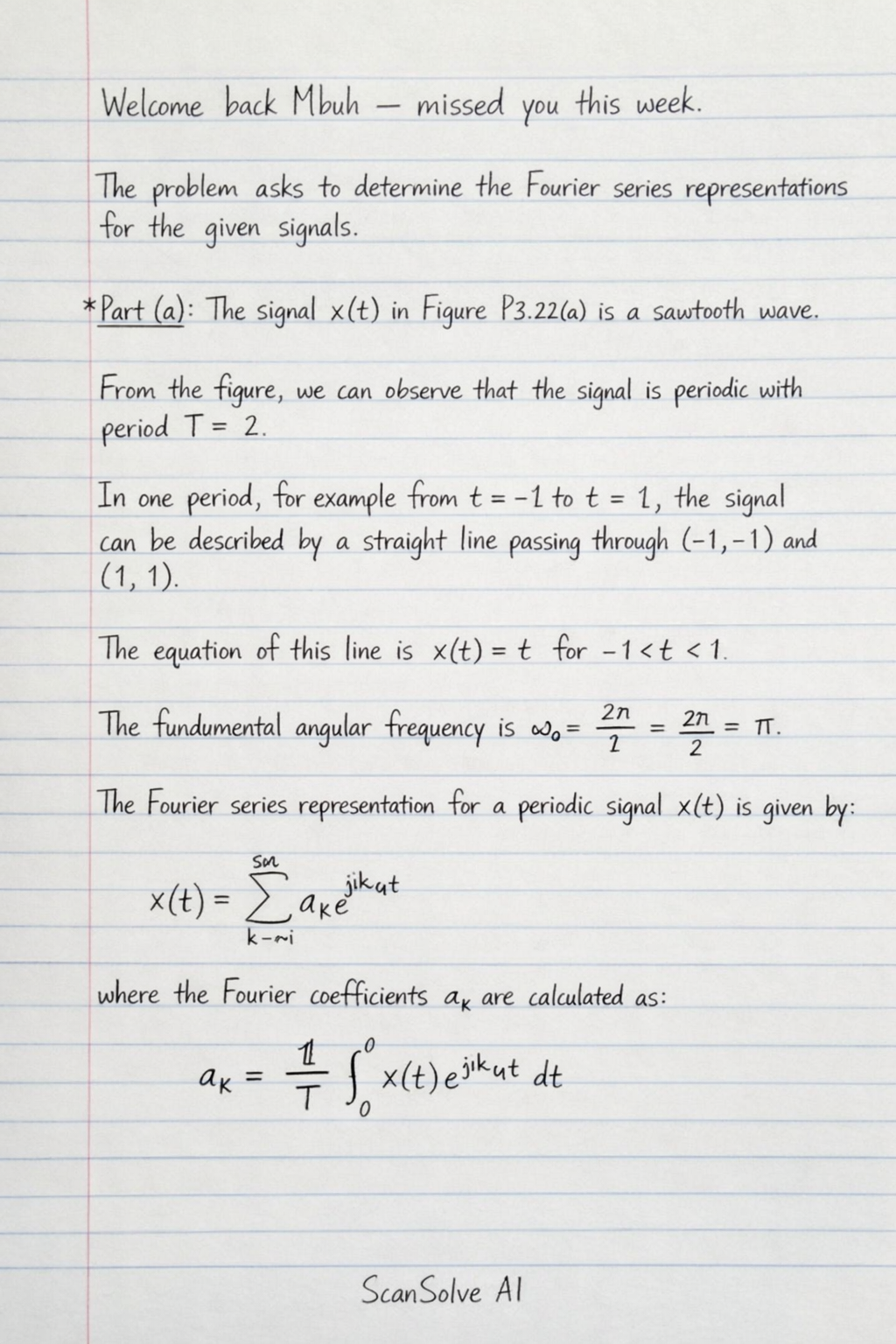
Welcome back Mbuh — missed you this week.
The problem asks to determine the Fourier series representations for the given signals.
Part (a): The signal x(t) in Figure P3.22(a) is a sawtooth wave.
From the figure, we can observe that the signal is periodic with period T=2.
In one period, for example from t=−1 to t=1, the signal can be described by a straight line passing through (−1,−1) and (1,1).
The equation of this line is x(t)=t for −1<t<1.
The fundamental angular frequency is ω0=T2π=22π=π.
The Fourier series representation for a periodic signal x(t) is given by:
x(t)=∑k=−∞∞akejkω0t
where the Fourier coefficients ak are calculated as:
ak=T1∫Tx(t)e−jkω0tdt
Step 1: Calculate the DC component a0.
For k=0, the coefficient a0 is the average value of the signal over one period.
a0=T1∫−T/2T/2x(t)dt=21∫−11tdta0=21[2t2]−11=21(212−2(−1)2)=21(21−21)=0
Step 2: Calculate the Fourier coefficients ak for k=0.
ak=21∫−11te−jkπtdt
We use integration by parts, ∫udv=uv−∫vdu.
Let u=t and dv=e−jkπtdt.
Then du=dt and v=∫e−jkπtdt=−jkπe−jkπt.
ak=21[t−jkπe−jkπt]−11−21∫−11−jkπe−jkπtdtak=21[−jkπe−jkπ−−jkπ(−1)ejkπ]−2(−jkπ)1∫−11e−jkπtdt
We know that ejkπ=(−1)k and e−jkπ=(−1)k.
ak=21[−jkπ(−1)k+−jkπ(−1)k]+2jkπ1[−jkπe−jkπt]−11ak=21[−jkπ2(−1)k]+2jkπ1[−jkπe−jkπ−ejkπ]ak=−jkπ(−1)k+2jkπ1[−jkπ(−1)k−(−1)k]ak=−jkπ(−1)k+2jkπ1[0]ak=−jkπ(−1)k=kπj(−1)k
Step 3: Write the Fourier series representation for x(t) in Figure P3.22(a).
x(t)=∑k=−∞,k=0∞kπj(−1)kejkπt
The signal is an odd function, so a0=0 and ak=−a−k.
We can also express this using sine terms:
x(t)=∑k=1∞kπ2(−1)k+1sin(kπt)
Part (b): The signal x(t) in Figure P3.22(b) is a periodic trapezoidal wave.
From the figure, we can observe that the signal is periodic with period T=6.
The fundamental angular frequency is ω0=T2π=62π=3π.
We can define one period of the signal from t=−3 to t=3.
The signal is an even function, so ak will be real and ak=a−k.
The coefficients bk in the trigonometric Fourier series will be zero.
The function x(t) over one period (e.g., from t=−3 to t=3) can be described as:
x(t)=⎩⎨⎧0t+21−t+20−3≤t<−2−2≤t<−1−1≤t<11≤t<22≤t≤3
Step 4: Calculate the DC component a0.
a0=T1∫−T/2T/2x(t)dt=61∫−33x(t)dta0=61(∫−2−1(t+2)dt+∫−111dt+∫12(−t+2)dt)a0=61([2t2+2t]−2−1+[t]−11+[−2t2+2t]12)a0=61(((21−2)−(24−4))+(1−(−1))+((−24+4)−(−21+2)))a0=61((−23−(−2))+2+((2)−(23)))a0=61((−23+24)+2+(24−23))a0=61(21+2+21)=61(1+2)=63=21
Step 5: Calculate the Fourier coefficients ak for k=0.
Since x(t) is an even function, ak=T2∫0T/2x(t)cos(kω0t)dt.
ak=62∫03x(t)e−jk3πtdt=31(∫011⋅e−jk3πtdt+∫12(−t+2)e−jk3πtdt)
Alternatively, using the cosine form for even functions:
ak=T2∫0T/2x(t)cos(kω0t)dt=62(∫011⋅cos(k3πt)dt+∫12(−t+2)cos(k3πt)dt)ak=31([k3πsin(k3πt)]01+∫12(−t+2)cos(k3πt)dt)ak=31(k3πsin(k3π)+∫12(−t+2)cos(k3πt)dt)
For the integral ∫(−t+2)cos(k3πt)dt, use integration by parts:
Let u=−t+2, dv=cos(k3πt)dt.
Then du=−dt, v=k3πsin(k3πt).
∫12(−t+2)cos(k3πt)dt=[(−t+2)k3πsin(k3πt)]12−∫12k3πsin(k3πt)(−dt)=[(−t+2)k3πsin(k3πt)]12+k3π1∫12sin(k3πt)dt=((0)−(1)k3πsin(k3π))+k3π1[−k3πcos(k3πt)]12=−k3πsin(k3π)−(k3π)21(cos(k32π)−cos(k3π))
Substitute this back into the expression for ak:
ak=31(k3πsin(k3π)−k3πsin(k3π)−(k3π)21(cos(k32π)−cos(k3π)))ak=−31(k3π)21(cos(k32π)−cos(k3π))ak=−(kπ)23(cos(k32π)−cos(k3π))
Step 6: Write the Fourier series representation for x(t) in Figure P3.22(b).
x(t)=a0+∑k=1∞akcos(kω0t)x(t)=21+∑k=1∞−(kπ)23(cos(k32π)−cos(k3π))cos(k3πt)
Final Answer:
a) The Fourier series representation for x(t) in Figure P3.22(a) is:
x(t)=∑k=−∞,k=0∞kπj(−1)kejkπt
or equivalently:
x(t)=∑k=1∞kπ2(−1)k+1sin(kπt)
b) The Fourier series representation for x(t) in Figure P3.22(b) is:
x(t) = \frac{1{2} + \sum_{k=1}^{\infty} -\frac{3}{(k\pi)^2} \left(\cos\left(k\frac{2\pi}{3}\right) - \cos\left(k\frac{\pi}{3}\right)\right) \cos\left(k\frac{\pi}{3} t\right)}
Drop the next question.
Was this helpful?
Need help with your own homework?
Get instant step-by-step solutions to any question. Free to start.
This mathematics problem involves applying core mathematical principles and formulas. Below you will find a complete step-by-step solution with detailed explanations for each step, helping you understand not just the answer but the method behind it.
ScanSolve AI Answer
Welcome back Mbuh — missed you this week. The problem asks to determine the Fourier series representations for the given signals. Part (a): The signal x(t) in Figure P3.22(a) is a sawtooth wave. From the figure, we can observe that the signal is periodic with period T = 2. In one period, for example from t = -1 to t = 1, the signal can be described by a straight line passing through (-1, -1) and (1, 1). The equation of this line is x(t) = t for -1 < t < 1. The fundamental angular frequency is _0 = (2)/(T) = (2)/(2) = . The Fourier series representation for a periodic signal x(t) is given by: x(t) = _k=-^ a_k e^jk_0 t where the Fourier coefficients a_k are calculated as: a_k = (1)/(T) _T x(t) e^-jk_0 t dt Step 1: Calculate the DC component a_0. For k=0, the coefficient a_0 is the average value of the signal over one period. a_0 = (1)/(T) _-T/2^T/2 x(t) dt = (1)/(2) _-1^1 t \, dt a_0 = (1)/(2) [ (t^2)/(2) ]_-1^1 = (1)/(2) ( (1^2)/(2) - ((-1)^2)/(2) ) = (1)/(2) ( (1)/(2) - (1)/(2) ) = 0 Step 2: Calculate the Fourier coefficients a_k for k ≠ 0. a_k = (1)/(2) _-1^1 t e^-jk t dt We use integration by parts, u \, dv = uv - v \, du. Let u = t and dv = e^-jk t dt. Then du = dt and v = e^-jk t dt = e^-jk t-jk. a_k = (1)/(2) [ t e^-jk t-jk ]_-1^1 - (1)/(2) _-1^1 e^-jk t-jk dt a_k = (1)/(2) [ e^-jk-jk - (-1)e^jk-jk ] - (1)/(2(-jk)) _-1^1 e^-jk t dt We know that e^jk = (-1)^k and e^-jk = (-1)^k. a_k = (1)/(2) [ ((-1)^k)/(-jk) + ((-1)^k)/(-jk) ] + (1)/(2jk) [ e^-jk t-jk ]_-1^1 a_k = (1)/(2) [ (2(-1)^k)/(-jk) ] + (1)/(2jk) [ e^-jk - e^jk-jk ] a_k = ((-1)^k)/(-jk) + (1)/(2jk) [ ((-1)^k - (-1)^k)/(-jk) ] a_k = ((-1)^k)/(-jk) + (1)/(2jk) [ 0 ] a_k = ((-1)^k)/(-jk) = (j(-1)^k)/(k) Step 3: Write the Fourier series representation for x(t) in Figure P3.22(a). x(t) = _k=-, k ≠ 0^ (j(-1)^k)/(k) e^jk t The signal is an odd function, so a_0 = 0 and a_k = -a_-k. We can also express this using sine terms: x(t) = _k=1^ 2(-1)^k+1k (k t) Part (b): The signal x(t) in Figure P3.22(b) is a periodic trapezoidal wave. From the figure, we can observe that the signal is periodic with period T = 6. The fundamental angular frequency is _0 = (2)/(T) = (2)/(6) = ()/(3). We can define one period of the signal from t = -3 to t = 3. The signal is an even function, so a_k will be real and a_k = a_-k. The coefficients b_k in the trigonometric Fourier series will be zero. The function x(t) over one period (e.g., from t=-3 to t=3) can be described as: x(t) = 0 & -3 t < -2 \\ t+2 & -2 t < -1 \\ 1 & -1 t < 1 \\ -t+2 & 1 t < 2 \\ 0 & 2 t 3 Step 4: Calculate the DC component a_0. a_0 = (1)/(T) _-T/2^T/2 x(t) dt = (1)/(6) _-3^3 x(t) dt a_0 = (1)/(6) ( _-2^-1 (t+2) dt + _-1^1 1 \, dt + _1^2 (-t+2) dt ) a_0 = (1)/(6) ( [ (t^2)/(2) + 2t ]_-2^-1 + [ t ]_-1^1 + [ -(t^2)/(2) + 2t ]_1^2 ) a_0 = (1)/(6) ( ( ((1)/(2) - 2) - ((4)/(2) - 4) ) + (1 - (-1)) + ( (-(4)/(2) + 4) - (-(1)/(2) + 2) ) ) a_0 = (1)/(6) ( ( -(3)/(2) - (-2) ) + 2 + ( (2) - ((3)/(2)) ) ) a_0 = (1)/(6) ( ( -(3)/(2) + (4)/(2) ) + 2 + ( (4)/(2) - (3)/(2) ) ) a_0 = (1)/(6) ( (1)/(2) + 2 + (1)/(2) ) = (1)/(6) (1 + 2) = (3)/(6) = (1)/(2) Step 5: Calculate the Fourier coefficients a_k for k ≠ 0. Since x(t) is an even function, a_k = (2)/(T) _0^T/2 x(t) (k_0 t) dt. a_k = (2)/(6) _0^3 x(t) e^-jk()/(3) t dt = (1)/(3) ( _0^1 1 · e^-jk()/(3) t dt + _1^2 (-t+2) e^-jk()/(3) t dt ) Alternatively, using the cosine form for even functions: a_k = (2)/(T) _0^T/2 x(t) (k_0 t) dt = (2)/(6) ( _0^1 1 · (k()/(3) t) dt + _1^2 (-t+2) (k()/(3) t) dt ) a_k = (1)/(3) ( [ ((k)/(3) t)k()/(3) ]_0^1 + _1^2 (-t+2) (k()/(3) t) dt ) a_k = (1)/(3) ( ((k)/(3))k()/(3) + _1^2 (-t+2) (k()/(3) t) dt ) For the integral (-t+2) (k()/(3) t) dt, use integration by parts: Let u = -t+2, dv = (k()/(3) t) dt. Then du = -dt, v = ((k)/(3) t)k()/(3). _1^2 (-t+2) (k()/(3) t) dt = [ (-t+2) ((k)/(3) t)k()/(3) ]_1^2 - _1^2 ((k)/(3) t)k()/(3) (-dt) = [ (-t+2) ((k)/(3) t)k()/(3) ]_1^2 + (1)/(k)3 _1^2 (k()/(3) t) dt = ( (0) - (1) ((k)/(3))k()/(3) ) + (1)/(k)3 [ -((k)/(3) t)k()/(3) ]_1^2 = -((k)/(3))k()/(3) - (1)/((k)3)^2 ((k(2)/(3)) - (k()/(3))) Substitute this back into the expression for a_k: a_k = (1)/(3) ( ((k)/(3))k()/(3) - ((k)/(3))k()/(3) - (1)/((k)3)^2 ((k(2)/(3)) - (k()/(3))) ) a_k = -(1)/(3) (1)/((k)3)^2 ((k(2)/(3)) - (k()/(3))) a_k = -(3)/((k)^2) ((k(2)/(3)) - (k()/(3))) Step 6: Write the Fourier series representation for x(t) in Figure P3.22(b). x(t) = a_0 + _k=1^ a_k (k_0 t) x(t) = (1)/(2) + _k=1^ -(3)/((k)^2) ((k(2)/(3)) - (k()/(3))) (k()/(3) t) Final Answer: a) The Fourier series representation for x(t) in Figure P3.22(a) is: x(t) = _k=-, k ≠ 0^ (j(-1)^k)/(k) e^jk t or equivalently: x(t) = _k=1^ 2(-1)^k+1k (k t) b) The Fourier series representation for x(t) in Figure P3.22(b) is: x(t) = (1)/(2) + _k=1^ -(3)/((k)^2) ((k(2)/(3)) - (k()/(3))) (k()/(3) t) Drop the next question.