
We read your photo as:
Calculate the common operating point parameters for the transistor circuit shown in Fig. 4.118.
ScanSolve AI Answer
Step-by-step solution
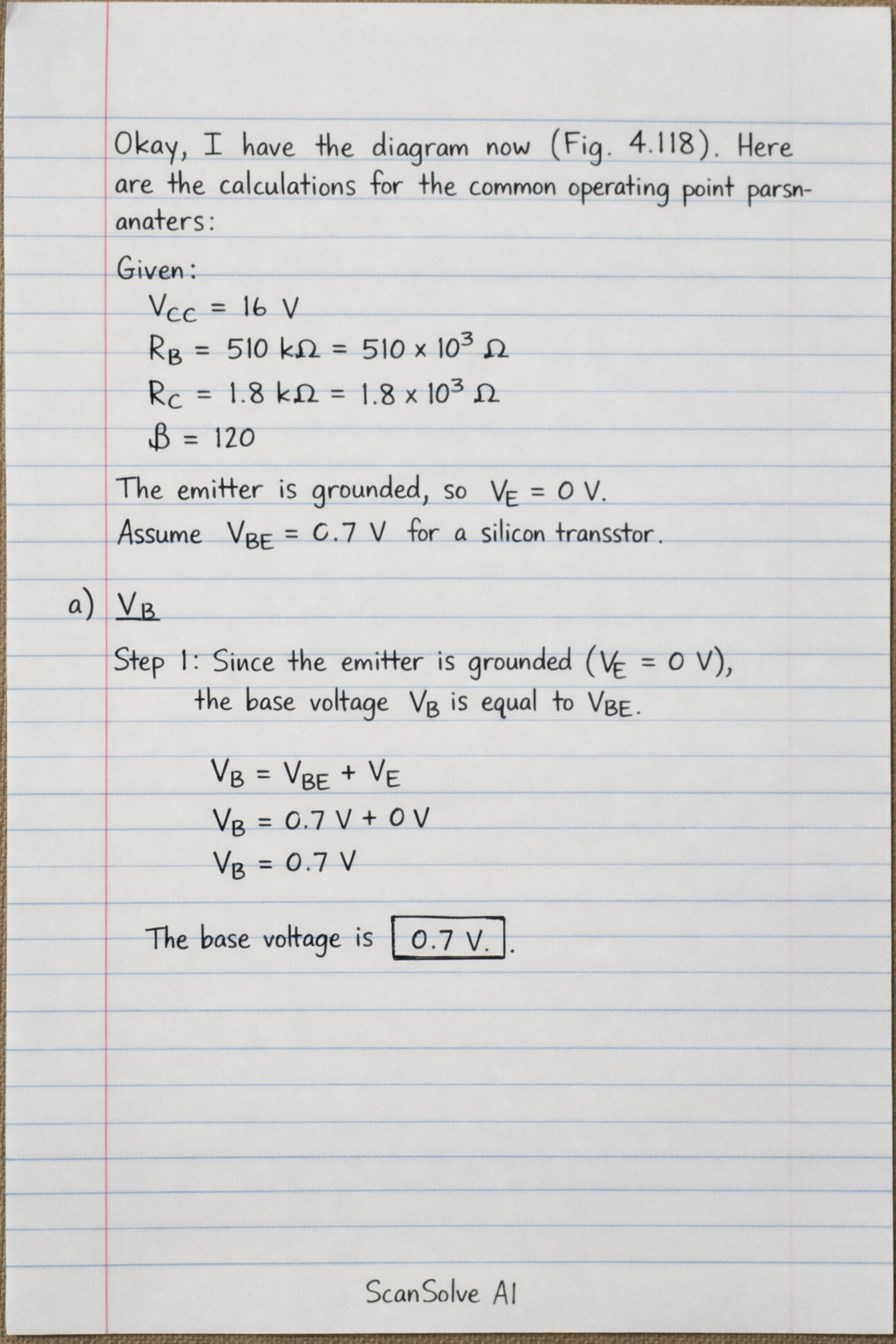
14 stepsOkay, I have the diagram now (Fig. 4.118). Here are the calculations for the common operating point parameters:
Given:
The emitter is grounded, so .
Assume for a silicon transistor.
Part a· 1 step
Since the emitter is grounded (), the base voltage is equal to .
The base voltage is .
Part b· 4 steps
Apply Kirchhoff's Voltage Law (KVL) to the base-emitter loop.
Rearrange to solve for .
Substitute the given values.
Calculate .
The base current is .
Part c· 3 steps
Use the relationship between collector current and base current.
Substitute the calculated and given .
Calculate .
The collector current is .
Part d· 4 steps
Apply KVL to the collector-emitter loop.
Rearrange to solve for .
Substitute the values.
Calculate .
The collector voltage is .
Part e· 2 steps
Use the definition of .
Substitute the calculated and .
The collector-emitter voltage is .
Still stuck on this one?
Ask a follow-up, and the answer starts from this question.
More Computer Science Questions
Handwritten Step-by-Step Solution
Get this as a handwritten image on WhatsApp — like a tutor wrote it for you.
Try on WhatsApp