

This computer science problem involves algorithmic thinking and programming concepts. The solution below explains the approach, logic, and implementation step by step.
ScanSolve AI Answer
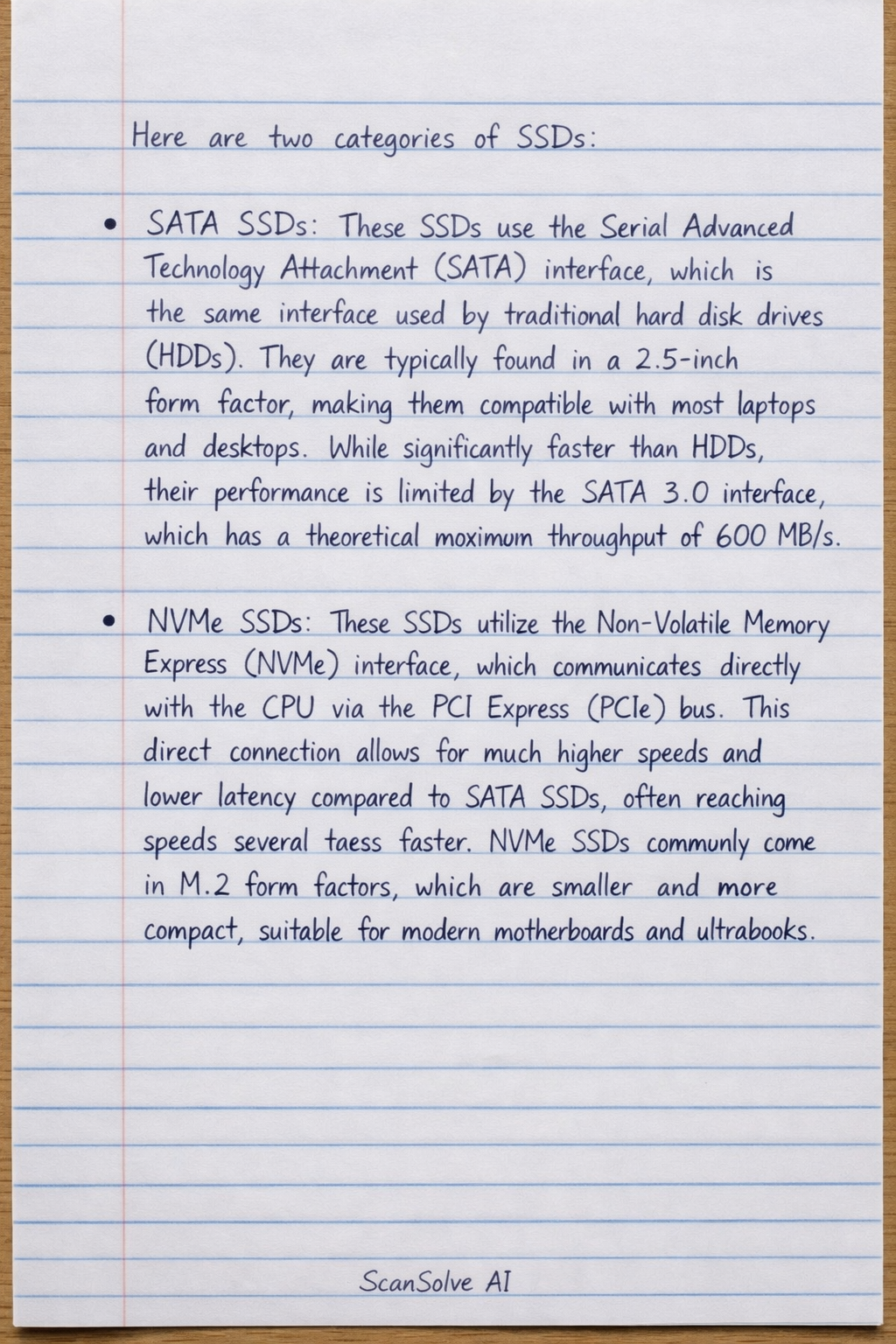
Here are two categories of SSDs: SATA SSDs: These SSDs use the Serial Advanced Technology Attachment (SATA)* interface, which is the same interface used by traditional hard disk drives (HDDs). They are typically found in a 2.5-inch form factor, making them compatible with most laptops and desktops. While significantly faster than HDDs, their performance is limited by the SATA 3.0 interface, which has a theoretical maximum throughput of 600 MB/s. NVMe SSDs: These SSDs utilize the Non-Volatile Memory Express (NVMe) interface, which communicates directly with the CPU via the PCI Express (PCIe)* bus. This direct connection allows for much higher speeds and lower latency compared to SATA SSDs, often reaching speeds several times faster. NVMe SSDs commonly come in M.2 form factors, which are smaller and more compact, suitable for modern motherboards and ultrabooks.